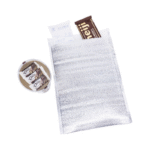
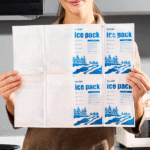
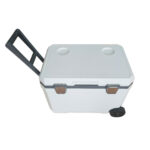
Ice packs do not have one reliable cold-life number for every cooler or shipment. Their useful hold time ends when the product space leaves its required temperature range, not when the pack first softens or stops feeling frozen. Coolant type and mass matter, but so do conditioning, payload, insulation, outside exposure, openings and placement.
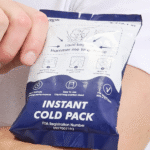
Scope of this guide: use this page to plan and verify one shipment’s hold time. For freezing time, return inspection, repeated use and retirement decisions, see the guide to reusable ice pack preparation and reuse. An instant cold pack is also a different product class; it is activated at the point of use and should not be treated as evidence for a preconditioned shipping packout.
First define what “stay cold” must mean
A useful duration needs a measurable endpoint. “The pack was still cool” is not enough for food, medicine, laboratory material or another temperature-sensitive payload. Start with the product’s actual transport limits and identify whether warming, freezing or both can cause failure.
| Question | Useful endpoint | What does not prove success |
|---|---|---|
| Did the shipment stay in range? | All relevant product-space sensors stayed within the accepted limits for the required period. | The ice pack was still partly frozen at delivery. |
| Did the packout avoid freezing? | Cold-spot sensors and the payload stayed above the lower acceptance limit. | The average temperature looked acceptable. |
| Can a supplier’s hour claim be compared? | The tested container, payload, coolant mass, conditioning, ambient profile, probe locations and endpoint match the intended use. | A label that only says “24 hours cold.” |
This is why the answer may be different for the same ice pack placed in a soft delivery bag, an EPS shipper or a high-performance insulated box. The pouch is only one component of the thermal system.
The seven inputs that control ice pack hold time
Record these inputs before comparing pack sizes or quantities. A missing input turns a duration estimate into a guess.
- Product temperature range. Define the accepted upper and lower limits. A setup that is cold enough for food may still create freeze risk for a sensitive medicine.
- Coolant formulation and mass. Water-based packs, gel packs, ice bricks and phase-change materials store and release heat differently. Compare actual product specifications rather than names alone.
- Starting condition. Record the coolant conditioning procedure and the payload’s starting temperature. A frozen exterior does not prove that a large pack is conditioned uniformly.
- Insulated container. Wall construction, thickness, lid fit, joints and usable internal space determine how quickly heat enters the packout.
- Payload. Product mass, arrangement, empty space and initial temperature change the heat load. An empty-box test cannot represent a loaded shipment.
- Route exposure. Include seasonal ambient conditions, direct sun, staging areas, vehicle conditions, transfers and delays, not only nominal carrier time.
- Layout and openings. Coolant position, separators, void fill and repeated opening can create different warm and cold locations inside the same box.
Match the cold source to the shipping task
| Cold source | Planning strength | Main check |
|---|---|---|
| Flexible frozen gel or water pack | Fits around irregular payloads and is practical for many chilled packouts. | Confirm conditioning, leak integrity, direct-contact risk and the complete thermal test. |
| Conditioned gel pack or PCM pack | Can support a selected temperature band when formulation and conditioning match the product requirement. | Verify the actual phase-change specification and preparation procedure; “PCM” alone does not establish performance. |
| Rigid ice brick | Provides repeatable shape and placement where a structured layout is helpful. | Check usable payload space, mass, separator needs and the tested orientation. |
| Instant cold pack | Provides cooling after activation without freezer conditioning. | Follow the specific manufacturer’s instructions and duration evidence. Do not substitute it for a tested shipping configuration. |
For chilled-shipment sourcing, compare the available gel ice pack formats only after defining the route and payload. The pack that stays frozen longest is not automatically the best option if it occupies too much payload space or creates an unacceptable cold spot.
Build the required protection window
Do not set the target from the carrier’s advertised transit time alone. Build a credible end-to-end exposure window:
Required protection window = packing and dispatch time + carrier transit + transfer and dwell time + receiving delay + justified contingency.
Use route records when available. A parcel may spend time on a warm loading dock before collection, wait at a transfer point, arrive after the receiving team has left or remain unopened during an exception. These events can consume reserve before the nominal transit period ends.
The Ice Pack Calculator can provide an early estimate for chilled pack quantity and layout. Its result is a planning starting point, not a qualification result.
Test the complete packout
For a decision that affects product quality or safety, test the assembled shipping system rather than the ice pack by itself.
Helpful decision tools
Check the details before you choose packaging
These quick tools can help you compare route risk, sizing needs, coolant choices, and packaging details before you request a quote.
Route Risk Checker
Review lane conditions before selecting packaging for real operating requirements.
Check route riskCompliance Checklist Generator
Build a practical checklist for packaging review, shipping, and documentation.
Build checklistDry Ice Calculator
Estimate dry ice needs for frozen or ultra-cold shipments before packing.
Estimate dry ice- Write the acceptance criteria. State the product range, required period and how excursions will be assessed.
- Fix the configuration. Record the container, coolant product and mass, conditioning, payload, separators, void fill, packing order and closure method.
- Represent payload limits. Evaluate the minimum and maximum loads that could change thermal behavior.
- Define the ambient profile. Use route and seasonal evidence where possible. Include hot, cold and delay risks that matter to the intended lane.
- Place sensors by risk. Measure expected warm and cold locations in the product space, not only beside a coolant pack.
- Run the entire exposure. Preserve the full temperature trace and note any openings or deviations.
- Review and approve the result. Compare every relevant sensor with the acceptance criteria and document the configuration that passed.
The World Health Organization’s shipping-container qualification guidance describes a formal approach for time- and temperature-sensitive pharmaceutical products. Its scope is regulated healthcare distribution, but the central lesson applies more broadly: performance evidence belongs to a defined system, protocol and acceptance criterion.
Why an hour claim cannot stand alone
A cold-life number becomes meaningful only when its test conditions are attached. As a clear example, the WHO vaccine-equipment program defines cold life for its insulated-container category using specified loading, ambient conditions and a temperature endpoint. That definition is not a universal rating for commercial ice packs; it shows why the test boundary must travel with the number. See the WHO cold-box and vaccine-carrier criteria.
When a supplier provides a duration claim, ask for:
- the exact container and closure;
- coolant type, unit mass, quantity and conditioning;
- payload mass, starting temperature and arrangement;
- ambient test profile and total test duration;
- temperature range and failure endpoint;
- sensor locations and calibration status;
- the tested minimum and maximum loads;
- the report date, configuration revision and approval status.
Avoid the shortcuts that cause false confidence
- Touching the pack. A cool pouch does not establish the product temperature.
- Testing an empty cooler. Payload thermal mass and internal arrangement change the result.
- Adding more frozen packs without review. More coolant can extend cooling but may also create freeze risk or displace payload.
- Testing one room-temperature condition. It may miss hot staging, cold exposure, sun load, transfers or long dwell periods.
- Using one center sensor. The center can hide warmer wall locations or cold spots beside coolant.
- Changing the layout after a pass. A different box, pack size, payload, separator or placement creates a different configuration.
Improve hold time without losing control
First reduce avoidable heat load: condition the coolant consistently, pre-chill the payload when the product procedure permits it, close the container promptly, minimize warm staging and prevent unnecessary openings. Then review insulation, coolant mass and placement as a complete design.
Use dividers or buffer layers where direct contact with frozen packs could damage the product. Control empty space so components do not shift, but do not assume that filling every void automatically improves thermal performance. Any substantial change should be retested against the same acceptance criteria.
Frequently asked questions
How long do ice packs stay cold in a cooler?
There is no dependable universal number. The answer depends on the cooler, coolant mass and starting condition, payload, ambient exposure, openings and the temperature endpoint. Use a monitored test of the intended configuration when the result matters.
How long do instant cold packs last?
Duration is product-specific and begins after activation. Check the manufacturer’s instructions and test evidence for that exact pack. Instant packs should not be assumed equivalent to frozen gel packs, ice bricks or PCM packs used in an insulated shipping system.
How long do ice packs take to freeze?
Freezing time varies with formulation, thickness, freezer temperature, pack spacing and freezer loading. Follow the supplier’s conditioning procedure and confirm the pack is ready throughout, rather than judging the surface alone. The reusable-pack guide covers this operating question in more detail.
Which ice packs stay cold the longest?
Compare candidates in the same container, payload, layout, ambient profile and acceptance range. A heavier or colder pack may last longer in one test but create freeze risk, excess weight or lost payload space in another.
Is a cold pack enough to prove food stayed safe?
No. For a US food example, USDA advises checking that delivered perishable food is frozen, partly frozen with ice crystals or refrigerator-cold below 40°F using a food thermometer. See the USDA mail-order food safety guidance. Follow the requirements that apply to the product and destination market.
Plan the next packout
Prepare the product temperature limits, payload dimensions and mass, container details, coolant specification, conditioning process, end-to-end exposure window and seasonal route profile. Use those inputs to compare cold sources and create a monitored trial. For a formal study structure, continue to the cold-chain transport validation guide.