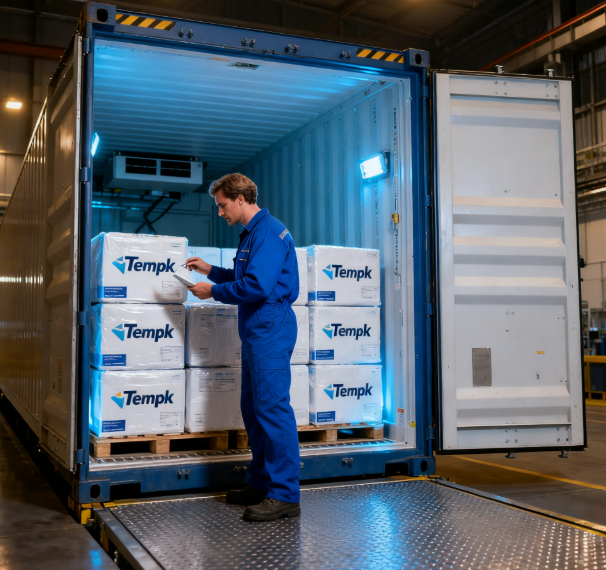
A passive cold-chain packout should be qualified against the product it protects, not against a generic refrigerant claim. Healthcare and veterinary shipments may both use insulated shippers and gel-based coolants, but their products, labelled storage conditions, market requirements, and quality processes can differ. The shared principle is simple: identify the product requirement first, design the complete packout around it, and document the evidence and limits of the result.
Begin With the Product Requirement
The relevant quality owner should define the storage condition, the permitted handling and shipping deviations, whether direct coolant contact is allowed, the duration and route profile to be evaluated, and the method used to decide whether a shipment is acceptable. The packaging team then translates that information into an insulated shipper, coolant arrangement, conditioning instruction, monitoring plan, and packout procedure.
FDA material for biological products advises handlers to consult the product label and record time and temperature conditions when assessing possible excursions. FDA VICH stability guidance also discusses the need to address short-term deviations outside labelled storage conditions during shipping or handling. These sources do not qualify any particular gel pack; they reinforce why the packout needs to be product-specific and documented.
Reference: FDA guidance on storage conditions and excursion records for biological products.
Reference: FDA VICH GL51 stability guidance.
Helpful decision tools
Check the details before you choose packaging
These quick tools can help you compare route risk, sizing needs, coolant choices, and packaging details before you request a quote.
Dry Ice Calculator
Estimate dry ice needs for frozen or ultra-cold shipments before packing.
Estimate dry iceBox Liner & Pallet Cover Sizing
Check box liner and pallet cover sizing logic for insulated packaging projects.
Estimate sizingInsulation Material Drop Resistance
Review drop resistance and handling factors before choosing insulation materials.
Check resistanceBuild the Whole Packout
| Element | Qualification question | Evidence to retain |
|---|---|---|
| Payload | What condition and physical protection does the product require? | Product requirement and defined acceptance criteria. |
| Coolant | Which format, amount, conditioning state, and placement are intended? | Approved component specification and packout drawing. |
| Insulation and carton | How do dimensions, material, and closure affect usable volume and heat gain? | Configuration record including internal layout. |
| Route profile | Which ambient, transfer, delay, and orientation conditions are represented? | Test profile and reason it represents the intended lane. |
| Monitoring | What sensors or indicators are used and where are they placed? | Sensor map, data review method, and decision rule. |
Keep Healthcare and Veterinary Contexts Separate
The same technical framework can be used for both applications, but product and regulatory conclusions should not be copied from one to the other. A hospital shipment may involve medicines, biologicals, samples, or other materials with specific product labelling and site procedures. A veterinary shipment may involve medicines, biologicals, laboratory materials, or other products governed by different product and market conditions. The responsible quality team should confirm the applicable requirements for the product and destination before the packaging claim is finalized.
Make the Test Reproducible
A chamber or route simulation is most useful when another team can repeat it. Record the sample lot, shipper, insulation, coolant type and quantity, conditioning method, payload mass and geometry, assembly sequence, starting conditions, sensors, ambient profile, orientation, delay condition, and result. If an assumption changes, decide whether the change is minor enough to document or large enough to require a repeat evaluation.
Avoid Misleading Claims
Do not describe a gel block, pouch, or logger as proof of compliance. A logger records conditions; it does not provide protection. An insulated carton can reduce heat gain, but it is not automatically qualified.
Define the Scope of Evidence
A successful test under one ambient profile is evidence for those conditions, not a promise for every season or destination. Clear wording protects both the reader and the quality process.
Release Checklist
- Product requirement and test acceptance criteria are documented before trial work begins.
- Component data and full-packout results are labelled separately.
- The test profile represents the intended route and an agreed contingency condition.
- The final work instruction shows coolant placement, barriers, closure, and receiving actions.
- Any product-specific regulatory or stability decision remains with the responsible quality owner.