Choosing an Insulated Box Producer for Pharmaceuticals by Evidence
The quotation may list an insulated box, coolant packs, and a temperature logger. Procurement still needs to know whether those items form a controlled system for the intended medicine. That is the central test when choosing an insulated box producer for pharmaceuticals. A credible decision connects five gates: a product-and-route requirement, a coherent thermal design, qualification evidence, an executable packout, and stable production over time. If any gate is missing, a low price or impressive material specification can create hidden work for quality and operations. The framework below helps a cross-functional team reach a defensible sourcing decision without assuming that packaging alone establishes compliance.
Gate One: Convert the Shipping Need Into Acceptance Criteria
Start with the medicine. The approved storage and transport information, supported by the product owner's stability knowledge, determines the required condition. Do not copy a familiar refrigerated range into a request simply because the shipment is pharmaceutical. Products may require refrigerated, controlled-room-temperature, frozen, or other specific conditions, and their tolerance to heat, cold, light, shock, or vibration can differ.
Next define the payload in physical terms. List the primary and secondary packs, orientation, quantity, dimensions, mass, starting condition, and allowable dunnage. Include the temperature monitor and any documents or security features that must travel inside. State both minimum and maximum loads if shipment quantity varies. The producer needs this information because thermal mass and geometry change internal conditions.
Define the route as elapsed risk time, not carrier transit time. Count preparation, post-pack staging, collection windows, line-haul, hubs, customs, last-mile appointment, failed-delivery risk, and transfer to controlled storage. Describe plausible summer and winter ambient exposure, especially at docks, ramps, vehicle stops, and intermediate facilities. Note whether the shipment moves as a parcel, on a pallet, in a refrigerated vehicle, or across several modes.
Finally, state what constitutes acceptance. Identify the relevant temperature condition, how it will be measured, where in the payload it applies, the test duration, and how uncertainty or brief deviations will be treated. The packaging team should not invent product disposition limits. Quality and the product owner need to approve them.
These inputs form a user requirement specification. It can be concise, but it should distinguish mandatory criteria from preferences. External box size might be limited by a carrier. Low packout complexity may be a strong operational preference. Reusability might be desirable only on lanes with dependable returns. When priorities conflict, the producer can make visible trade-offs rather than silently optimizing for cost or headline duration.
Gate Two: Build a Coherent Thermal and Handling Design
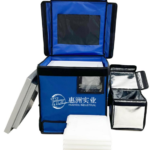
An insulated box resists heat flow; refrigerants supply thermal capacity. Separators manage contact. The payload contributes mass. The outer carton or shell protects the insulation. A closure keeps the intended geometry. Together, these parts create a passive temperature-controlled packout. A logger observes that system but does not control it.
Material selection should follow the constraint. EPS can provide a light, rigid structure for many one-way shippers. EPP can suit managed reuse where cleaning, inspection, and return logistics are viable. VIP construction may help when external cube is tight, but panel edges, puncture protection, and integrity control require attention. Flexible liners can simplify storage and assembly for suitable parcel applications. None of these labels proves performance.
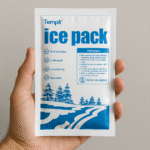
Refrigerants must be selected and conditioned for the target design. Frozen water or gel packs can produce cold boundary conditions, so freeze-sensitive product should not contact them unless a specifically supported design permits it. European GDP guidance calls for cool-packs in insulated boxes to be positioned to avoid direct medicine contact and emphasizes trained assembly, seasonal configurations, and pack reuse procedures. PCM can buffer heat around a designed phase transition, yet the finished payload temperature depends on the complete arrangement.
Use the following matrix to keep the design discussion tied to constraints.
| Shipment constraint | Design response worth evaluating | Assumption that must not slip through |
|---|---|---|
| Small, variable payload | Inserts, modular payload spaces, or qualified load variants | A result at maximum load covers a nearly empty box |
| Tight external dimensions | Thin-wall architecture or geometry optimization | Material data alone predicts finished performance |
| Freeze-sensitive medicine | Controlled refrigerant conditioning and physical separation | "More frozen packs" always creates more protection |
| Rough repeated handling | Reusable shell, replaceable parts, inspection and retirement rules | Reusable material remains suitable indefinitely |
| One-way dispersed delivery | Right-sized single-use system and clear disposal information | Nominal recyclability means local recovery occurs |
| Long or uncertain handovers | Evidence-supported duration plus delay and receiving controls | A laboratory duration applies to any customs or hub condition |
The table is a design conversation, not a product selector. More insulation may reduce heat ingress but increase external cube. More coolant can extend capacity but take payload space, add freight weight, complicate conditioning, and increase cold risk. The strongest concept balances thermal margin with the real packing and distribution operation.
Physical distribution performance also belongs in the design. A thermally capable shipper can still fail if its outer carton crushes, a lid opens, a coolant pack leaks, or a VIP is punctured. Determine which compression, vibration, impact, orientation, moisture, and handling challenges are relevant. Thermal and physical testing may be planned separately or in a justified sequence, but their conclusions should refer to the same production-representative construction.
Gate Three: Test the Configuration and Read the Boundaries
Qualification turns a proposed configuration into documented evidence under specified conditions. It does not certify every possible product or route.
The protocol should identify the complete bill of materials, assembly method, payload or justified simulant, minimum and maximum load cases, component starting conditions, ambient profile, test equipment, sensor map, logging interval, calibration requirements, number of runs, acceptance criteria, and deviation process. Photographs and diagrams should make the setup reproducible. If the producer refers to a passed test but cannot identify these details, the claim is not ready for a pharmaceutical quality review.
Recognized frameworks can provide structure. WHO's model guidance addresses storage and transport of time- and temperature-sensitive pharmaceutical products, and its technical supplement discusses qualification of shipping containers. ISTA Standard 20 describes a design and qualification process for insulated shipping containers. ISTA 7E provides heat and cold profiles derived for parcel-delivery thermal testing. USP <1079> discusses risk and mitigation across storage and transportation of finished drug products. EU GDP expects risk-based route planning and, where relevant, validated temperature-control systems.
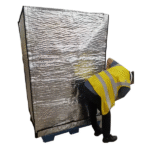
Use these sources according to their scope. An ISTA parcel profile is not automatically a model for a pallet under a thermal cover. WHO guidance does not approve a particular producer's box. EU GDP does not supply the buyer's product acceptance criterion. The standards and guidance help define a sound process; the protocol must still represent the intended use.
Sensor placement deserves particular scrutiny. Heat does not enter uniformly, and cold refrigerants can create local extremes. Mapping positions near walls, corners, refrigerants, and the payload core can identify gradients. The routine logger position may then be chosen from risk and mapping knowledge. A single device placed for easy retrieval should not be presented as proof that every point in the load behaved identically.
Read failures and anomalies. A result just inside a limit under one ideal assembly may not provide useful operating margin. Variability across replicated runs may reveal sensitivity to a small gap, coolant position, or payload condition. Missing data, unexpected spikes, and excluded sensors require documented investigation. Qualification is valuable partly because it exposes weak design assumptions before product is at risk.
After testing, write a design-space statement: what product condition, payload, components, packout, ambient challenges, and duration the evidence supports; which seasonal variants exist; and which conditions remain outside scope. A bounded claim is more useful than "qualified pharmaceutical box."
Gate Four: Make the System Work at 6 a.m. on the Packing Floor
The validated arrangement must survive routine work. That requires component control, simple instructions, conditioning capacity, training, monitoring, and a response when something goes wrong.
Helpful decision tools
Check the details before you choose packaging
These quick tools can help you compare route risk, sizing needs, coolant choices, and packaging details before you request a quote.
Insulation Material Drop Resistance
Review drop resistance and handling factors before choosing insulation materials.
Check resistanceDry Ice Calculator
Estimate dry ice needs for frozen or ultra-cold shipments before packing.
Estimate dry iceBox Liner & Pallet Cover Sizing
Check box liner and pallet cover sizing logic for insulated packaging projects.
Estimate sizingCreate a packout instruction around observable actions. Use exact component identities and counts. Show refrigerant orientation, product separation, logger location, fill of empty space, lid seating, closure, and labels. State the allowable time between removing conditioned components and closing the shipper. Distinguish seasonal configurations visually. Include rejection rules for leaking coolant, cracked insulation, damaged panels, wet cartons, or missing parts.
Check capacity before launch. Refrigerant freezers or conditioning equipment must accommodate daily demand without crowding that prevents components from reaching their intended state. Packing areas need enough space to segregate prepared and unprepared parts. Operators need tools to confirm component identity. Receiving sites need access to the logger or indicator and a clear instruction not to release questionable product automatically.
Practical launch scenario
Consider a pharmaceutical distributor introducing same-day and next-day service from one hub. Payload quantity varies, and the latest orders are packed shortly before carrier cutoff. Development has produced a summer and a winter configuration.
During a pilot, the team learns that operators cannot visually distinguish two conditioned PCM sets and that the minimum-load insert is often omitted. Rather than treating these as training failures, the producer and buyer revise labels and component colors, separate inventory locations, simplify the instruction, and repeat the relevant verification. The organization also changes order cutoffs so the conditioning and packing process has enough time. This hypothetical example illustrates a core point: human factors are design inputs, not an afterthought.
Temperature monitoring completes the operating loop. Select a device with a suitable measurement range, calibration support, sampling interval, data format, start method, and software access. Decide who starts it, where it sits, who stops or reads it, and how records are retained. Build an excursion procedure that directs the receiver to quarantine affected medicine, preserve evidence, and contact the authorized quality function. The packaging producer can help interpret package behavior, but product disposition belongs to the organization with product-specific authority and data.
Track execution after launch. Useful indicators may include packout deviations, damaged components, late collections, temperature alarms, missing reports, return turnaround, and recipient errors. The purpose is not to generate a perfect scorecard. It is to detect when the actual process moves outside the qualified assumptions.
Gate Five: Control the Pharmaceutical Insulated Box Producer Relationship
Sourcing does not end with approval of a sample. Later boxes must remain equivalent to the qualified construction within defined tolerances.
Agree on drawings, specifications, bill of materials, reference samples, and critical-to-quality attributes. Depending on design, controls may cover enclosure dimensions, lid engagement, insulation condition, VIP presence and protection, coolant identity and seal integrity, spacer geometry, and outer-carton fit. Review production-representative units, not only hand-built prototypes.
Change control should name triggers. A new resin or foam supplier, revised mold, different barrier film, alternative adhesive, modified coolant formulation, panel-layout change, or relocated production process may require assessment. Not every change demands a complete thermal program, but every potentially meaningful change needs documented evaluation and an approved decision. The producer should not substitute critical parts solely because they appear commercially equivalent.
Traceability should support investigation. The organization may need to link a shipment to the packaging configuration, instruction revision, critical component lots, logger identifier, and operator record. Incoming inspection should identify damage, incorrect parts, contamination, or dimensional problems before stock reaches the packing line. Nonconforming material needs segregation and disposition.
Compare cost across the operating system: box and refrigerants, conditioning energy and space, labor, storage, freight cube and mass, logger and data handling, qualification, damage, waste processing, return transport, cleaning, inspection, losses, and replacement. A reusable EPP or VIP-based system can be attractive on the right loop, while a simple EPS design may be more practical on a one-way route. Environmental comparison should use the same system boundary and avoid unsupported "green" claims.
For reusable assets, establish cleaning compatibility, drying, inspection, repair, traceability, and retirement. A fixed cycle-life promise is not credible unless conditions and evidence are defined. For single-use packaging, provide accurate material identification and consider right-sizing and separation at the receiving site. Local recovery infrastructure determines what is actually recycled.
Frequently Asked Questions
What should be sent to an insulated box producer before requesting a quote?
Send the product condition, packed-unit dimensions and mass, minimum and maximum payloads, route stages, seasonal and delay exposures, transport mode, monitoring needs, and required evidence. Also identify external-size or handling constraints. This lets the producer propose a testable system instead of guessing from a requested cavity volume.
Is a qualified packout the same as a compliant shipment?
No. Qualification supports a defined configuration under stated conditions. Compliance and shipment release also depend on the product, market, procedures, training, monitoring, documentation, carrier, and quality oversight. No packaging system should be described as universally compliant for all pharmaceutical uses. The buyer's quality system must still approve the intended use.
How much extra duration should a buyer request?
There is no universal margin. Base the duration on total elapsed route time, credible delays, ambient uncertainty, product risk, and the organization's quality-risk process. Excess refrigerant or insulation can add weight, complexity, and cold exposure. Define contingencies rather than selecting the longest claim by default.
Does a temperature logger replace thermal qualification?
No. A logger records a particular shipment at its measurement location. Qualification evaluates whether a defined packout can meet requirements under specified challenges and maps behavior before routine use. Monitoring can confirm and trend shipments, but it does not create protection or prove conditions at every point.
When should a packaging change trigger requalification?
The decision should follow documented risk assessment. Changes to insulation, geometry, coolant, payload, packout, manufacturing source, or route profile may affect performance. Some changes can be addressed by engineering justification or focused comparative testing; others need broader requalification. Notification and decision rules should be agreed before supply begins.
Conclusion: Pass All Five Gates
A defensible producer choice begins with precise shipment requirements and ends with lifecycle control. Verify that the thermal architecture fits the payload, that qualification data reveal their scope and limits, that warehouse staff can repeat the packout, and that production changes cannot occur invisibly. Then compare cost and environmental impact across the actual route. An insulated box producer for pharmaceuticals should contribute components, engineering clarity, and evidence; the pharmaceutical organization's quality system decides whether the complete solution is suitable for use.
About Tempk
Tempk is the brand of Shanghai Tempk Industrial Co., Ltd. We offer gel and water ice packs, phase change materials, insulated liners and bags, EPS, EPP, and VIP boxes, thermal pallet covers, medical coolers, and temperature data loggers as cold-chain packaging solutions. Tempk can also discuss validation and packout support. For pharmaceutical projects, our role is to help connect component choices to the buyer's payload, route, conditioning process, and documentation needs without presenting any box or material as universally qualified.
Send Tempk your user requirements and current route assumptions to start an evidence-based review before samples, testing, or production scale-up.