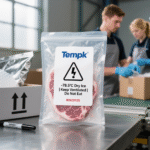
You can ship frozen food through the U.S. mail when the food is mailable and the package can contain leaks, odors, coolant and normal handling. Priority Mail Express can shorten the journey, but USPS does not refrigerate parcels. Start with frozen product, use a tested insulated packout, confirm the route-specific delivery commitment, follow the current coolant rules and arrange prompt receipt.
For many frozen shipments, dry ice provides a colder source than ordinary gel packs. It also introduces strict packaging, marking and documentation duties. A service name or insulated box alone does not prove that food will remain frozen. The complete system must cover the period from packing until the recipient transfers the food to suitable storage.
Can you send frozen food in the mail through USPS?
USPS says frozen articles may be mailed at the sender’s risk when they are properly packaged. Its cold and refrigerated mailing guidance recommends Priority Mail or Priority Mail Express for items that need refrigeration, while also making clear that USPS does not provide refrigeration.
First confirm that the food and destination are permitted. Meat, produce and other foods may be subject to federal, state, territorial or destination-specific restrictions. The food must not leak or create an offensive odor. Perishable handling and hazardous-material fees may also apply, so check current eligibility, charges and acceptance requirements before packing.
Choose cold packaging for shipping frozen food
A practical frozen-food package uses several layers. Each layer has a separate job:
| Layer | Purpose | What to verify |
|---|---|---|
| Food packaging | Contains the product and prevents leakage or odor | Seals remain intact at the planned temperature |
| Secondary containment | Contains drips, condensation or a damaged primary pack | Absorbent material and a leak-resistant liner are adequate |
| Insulated container | Slows heat entering the package | Material, thickness, lid and joints match the tested design |
| Coolant and separators | Provide cooling while protecting food from unsuitable contact | Type, amount, conditioning and placement match the packout |
| Rigid outer box | Protects the insulated system during postal handling | Strength, closure, labels and dimensions meet current rules |
Insulation only slows heat transfer; it does not create cooling. Avoid loose space that allows the contents or coolant to move. At the same time, never make a dry-ice package airtight. Carbon dioxide gas must be able to escape.
Choose gel packs or dry ice from the required condition
| Coolant | Typical use | Main caution |
|---|---|---|
| Gel packs or phase-change packs | Often used for chilled food or a defined refrigerated range | Common water-based packs do not automatically keep food frozen; direct contact can also overcool sensitive items |
| Dry ice | Often used when the product must remain frozen | Requires venting, protective handling, current USPS markings and, for air transport, quantity and documentation controls |
Do not use a universal coolant-to-food ratio. The required amount depends on product mass and starting temperature, box size, insulation, route exposure, delay allowance and the acceptance criterion. Verify the full configuration with a representative shipment or thermal test. For an initial estimate, use the same-site Dry Ice Calculator, then confirm the result against actual packout evidence and postal limits.
How to pack frozen food for Priority Mail Express
- Confirm mailability and the service commitment. Check the food, destination and refrigerant rules. USPS currently offers Priority Mail Express delivery in 1, 2 or 3 delivery days depending on acceptance, origin and destination ZIP Codes. Verify the actual commitment for the mailing date rather than assuming overnight delivery.
- Freeze the food before packing. The shipping system should maintain the intended condition, not remove a large amount of heat from warm food. Use the product’s approved preparation and temperature criteria.
- Seal and contain the food. Use sound food packaging, secondary containment and enough absorbent material for credible leakage or condensation. Keep food from direct contact with dry ice unless the product and package are designed for it.
- Prepare the insulated container. Use the exact liner, cooler or shipper from the qualified configuration. Check for cracks, damaged lids and gaps. Add separators and cushioning so the load stays in position as coolant is depleted.
- Load the coolant as documented. Wear insulated gloves when handling dry ice. Record the type, starting condition, amount and placement. Do not improvise a different arrangement after a successful test.
- Close the system correctly. Secure the outer box against normal handling. Contain liquids and odors, but maintain the required carbon-dioxide vent path when dry ice is present.
- Apply all required labels and documents. Put dry-ice markings on the address side and complete any required declaration. Confirm the acceptance procedure with USPS before tendering the parcel.
- Coordinate receipt. Send early enough to avoid unnecessary dwell, notify the recipient and make sure someone can inspect the food and transfer it to appropriate storage promptly.
Current USPS dry-ice rules for Priority Mail Express
USPS Publication 52 section 349.32 and Packaging Instruction 9A govern dry ice in domestic mail. For a Priority Mail Express parcel routed by air, the key requirements include:
- no more than 5 pounds of dry ice per mailpiece;
- a container that releases carbon dioxide gas;
- enough insulation to prevent condensation from wetting a fiberboard outer box;
- the name of the contents being cooled and the net weight of the dry ice on the address side;
- a Class 9 DOT miscellaneous hazardous-material label;
- the marking “Carbon Dioxide Solid, UN1845” or “Dry Ice, UN1845”;
- a properly completed shipper’s declaration for dangerous goods, prepared in triplicate and attached to the outside.
Dry ice is prohibited in USPS international mail. Domestic surface mail has different quantity, marking and documentation rules, and a surface-only dry-ice parcel must never be routed by air. Because Priority Mail Express may travel by air, do not prepare it under surface-only rules. Recheck the current USPS instructions when you dispatch.
Plan for the full packing-to-receipt exposure
The current Domestic Mail Manual for Priority Mail Express says availability depends on the acceptance date and origin and destination ZIP Codes. A parcel presented after the local acceptance time is treated as mailed on the next day that office is open. This makes the acceptance cutoff part of the thermal plan.
Helpful decision tools
Check the details before you choose packaging
These quick tools can help you compare route risk, sizing needs, coolant choices, and packaging details before you request a quote.
Packaging Selector
Compare insulated packaging options by product, route, and temperature need.
Find packagingInsulation Material Reference
Compare insulation material choices for different cold chain packaging needs.
Compare materialsInsulation Material Drop Resistance
Review drop resistance and handling factors before choosing insulation materials.
Check resistanceBuild the package for the full period from final packing through postal acceptance, transport, delivery attempt, pickup if needed and transfer to a freezer. Add a justified delay allowance. Use the companion Priority Mail Express dispatch and receipt plan to document those events without duplicating the packout procedure on this page.
A postal delivery guarantee is not a temperature guarantee. USPS guidance also says a spoilage claim is not paid merely because a perishable item arrived spoiled. If the shipment has commercial, safety or regulatory consequences, define acceptance, monitoring and exception-handling responsibilities before dispatch.
Check frozen food when it arrives
The recipient should open a perishable shipment promptly and follow the product-specific acceptance procedure. For consumer foods, the USDA mail-order food guidance says perishable food should arrive frozen or partly frozen with ice crystals, or at least refrigerator-cold below 40°F (4.4°C). It advises not eating or tasting perishable food that arrives above 40°F.
That USDA threshold is a food-safety check, not proof that a shipment met a stricter “remain frozen” specification. If the sender requires the product to stay frozen, define that condition and the measurement method in advance. Appearance, delivery time and the presence of remaining dry ice do not by themselves establish product temperature history.
Common frozen-food mailing mistakes
- Assuming Priority Mail Express refrigerates the parcel.
- Promising overnight delivery without checking the actual ZIP-to-ZIP commitment and acceptance cutoff.
- Using a thin retail foam cooler or weak outer box without evidence that it survives handling.
- Choosing an arbitrary quantity of gel packs or dry ice.
- Sealing dry ice in an airtight container.
- Copying the 5.5-pound airline passenger-baggage figure into a USPS air-mail plan; USPS uses a 5-pound limit per mailpiece.
- Omitting the contents name, net dry-ice weight, Class 9 label or shipper’s declaration.
- Ignoring weekends, failed delivery attempts and delayed transfer to a freezer.
Frequently asked questions
What is the best way to send frozen food in the mail?
There is no universal best packout. Start with frozen food, use suitable primary and secondary containment, select an insulated system and coolant for the route, comply with the carrier rules, and confirm the complete configuration under representative exposure.
Will gel packs keep food frozen during shipping?
Do not assume they will. Many gel packs are intended for chilled conditions. Their phase-change temperature, amount, conditioning, placement and the complete package determine whether they can support a frozen requirement.
How much dry ice can I put in a Priority Mail Express package?
For domestic air transportation, USPS currently permits up to 5 pounds per mailpiece. Priority Mail Express is listed by USPS as an air-transport service for this rule. Other packaging, marking and documentation requirements still apply.
Can I mail frozen food internationally with dry ice through USPS?
No. USPS Publication 52 prohibits dry ice in international mail. Check a suitable carrier and the origin, destination and transport regulations before choosing another arrangement.
Should I write “Keep Frozen” on the box?
A handling statement may help the recipient, but it does not replace required dry-ice markings, documentation or a verified thermal design. Apply the official markings first and make all additional instructions clear and non-conflicting.
Final checklist before mailing frozen food
- The food and destination are mailable.
- The product is at its required starting condition.
- The insulated packout matches the configuration you assessed.
- Leakage, condensation, odor and movement are controlled.
- The coolant choice and amount cover the full planned exposure and delay allowance.
- A dry-ice package is vented and stays within the applicable USPS quantity limit.
- All required labels, markings and declarations are complete.
- The route commitment and local acceptance cutoff are confirmed.
- The recipient is ready to inspect and store the food.
For a dry-ice-specific packing review, continue with the USPS dry-ice shipping checklist. Keep that compliance check separate from the thermal evidence for the food and route.