


Partial thaw during transfer
Dock delay, air transfer, or insufficient dry ice can warm edges before the core responds.
Fresh frozen plasma needs a frozen route that prevents thawing without letting dry ice damage bags, labels, or documents. The packout should control temperature, bag support, vapor space, and receiving evidence together.
Blood product shipments should be judged by temperature history and by receiving condition. The details below are packaging planning guidance; final handling must follow your facility procedure and local requirements.
Dock delay, air transfer, or insufficient dry ice can warm edges before the core responds.
Direct contact can make bags brittle, damage labels, or cause localized over-cooling and handling issues.
Frost, meltwater, or dry ice vapor management can make receiving paperwork and carton condition difficult to review.
| Route condition | Temperature intent | Packaging setup | Coolant or dry ice planning | Receiving check |
|---|---|---|---|---|
| Short frozen courier, 0-8 h | Maintain frozen condition and prevent surface thaw during handoff. | Frozen medical shipper, rigid bag tray, dry ice separated from bags, absorbent or leak-resistant liner, one logger near payload edge. | Small parcel trials often start with 1-3 kg dry ice when allowed by carrier and route rules. | Frozen arrival, no puncture, dry documents, remaining dry ice, and handoff time. |
| Standard frozen parcel or air lane, 8-24 h | Hold frozen condition through transfer, delay, and receiving queue. | High-insulation shipper, dry ice above or around a protected payload zone, vented shipper, documents isolated from frost. | Test 3-8 kg dry ice for common parcel lanes, then adjust for payload mass, shipper size, and ambient exposure. | Logger curve, remaining dry ice, bag brittleness, carton frost, and label readability. |
| Long lane or hot-season disruption, 24-48 h | Validated frozen route with enough dry ice reserve and clear handling rules. | Larger insulated shipper, dry ice reserve zone, spacer layers, dry ice marking, route-risk review, receiving procedure. | Some longer or hot lanes may require 8-15 kg or more dry ice; calculate and validate before use. | Frozen condition, minimum temperature, remaining dry ice, bag support, and receiving delay. |
Use these ranges as a starting point for sampling and quotation. Final coolant, PCM, dry ice, insulation, and monitoring choices should be validated with the real payload, shipper size, route duration, carrier process, season, and receiving procedure.
The packout should preserve a frozen component, not freeze product during transport.
Use trays, spacers, or liners so dry ice does not touch bags, labels, or paperwork directly.
Use a vented shipper and follow the carrier procedure for dry ice weight, labeling, and documents.
Receiving should review logger data with bag condition, remaining dry ice, documents, and delay notes.
These are the visible and operational issues the packout should reduce before the shipment reaches the receiver.
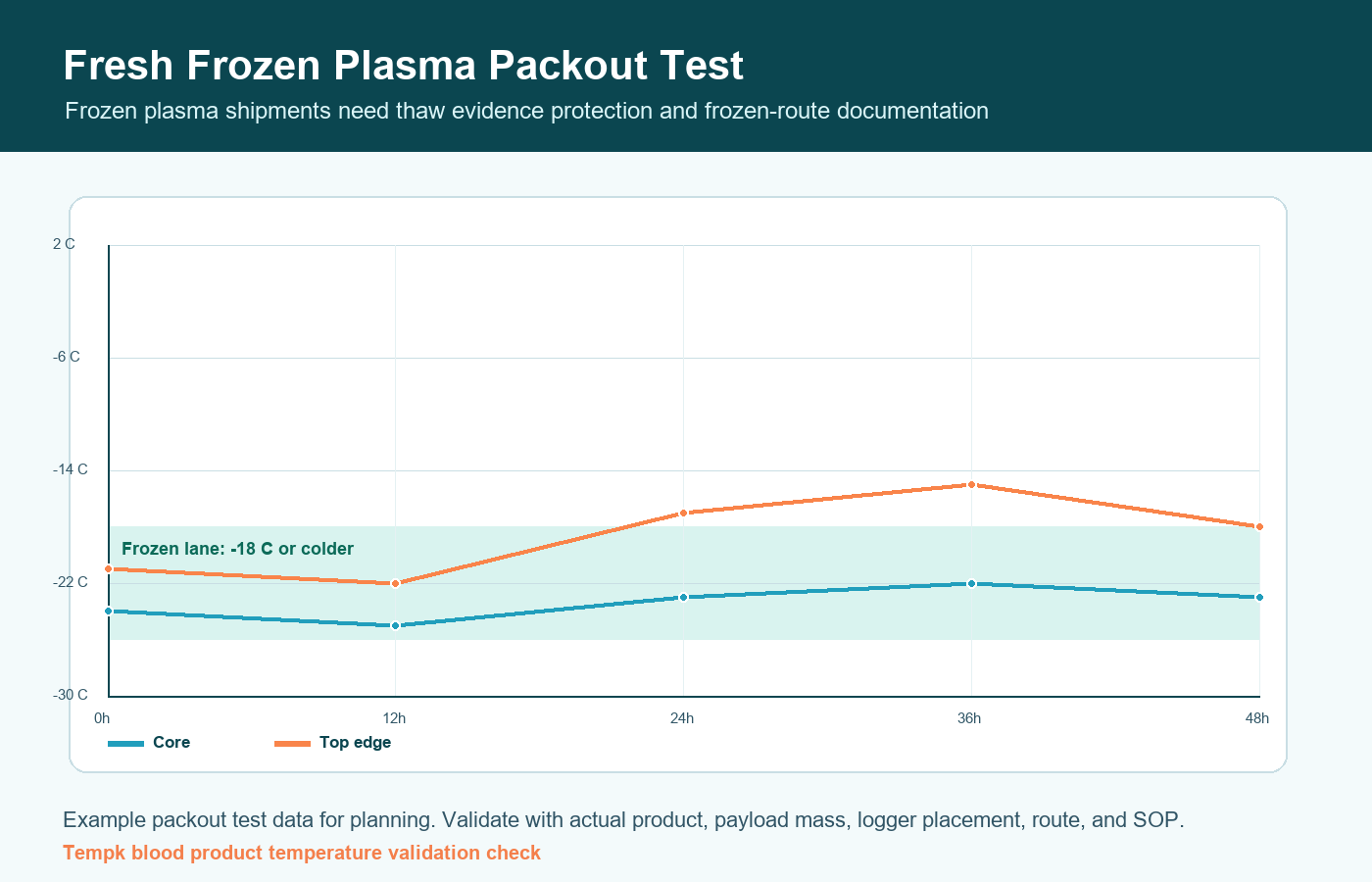
Use the test curve as a working comparison, then validate with the actual payload, shipper, coolant or dry ice mass, lane duration, ambient profile, and receiving process.
Use these pages to compare nearby blood product routes, coolant choices, insulation options, and route-risk questions before sampling.
Fresh frozen plasma needs a frozen route with enough coolant capacity for delays. The packout should avoid partial thaw at the top layer and protect bags from dry ice pressure points.
Common failures include edge thaw, bag brittleness, dry ice depletion, label frost damage, and cartons wet after tempering.
Use a frozen-qualified insulated shipper, bag separators, and a flat barrier between dry ice and plasma bags. Keep documentation dry and outside the coldest zone.
Use dry ice or validated frozen packaging for the required duration. Size dry ice for the route plus receiving delay, not only scheduled transit time.
Check bag hardness, dry ice remaining, logger data, label readability, and any signs of partial thaw.
Fresh frozen plasma routes should be sized for the scheduled transit plus realistic receiving delay. The top layer and edge bags usually warm first, so they need special attention in the test packout.
Use a frozen-qualified shipper, bag separators, and a dry ice barrier that prevents pressure marks or label frost damage. Keep documents dry and outside the coldest zone.
Tempk should validate dry ice mass, bag count, payload arrangement, and route delay. Check dry ice remaining, bag hardness, logger data, label readability, and any partial thaw signs.
Custom packout support
For fixed carton sizes, payload limits, branding requirements, seasonal lanes, or validation targets, Tempk can adapt this solution into a custom cold-chain packout.
Share the component type, payload count, bag or container size, target range, route duration, ambient condition, courier steps, handoff limit, and receiving checks. Tempk can help compare the shipper, coolant layout, support insert, monitoring position, and validation plan.
Request a packout review