


Chill exposure
A chilled packout or frozen gel pack can push platelets below the intended controlled room-temperature range.
Platelet transport is not a refrigerated packout. It needs controlled room-temperature planning, no frozen coolant contact, stable bag support, short validated lanes, and clear handoff records.
Blood product shipments should be judged by temperature history and by receiving condition. The details below are packaging planning guidance; final handling must follow your facility procedure and local requirements.
A chilled packout or frozen gel pack can push platelets below the intended controlled room-temperature range.
Hot vehicles, long waiting time, or direct sunlight can warm the shipper quickly if insulation and PCM are not validated.
Loose bags, rough courier handling, and unrecorded stops make arrival checks harder to trust.
| Route condition | Temperature intent | Packaging setup | Coolant or dry ice planning | Receiving check |
|---|---|---|---|---|
| Indoor courier or same-campus route, 0-4 h | Maintain controlled room-temperature handling according to the facility procedure. | Clean insulated carrier, bag support, no frozen coolant, logger near the payload. | Often no active coolant is needed if the lane stays stable. Use a room-temperature buffer only after validation. | Temperature curve, route time, bag position, and handoff signature. |
| Same-day courier, 4-12 h | Control both warm and cool exposure without using chilled packout logic. | Insulated shipper, 20-24 C PCM if validated, payload sleeve, logger near likely warm and cool sides. | Small parcel trials often start with 0.8-2 kg controlled room-temperature PCM, placed away from direct bag pressure. | No chill dip, no overheating, bag support, and arrival record completeness. |
| Seasonal or cross-city route, 12-24 h | Use a qualified controlled room-temperature system rather than improvised gel packs. | Higher-performance insulated shipper, validated PCM mass, external temperature shield, route-risk review. | Test 2-4 kg 20-24 C PCM for larger parcel lanes, then adjust based on logger curves and ambient profile. | Minimum and maximum temperature, handoff delay, bag movement, and route notes. |
Use these ranges as a starting point for sampling and quotation. Final coolant, PCM, dry ice, insulation, and monitoring choices should be validated with the real payload, shipper size, route duration, carrier process, season, and receiving procedure.
Platelets should not be packed like red cells. Avoid ice, frozen gel packs, and direct chill sources.
If coolant is required, use PCM designed for the intended room-temperature band and validate the real lane.
Use a sleeve or tray so bags stay stable but are not pressed against PCM panels or hard inserts.
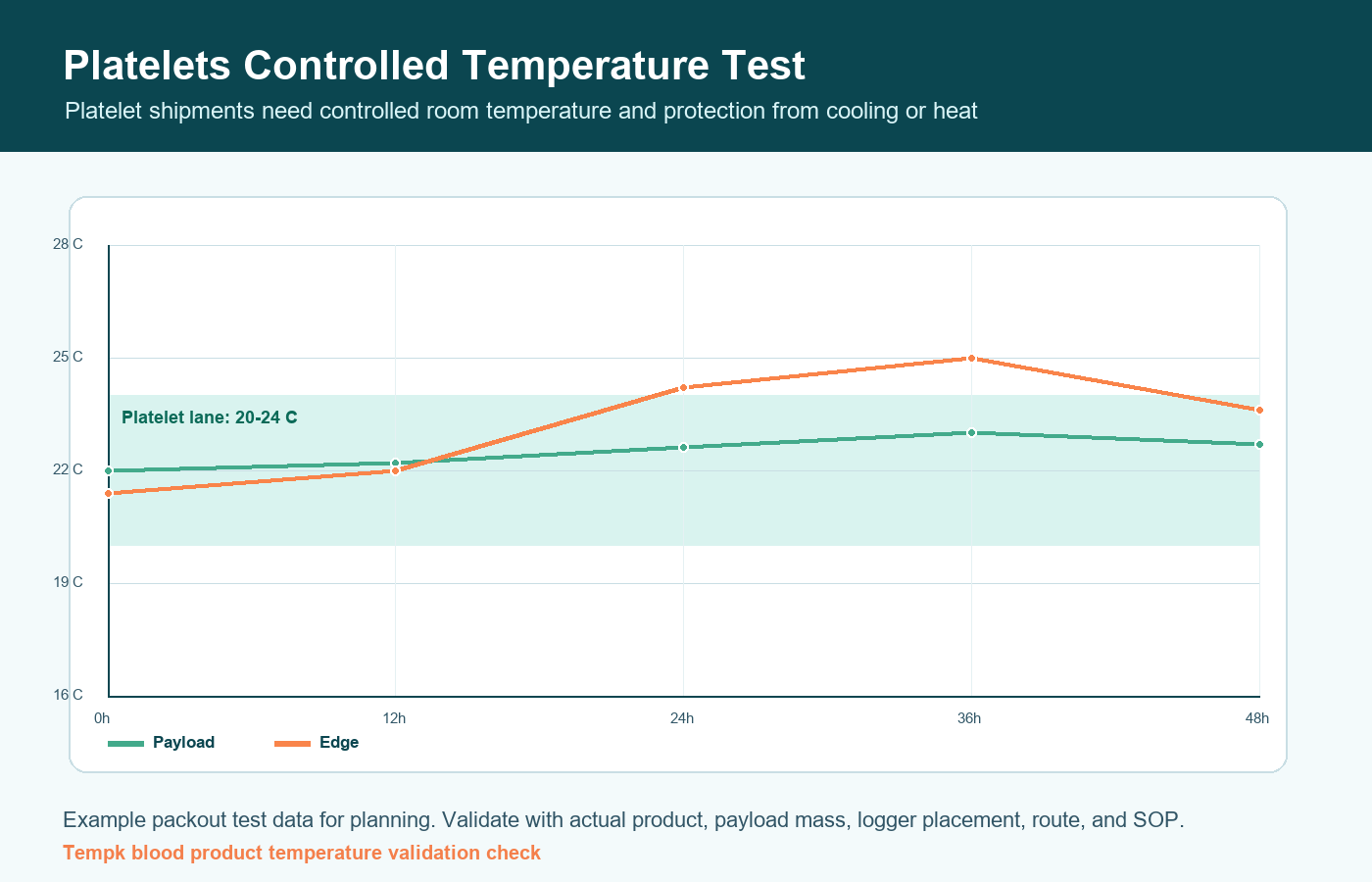
Platelet shipments need clear handoff timing and a logger curve that shows both warm and cool risks.
These are the visible and operational issues the packout should reduce before the shipment reaches the receiver.
Use the test curve as a working comparison, then validate with the actual payload, shipper, coolant or dry ice mass, lane duration, ambient profile, and receiving process.
Use these pages to compare nearby blood product routes, coolant choices, insulation options, and route-risk questions before sampling.
Platelets are usually transported at controlled room temperature, not in the same chilled packout as red blood cells. The package must prevent cold exposure while maintaining the required range.
The largest risks are accidental cooling, poor agitation planning, delivery delays, and staff placing the shipper in a refrigerator by mistake.
Use a controlled temperature shipper with cushioning that supports platelet containers without compressing them. Add clear handling labels for non-refrigerated receipt.
Use validated phase-change components for the required room-temperature lane. Standard ice packs are not appropriate for platelet transport.
Check temperature log, container condition, label clarity, and receiving workflow. The acceptance check should confirm the shipper was not refrigerated.
Platelets are a special case because many lanes require controlled room temperature rather than a chilled packout. Adding standard ice packs can create a serious cold-exposure problem.
Use validated room-temperature PCM or a qualified controlled-temperature shipper. The package should clearly tell receiving staff not to refrigerate the shipment unless their procedure specifically requires it.
Tempk validation should include target range, transit time, orientation, handoff, and any agitation requirement. Review logger data, container condition, label clarity, and receiving actions.
Custom packout support
For fixed carton sizes, payload limits, branding requirements, seasonal lanes, or validation targets, Tempk can adapt this solution into a custom cold-chain packout.
Share the component type, payload count, bag or container size, target range, route duration, ambient condition, courier steps, handoff limit, and receiving checks. Tempk can help compare the shipper, coolant layout, support insert, monitoring position, and validation plan.
Request a packout review