


Mixed SKU compatibility
Prepared foods, dairy, produce, and beverages may not share the same odor, moisture, or carton-strength tolerance.
Chilled mixed grocery pallets combine products with different moisture, odor, carton strength, and temperature sensitivity. The route plan should keep the pallet chilled without blocking airflow or crushing softer cartons.
Pallet routes should be judged by load-level temperature and by receiving condition. The plan below gives a practical starting point before running a lane test with the actual pallet pattern and trailer process.
Prepared foods, dairy, produce, and beverages may not share the same odor, moisture, or carton-strength tolerance.
Over-wrapping can trap warm zones and prevent warehouse or trailer cold air from reaching exposed areas.
Outer cartons see dock and trailer-transfer exposure first, while condensation can weaken labels and board.
| Route condition | Temperature intent | Load protection setup | Coolant or cover planning | Receiving check |
|---|---|---|---|---|
| Cold room to reefer, 0-4 h dock exposure | Use the strictest SKU requirement on the pallet, often 2-8 C for chilled grocery. | Pre-cooled pallet, airflow-aware wrap, corner boards if needed, thermal cover during dock transfer. | Usually no add-on coolant when the reefer lane is stable. If handoff exposure is high, test 4-10 kg PCM or gel packs in a separated pallet buffer. | Top, edge, and core temperatures; wrap movement; wet cartons; crushed soft cartons. |
| Cross-dock or multi-stop route, 4-12 h | Hold chilled temperature through transfer points and open-door events. | Thermal pallet cover or liner, SKU separation by moisture/odor risk, logger map at exposed edge and core. | For validated passive support, test about 8-20 kg PCM or conditioned gel packs, placed so airflow is not blocked. | Temperature spread, condensation, label readability, odor transfer, and receiving delay. |
| Disruption or passive buffer route, 12-24 h | Validated chilled route with more insulation and clear receiving limits. | Insulated pallet shroud, breathable or controlled wrap pattern, separated coolant zones, route-risk review. | About 20-40 kg PCM or conditioned gel packs may be needed for a passive pallet plan; confirm with lane testing. | Logger curve, carton moisture, edge warming, product compatibility, and cover fit. |
Use these ranges for sampling and quotation. Final dry ice, PCM, gel pack, cover, or liner choices should be confirmed with pallet mass, carton pattern, route duration, ventilation, carrier rules, ambient exposure, and receiving handling.
Separate products that create moisture, absorb odor, or crush easily. Mixed grocery pallets fail when the weakest SKU is ignored.
Do not wrap so tightly that airflow is blocked. Use vents, cover fit, and wrap tension based on the warehouse and trailer layout.
Gel packs or PCM can help during handoff exposure, but only when they are separated from product and do not block air channels.
Place sensors at the top, outer edge, center, and lower layer so the route review reflects the whole pallet.
These are the visible and operational issues the pallet plan should reduce before the load reaches the receiver.
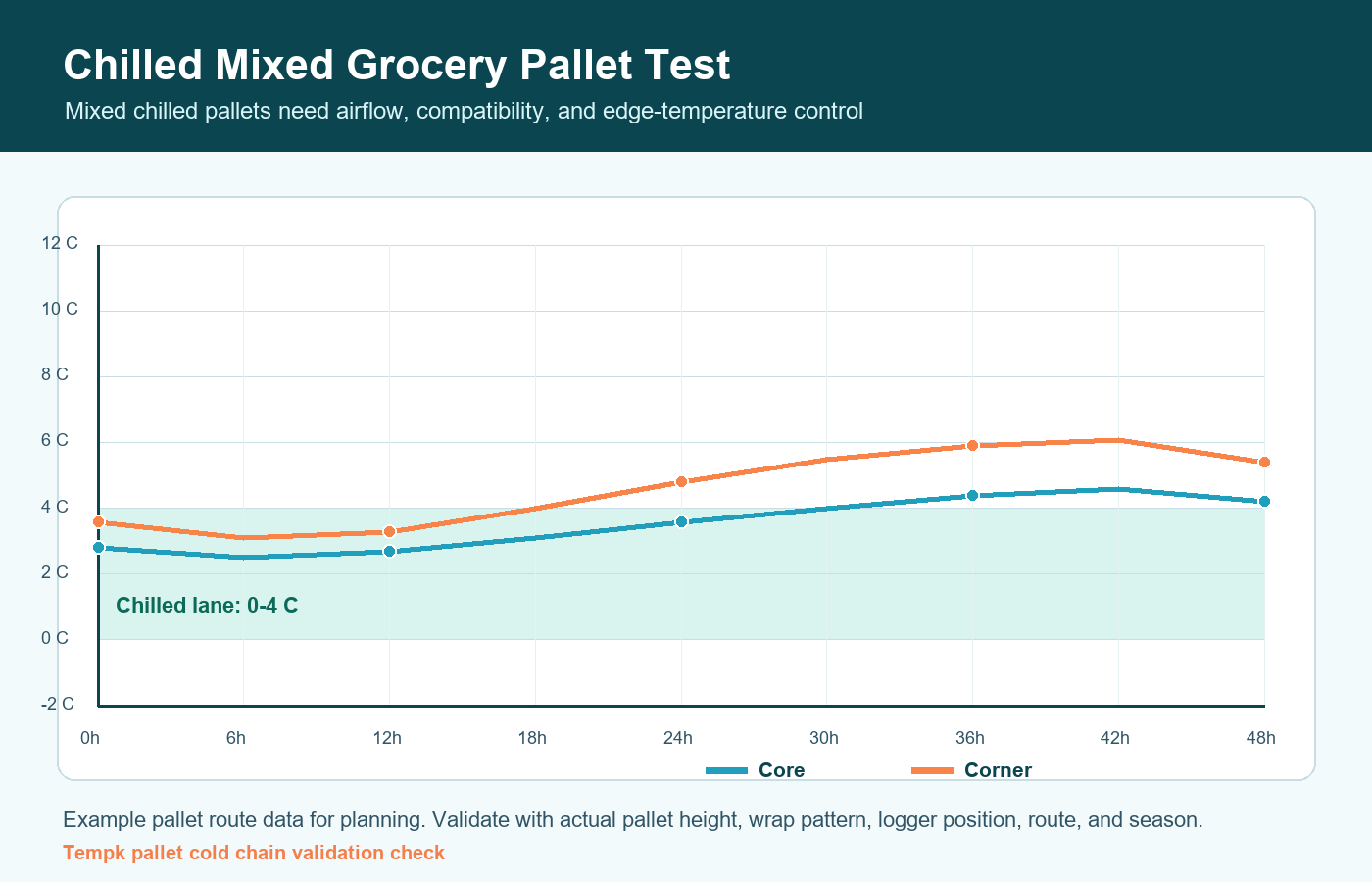
Use the test curve as a working comparison, then validate with the actual pallet mass, cover, liner, coolant support, trailer process, and season. For pallets, the exposed edge and top layer often matter as much as the core.
Use these pages to compare nearby pallet routes, dry ice planning, insulation choice, and route risk before sampling.
For chilled mixed grocery pallets, mixed pallets contain products with different heat load and crush limits. The packout should be chosen from the product condition and delivery promise, not from carton size alone. Start with 0-4 C chilled or -18 C frozen control across pallet staging, dock transfer, and line-haul, then decide whether the bigger risk is warming, freezing, condensation, leakage, pressure damage, or receiving delay.
Use pallet blankets or chilled staging, place sensitive items away from pallet edges, and reduce dock dwell time. Validate edge cartons and the pallet core separately. The insulation should leave a stable payload cavity and the coolant should be placed where it removes heat without touching sensitive product surfaces. If the route is short and controlled, a lighter conditioned gel-pack layout may be enough. If the route includes summer parcel dwell, air freight delay, or weekend receiving risk, use more insulation or a smoother PCM profile before adding aggressive frozen coolant.
Run the test with the actual product count, box size, coolant mass, and packer workflow. Record the warmest product point, the coldest point next to coolant, package condition, and time from delivery to storage. The final Tempk recommendation should tell the packing team exactly where each coolant item sits and what the receiver should check first.
Custom packout support
For fixed carton sizes, payload limits, branding requirements, seasonal lanes, or validation targets, Tempk can adapt this solution into a custom cold-chain packout.
Share the pallet dimensions, product mass, carton pattern, target temperature, dock time, trailer type, cross-dock steps, ambient condition, and receiving checks. Tempk can help compare covers, liners, gel packs, PCM, dry ice support, logger positions, and validation steps.
Request a pallet route review