


Load hard-frozen product
Dry ice is route protection, not a way to rescue soft product. Start with product that is already fully frozen.
Ice Cream & Frozen Desserts
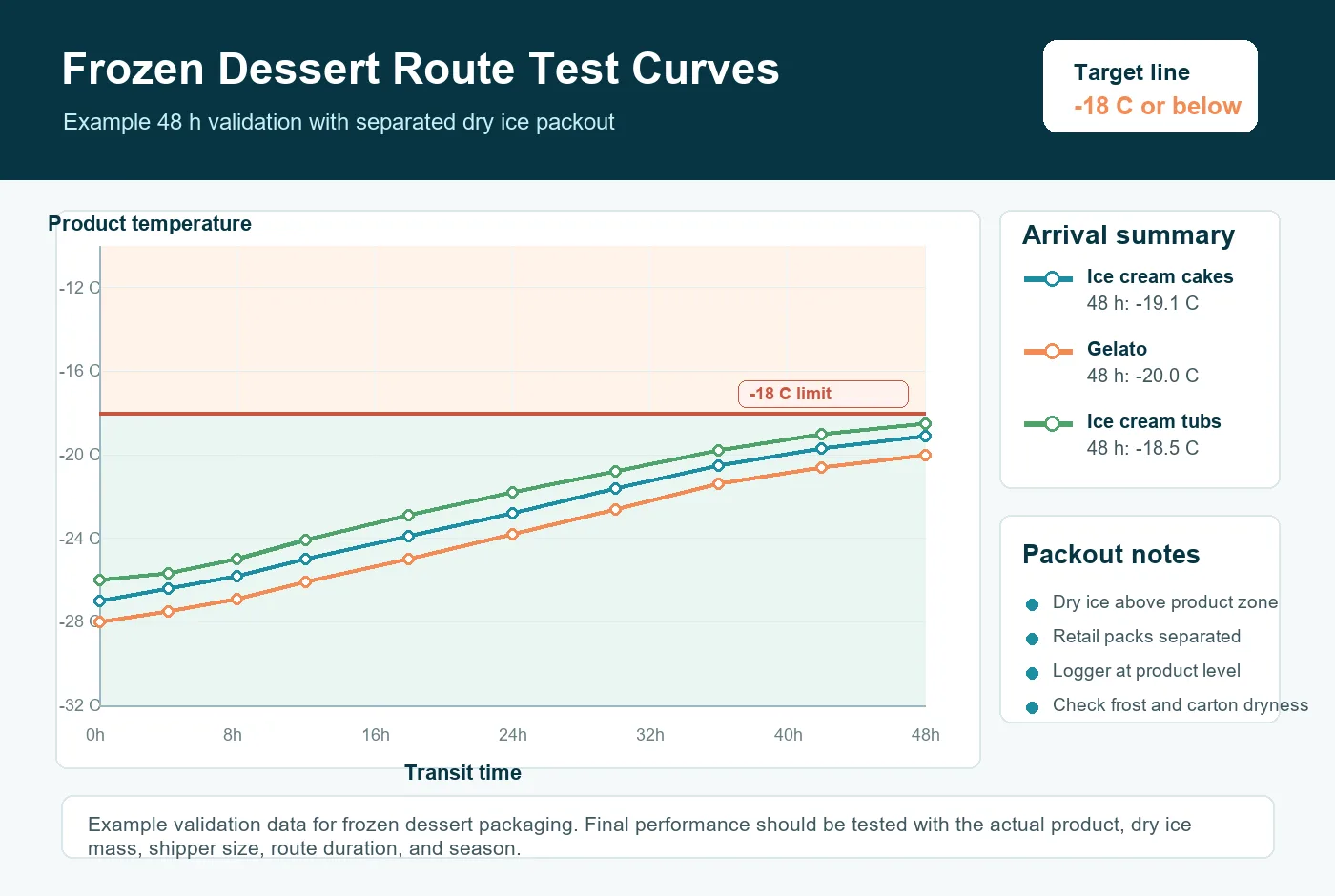
Ice cream cakes, gelato, and tubs need frozen holding, not a chilled dessert packout. The package has to protect product firmness, texture, decorations, labels, and carton condition while allowing dry ice to vent safely.
Category Decisions
Frozen dessert logistics is not the same as refrigerated bakery delivery. Ice cream cakes need shape and decoration protection, gelato needs texture stability, and retail tubs need lid security and carton dryness. The package should keep the product hard frozen while avoiding dry ice pressure, blocked venting, and wet retail packaging.
Dry ice is route protection, not a way to rescue soft product. Start with product that is already fully frozen.
Use dividers and headspace so dry ice does not crush cartons, mark surfaces, or contact delicate cake boxes.
Dry ice sublimates into gas. The shipper must allow controlled venting and comply with carrier requirements.
Review temperature trace, product hardness, frost, lid seal, carton dryness, decoration condition, and remaining dry ice.
High-Value Product Routes
Each product page gives route scenarios, dry ice starting ranges, packout layers, and receiving checks for a specific frozen dessert format.
Frozen packouts for cake shape, decorations, board restraint, carton clearance, and separated dry ice placement.
View ice cream cake solution Texture controlDense frozen dessert routes focused on thaw-refreeze prevention, frost control, lid protection, and short-lane reliability.
View gelato solution Retail tubsParcel and DTC packouts for lid security, carton dryness, tub stack pressure, dry ice margin, and frozen texture.
View ice cream tub solutionRoute Planning
Frozen desserts usually need dry ice or a validated frozen system. Gel packs may be useful as supporting coolant in some hybrid tests, but they should not replace dry ice for standard parcel routes that require hard frozen arrival.
| Shipment condition | Package direction | Dry ice direction | What to verify |
|---|---|---|---|
| Same-day frozen delivery Hard-frozen product, short route, limited dock exposure |
EPS or EPP insulated shipper, divider, liner, product support, and vented outer carton | Use a small separated dry ice zone above or around the payload; confirm carrier handling and venting. | Product hardness, lowest contact area, carton dryness, lid security, and remaining dry ice |
| Overnight parcel route Depot handling, last-mile exposure, 18-36h delivery window |
Thicker EPS/EPP shipper, dry ice divider, product spacer, logger, and stronger outer carton | Size dry ice by payload, box volume, insulation, route time, ambient heat, and carrier rules. | Temperature trace, dry ice remaining, product texture, frost level, and package deformation |
| Hot-weather or delay-prone route 30-35 C ambient, 36-48h risk, weekend hold possible |
Higher-performance insulation, larger dry ice margin, strong divider, vent path, and route logger | Increase dry ice only with enough headspace and separation so gas venting, pressure, and product damage are controlled. | Peak temperature, remaining dry ice at delayed receipt, carton wet-out, product shape, and safety labeling |
Supporting Frozen Dessert Guides
Popsicles and frozen yogurt can stay within this frozen dessert cluster without turning every product into a separate solution page.
Useful Internal Links
Share product type, product temperature at packing, carton size, payload weight, route duration, ambient range, carrier mode, and receiving checks. Tempk can help choose insulation, dry ice layout, dividers, venting, and validation steps.
Request a frozen route reviewIce cream cakes, gelato, and tubs all need frozen handling, but each fails differently. The right packout depends on whether the customer sees shape, texture, lid integrity, or scoop quality first.
Typical claims include soft edges, refrozen ice crystals, crushed cakes, wet cartons, and lids that pop during dry ice shipping.
Use the product format to choose the insert: cake boards and collars for cakes, dense side protection for gelato, and top-load protection for tubs.
Dry ice is common for longer parcel routes, while frozen gel packs may work for short controlled lanes. Keep dry ice separated from exposed labels and retail plastic when brittleness is a risk.
Validate with the actual carton, product mass, route duration, and receiving hold time. Check texture and carton dryness after the product tempers.
Use this category page as a selection point, not a single frozen recipe. If the product is an ice cream cake, the first risk is shape and decoration. If it is gelato, the first risk is texture change from thaw and refreeze. If it is a retail tub, lid pressure and label wetting are usually the first customer-visible defects. The category page should push users toward a product-specific route test with product mass, dry ice allowance, carton strength, and final-mile dwell. A frozen temperature reading is only one part of acceptance; shape, texture, lid condition, and carton dryness decide whether the shipment can sell.
Custom packout support
For fixed carton sizes, payload limits, branding requirements, seasonal lanes, or validation targets, Tempk can adapt this solution into a custom cold-chain packout.