


Steaks
Choose chilled gel pack or frozen dry ice logic based on whether the steak must arrive fresh, deeply chilled, or frozen solid.
Meat and poultry shipments are not one packaging problem. Premium steaks can be chilled or frozen, raw chicken needs stronger leak containment, and deli meats need clean retail presentation. The packout should match product form, target temperature, coolant behavior, route duration, and receiving quality checks.
Temperature matters, but meat programs also fail from purge leakage, crushed trays, wet labels, coolant contact, and unclear chilled-versus-frozen route intent.
Choose chilled gel pack or frozen dry ice logic based on whether the steak must arrive fresh, deeply chilled, or frozen solid.
Control raw poultry leakage, absorbent capacity, liner integrity, and cross-contact risk while holding a 0-4 C chilled route.
Protect 0-4 C temperature, label readability, retail pack appearance, condensation, and odor separation without freezing the product surface.
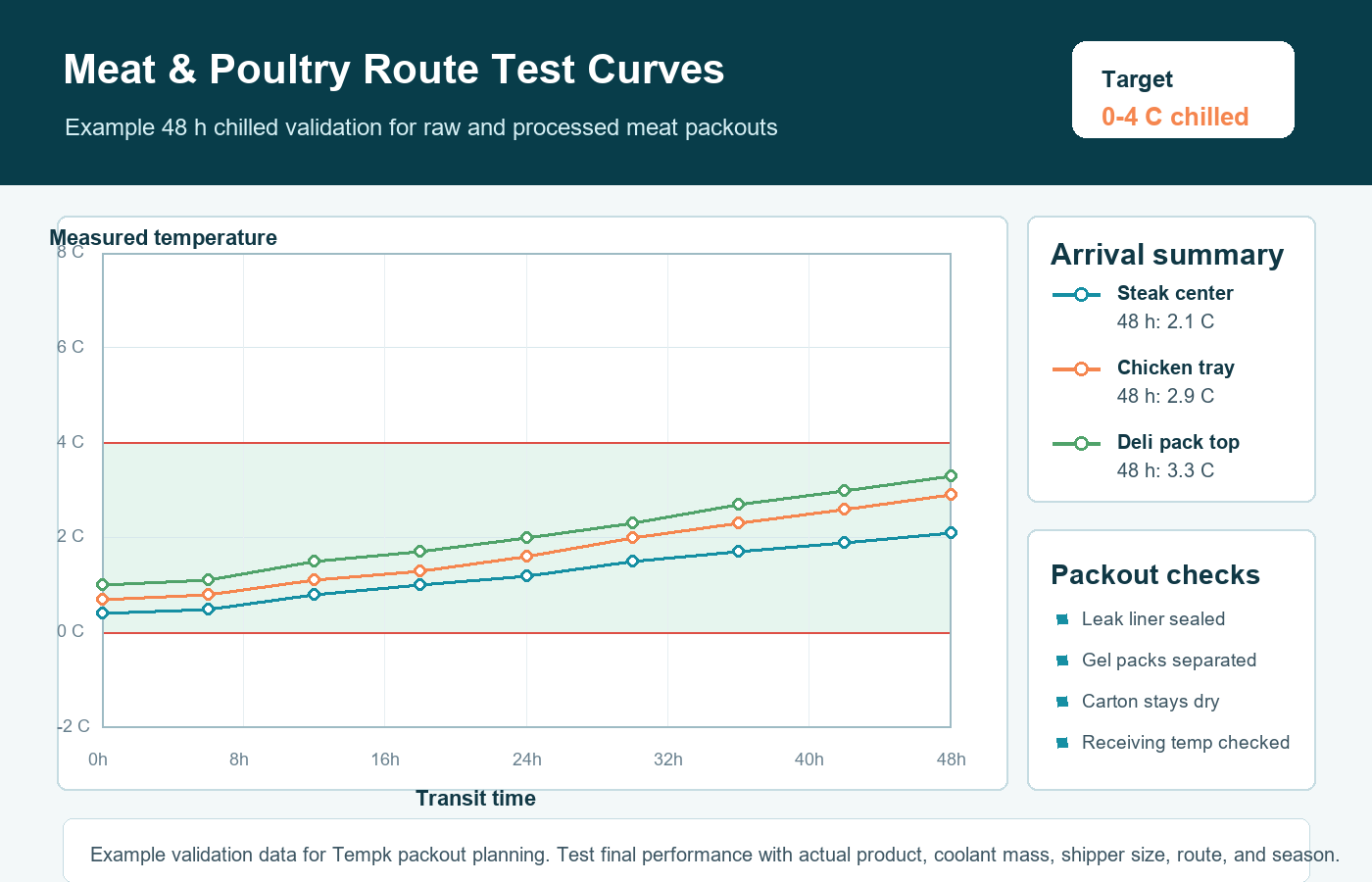
Use these planning ranges to pick the first Tempk packout for testing. Final coolant mass should be validated with the exact payload, insulation size, route, and season.
| Product route | Common target | Packaging structure | Coolant starting point | Watch first |
|---|---|---|---|---|
| Premium chilled steaks, 8-36 h | 0-2 C for high-quality chilled presentation, or 0-4 C where the food safety program allows. | Vacuum or tray pack, absorbent layer, leak liner, EPP or insulated carton, separated gel packs or 0 C PCM. | About 0.8-2.8 kg gel packs or PCM for 1-4 kg payload. | Freeze marks, purge, tray dents, color change. |
| Raw chicken breast, 8-36 h | 0-4 C chilled route with strict leak control. | Primary sealed pack, secondary liner, absorbent base, coolant separated from poultry packs. | About 0.8-2.6 kg conditioned gel packs or PCM for 1-4 kg payload. | Leaks, carton wet-out, cross-contact risk, warm top layer. |
| Sausages and deli meats, 8-36 h | 0-4 C chilled route for processed or ready-to-eat packs. | Retail pouch or tray, condensation barrier, label protection, side and top coolant with divider. | About 0.6-2.2 kg gel packs or PCM for 1-4 kg payload. | Condensation, label damage, odor transfer, surface freezing. |
| Frozen meat shipments | -18 C or below when the route is specified as frozen. | Frozen shipper, dry ice or frozen coolant plan, vapor gap, label and carrier checks. | Use dry ice planning by box size, meat weight, route time, and carrier limit. | Dry ice sublimation, thaw at last mile, regulatory marking. |
For frozen pallet or bulk programs, see Frozen Meat Pallets. For subscription programs, see DTC Meat Boxes.
Temperature curves are only useful when they are paired with receiving checks: purge, leakage, label condition, carton dryness, coolant position, and product surface quality.
These product guides support the category page without forcing every product into a separate solution page.
Use this guide when the product is not one of the three priority pages but still needs a product-specific meat packout decision.
Use this guide when the product is not one of the three priority pages but still needs a product-specific meat packout decision.
Use this guide when the product is not one of the three priority pages but still needs a product-specific meat packout decision.
Use this guide when the product is not one of the three priority pages but still needs a product-specific meat packout decision.
Use the tools to size the first trial, then validate with the real meat payload and receiving checks.
Share the product form, chilled or frozen target, payload weight, box size, route duration, season, and receiving checks. Tempk can help choose insulation, coolant mass, liner structure, and validation steps.
Meat & Poultry shipments should not use one fixed box recipe for every product. Start with 0-4 C chilled control for fresh cuts or -18 C for frozen meat programs, then separate products by heat load, packaging strength, and how they are received. For mixed programs, Tempk usually compares a short local route, an overnight parcel route, and the hottest expected season before confirming the shipper.
Use vacuum-pack support, absorbent pads, leak liner, insulated carton, and corner protection. The coolant plan should begin with gel packs for chilled packs and dry ice or frozen PCM for frozen lanes that require extended hold time. When the payload has delicate retail cartons, soft texture, live material, or medical documentation, protect the payload first and then add cooling capacity. If the shipment is delayed at packing, handoff, customs, or dock transfer, the route profile should be rechecked instead of only increasing coolant weight.
Validation should include check purge control, surface temperature, carton compression, and unloading time at the destination. A useful test records the warmest payload point, the coldest point near coolant, and the receiving condition after handling. This gives the operations team a practical packout instruction, not just a temperature chart.
Custom packout support
For fixed carton sizes, payload limits, branding requirements, seasonal lanes, or validation targets, Tempk can adapt this solution into a custom cold-chain packout.