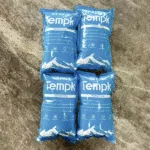
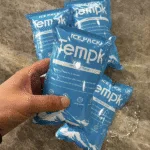
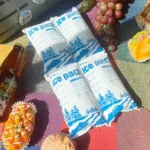
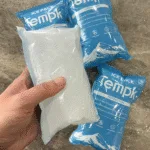
Real dry ice is solid carbon dioxide. It sublimates into gas and cannot be regenerated in a household freezer after it has disappeared. A gel pack or a water-activated freezing sheet may be reusable, but it is a different product. Check the material and supplier instructions before applying any reuse advice.
The name on the pack can be misleading
| Material | What happens during use | Reuse decision |
|---|---|---|
| Solid carbon dioxide | Changes directly from solid to gas | Remaining solid may still provide cooling; lost material must be replaced. |
| Water or gel coolant pack | Warms and may change from frozen to liquid | Refreeze only when designed for reuse and still serviceable. |
| Water-activated sheet | Absorbs water before freezing, depending on design | Follow the specific hydration, freezing and reuse instructions. |
Do not identify a coolant from a marketing phrase such as “dry ice pack.” Ask for the material declaration and safety information. A flexible hydrated sheet is not evidence of solid CO₂, and dry ice should never be added to water as a preparation step for a reusable pack.
Why a freezer cannot replace lost dry ice
A domestic freezer is designed for food storage, not for manufacturing solid carbon dioxide. The gas released by dry ice is no longer available as a reusable coolant block. Attempting to trap it in a bottle or sealed container creates a pressure hazard.
Do not store real dry ice in an airtight container or an enclosed, poorly ventilated space. Use suitable insulated handling protection and follow the sender’s handling instructions. CDC: carbon dioxide exposure associated with dry ice explains the danger of CO₂ accumulation during dry-ice use.
Assess an ordinary reusable coolant pack
- Confirm that the pack is reusable and suitable for the product’s temperature range.
- Inspect seams, film, closure and contents for leaks, swelling or damage.
- Remove packs contaminated by product leakage or other materials that cannot be safely cleaned.
- Use the specified freezer or conditioning process; do not guess preparation time from surface hardness.
- Keep a record of the pack type and condition when it is used in a qualified shipping configuration.
Replacing a gel pack with real dry ice changes both the thermal behavior and handling requirements. For a freeze-sensitive product, colder is not automatically better. Reassess the complete packout before making that substitution.
What to do with leftover solid dry ice
Keep people and pets away from it. Use only a suitable container that releases gas, in a location managed for ventilation and access control. Do not seal it to slow its loss. For unwanted material, follow the sender’s disposal instructions or the workplace procedure; do not put it in drains or sealed waste containers.
Helpful decision tools
Check the details before you choose packaging
These quick tools can help you compare route risk, sizing needs, coolant choices, and packaging details before you request a quote.
Packaging Selector
Compare insulated packaging options by product, route, and temperature need.
Find packagingInsulation Material Drop Resistance
Review drop resistance and handling factors before choosing insulation materials.
Check resistanceCoolant & PCM Reference
Compare coolant and PCM options when a route needs added temperature support.
Compare optionsIf the remaining material is insufficient for a validated shipment, replenish the specified quantity through an appropriate supplier. Leftover dry ice of unknown mass is not a reliable basis for a new shipping duration.
Frequently asked questions
Can I refreeze a pack that looks like dry ice?
First identify its contents. A water or gel pack may be reusable; real solid CO₂ cannot be restored after sublimation in a household freezer.
Does adding water bring dry ice back?
No. Water does not regenerate solid carbon dioxide. It can increase gas generation and introduce handling hazards.
Can remaining dry ice be used for another shipment?
Only when the material, container, quantity and handling arrangements meet that shipment’s requirements. Do not estimate suitability from appearance alone.
Related handling guidance
For a delivered parcel, see handling dry ice after receipt.