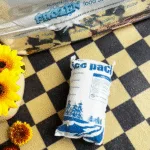
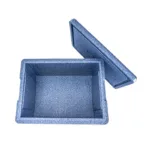
Reusable ice packs do not have one reliable “4-hour,” “12-hour,” or “24-hour” rating for every use. Their useful cooling time is the period during which a specific insulated setup keeps the payload inside its required temperature range. Pack formulation and mass matter, but so do conditioning, insulation, payload, outside exposure, openings, and pack placement. If the result matters for product quality or safety, verify the complete setup with temperature measurements rather than judging whether a pack still feels cold.
Start with three different time questions
Many conflicting answers come from treating three separate measurements as if they were the same.
| Question | What it means | What confirms it |
|---|---|---|
| How long does the pack take to freeze or condition? | Time needed to bring the coolant to its specified starting state before packing. | The supplier’s instructions, the freezer or conditioning temperature, pack arrangement, and a repeatable preparation check. |
| How long does it stay useful? | Time the assembled packout keeps the payload within its defined temperature limits. | A monitored trial using the intended container, payload, coolant layout, and exposure profile. |
| How long can the pack be reused? | Service life before damage, contamination, material loss, or changed performance makes the pack unsuitable. | Inspection criteria, handling history, supplier limits, and retesting when the process changes. |
A reusable pack can refreeze and still fail a return-to-service inspection. It can also feel cold after delivery while the product space has already left its acceptable range. Keep these decisions separate.
How long should reusable ice packs freeze before use?
Use the preparation instructions for the exact pack. Water-based packs, gel packs, ice bricks, and phase-change materials do not necessarily use the same starting condition. Some products are frozen solid; others are conditioned to a specified state or temperature.
If the supplier does not provide a preparation time, avoid inventing a universal number. Establish a repeatable method for your freezer and workload:
- Record the freezer or conditioning setpoint and the permitted operating range.
- Define how packs are arranged. Dense stacks or tightly loaded bins can condition differently from separated packs.
- Use representative packs from the thickest or slowest-conditioning format in the process.
- Confirm the whole pack reached the intended starting state. A hard outer layer alone is not sufficient evidence.
- Document the accepted loading pattern and preparation window for operators.
For routine operations, this controlled method is more useful than copying a freeze-time estimate from a different pack size, formulation, or freezer.
What determines how long a reusable ice pack stays cold?
| Input | Why it changes the result | What to control |
|---|---|---|
| Coolant type and mass | Different formulations and quantities absorb and release heat differently. | Pack model, fill mass, number of packs, and starting condition. |
| Insulated container | Heat enters through walls, seams, the lid, and openings. | Container model, closure, condition, and insulation construction. |
| Payload | A warm or lightly loaded payload can respond differently from a dense, preconditioned load. | Product mass, starting temperature, arrangement, and empty space. |
| Ambient exposure | Sun, hot vehicles, cold weather, staging, and delivery delays change the heat load. | Seasonal route profile, dwell time, and credible delay. |
| Pack placement | Placement affects warm areas and can also create freezing risk near the coolant. | Top, side, and bottom positions plus any separator or buffer layer. |
| Opening frequency | Repeated access replaces conditioned air with outside air. | Loading sequence, lid-open time, and delivery workflow. |
This is why two users can report very different cooling times for the same reusable pack. They may be testing different systems rather than measuring a different product.
Extend cooling time without creating a new risk
- Condition every component consistently. Prepare the coolant as specified and bring the payload to its approved starting condition before packing.
- Use the intended insulated container. A larger box or damaged lid can change the result even when the number of packs stays the same.
- Keep the approved layout. More packs are not automatically better; they can reduce payload space or create cold spots.
- Limit avoidable heat exposure. Close the container promptly and reduce warm staging time before dispatch.
- Protect freeze-sensitive products. Use the specified separator or buffer and check both warm and cold locations during testing.
For an early planning estimate, use the ice pack calculator. Its output is a starting point, not a thermal qualification.
Inspect each returned pack before reuse
| Inspection point | Return-to-service question |
|---|---|
| Identity | Does the pack match the approved size, formulation, and specification? |
| Seal and enclosure | Are the seams, cap, valve, film, or shell intact without leakage, puncture, or splitting? |
| Shape and fill | Has swelling, deformation, or material loss changed how the pack fits in the layout? |
| Cleanliness | Can the pack be cleaned under the supplier’s instructions and the site hygiene procedure? |
| Handling history | Was the pack exposed to an event that requires segregation, investigation, or retirement? |
Remove failed packs from usable inventory. Do not assume that tape or an undocumented repair restores the original specification. If the supplier permits a repair, follow the documented method and decide whether the accepted packout still applies.
When should a reusable ice pack be replaced?
Retire a pack when it no longer meets the approved inspection criteria. Common triggers include leakage, damaged seams or shells, contamination that cannot be removed safely, loss of fill, permanent deformation, unreadable identification, or performance that no longer matches the accepted process.
Helpful decision tools
Check the details before you choose packaging
These quick tools can help you compare route risk, sizing needs, coolant choices, and packaging details before you request a quote.
Packaging Selector
Compare insulated packaging options by product, route, and temperature need.
Find packagingIce Pack Calculator
Estimate gel ice pack quantity for chilled shipments and practical route planning.
Estimate ice packsDry Ice Calculator
Estimate dry ice needs for frozen or ultra-cold shipments before packing.
Estimate dry iceDo not promise an unlimited number of reuse cycles without product-specific evidence. Service life depends on the enclosure, sealing method, cleaning chemicals, handling, storage, return logistics, and the retirement rules used by the operator.
How to test useful cooling time
A practical test should represent the actual decision you need to make. Define the product temperature limits, maximum credible transit window, container, payload, coolant preparation, pack quantity and placement, ambient exposure, and sensor locations before the test starts.
- Test representative minimum and maximum payloads when both will be used.
- Place calibrated sensors at justified warm and cold locations in the product space.
- Record the complete temperature trace, not just the temperature at opening.
- Check for both warming and overcooling against the product limits.
- Document the accepted configuration and repeat the study after a significant change.
For regulated distribution, qualification requires a defined protocol and acceptance criteria. The WHO guidance on qualification of shipping containers explains the role of documented container studies. A casual cooler test or a pack that remains partly frozen is not equivalent evidence.
Choose the right page for the next decision
This page is about the individual reusable pack: how to prepare it, inspect it, reuse it, and decide when its performance needs to be checked again. If you need to determine how long an entire insulated shipment can protect a product, use the ice pack hold-time and packout planning guide.
To compare available formats, review reusable gel ice packs. Then evaluate the chosen coolant together with the container, payload, route, and operating procedure.
Frequently asked questions
Can a reusable ice pack stay cold all day?
It may be possible in a suitable insulated setup, but “all day” is not a product specification. Confirm the required temperature range and test the intended payload, container, pack layout, and exposure duration.
How do I know when an ice pack is fully frozen?
Use the supplier’s acceptance method for that formulation and pack size. Surface hardness alone may not show whether the pack’s center reached the required starting state.
Are instant cold packs the same as reusable ice packs?
No. Instant cold packs create cooling through a one-time activation and usually do not require freezing. This guide covers reusable packs that are frozen or conditioned before use.
Does adding more reusable packs always increase hold time?
No. It changes the complete configuration and may create cold spots, reduce payload space, or alter airflow. Verify quantity and placement as part of the packout.