


Start cold, then hold cold
Finished desserts should be chilled before packing. Extra gel packs cannot correct a warm cake without creating wet or frozen edges.
Bakery & Desserts Cold Chain
Bakery desserts are judged by shape, surface finish, carton dryness, and food-safe chilled handling. A practical packout has to protect cream, dairy filling, glaze, cake boards, and box clearance while controlling temperature.
Category Decisions
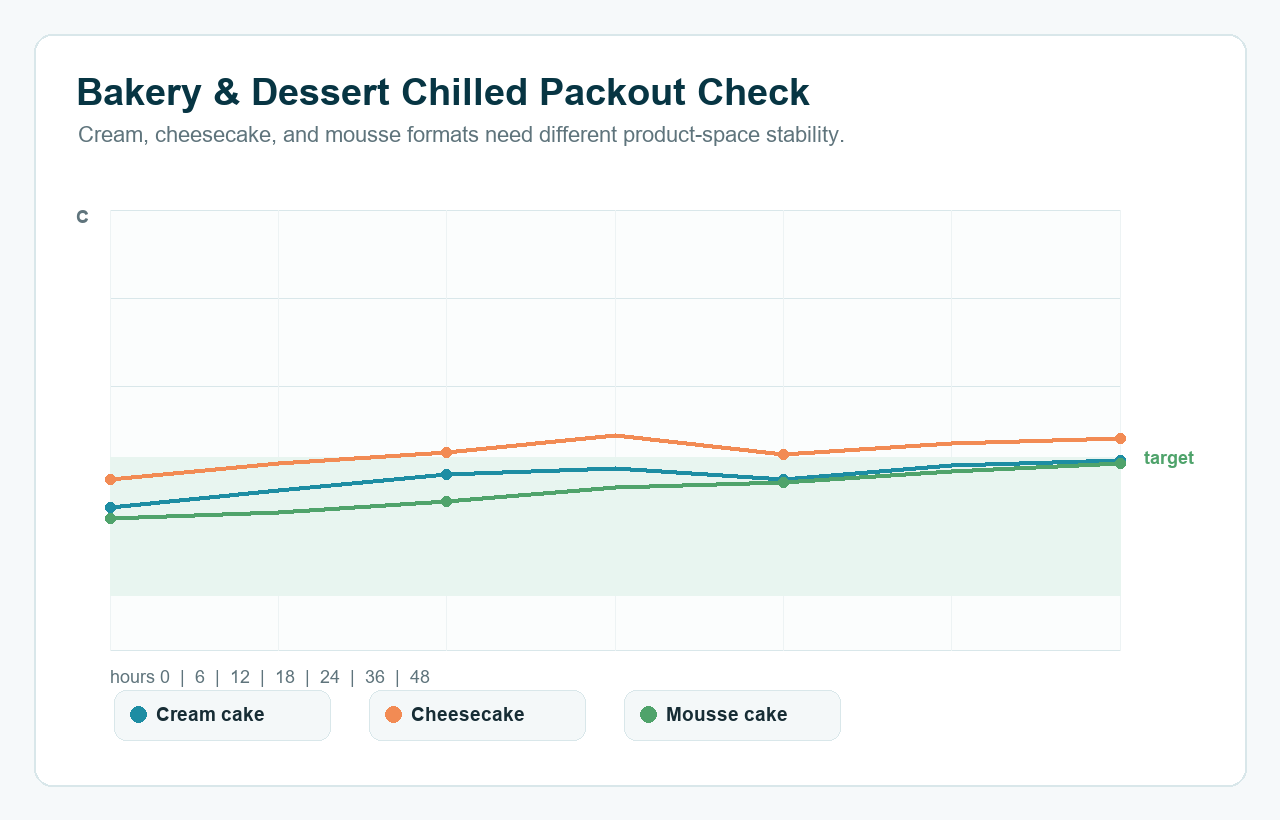
Cream cakes, cheesecakes, and mousse cakes can share a refrigerated route, but they do not fail the same way. Cream cakes lose shape, cheesecakes can crack or sweat, and mousse cakes are sensitive to vibration, glaze finish, and tilt. The package should protect the exact dessert format first, then size the coolant and insulation around it.
Finished desserts should be chilled before packing. Extra gel packs cannot correct a warm cake without creating wet or frozen edges.
Use cake boards, rings, inserts, and fixed carton fit so the product stays level through courier handling.
Condensation can weaken cake boxes, soften labels, and mark pastry surfaces even when the temperature is acceptable.
Receiving checks should include surface finish, frosting firmness, crust condition, carton dryness, board movement, and logger trace.
High-Value Product Routes
Each product page gives practical route choices, coolant starting ranges, packout layers, and receiving checks for a specific dessert structure.
Chilled packouts for whipped cream, frosting height, sponge layers, cake-board movement, and carton clearance.
View cream cake solution Dense dairyPackouts for dense fillings, pan support, crust moisture, surface cracking, and slow temperature recovery.
View cheesecake solution Delicate layersGentle chilled routes for aerated layers, mirror glaze, humidity-sensitive surfaces, and vibration control.
View mousse cake solutionRoute Planning
Most bakery desserts in this group need chilled holding, not freezing. The route plan should prevent warm exposure while avoiding direct contact with hard frozen coolant.
| Shipment condition | Typical package direction | Coolant direction | What to verify |
|---|---|---|---|
| Same-day bakery delivery Pre-chilled product, short route, limited depot time | Insulated carton liner or compact EPS shipper, cake board support, moisture barrier, and fixed carton fit | Conditioned gel packs on side walls or top corner, separated from cake boxes by a divider | Product temperature, frosting firmness, carton dryness, cake movement, and remaining coolant state |
| Overnight parcel route 18-36h route, depot exposure, warm van risk | EPP or EPS insulated box, liner bag, stronger outer carton, insert support, and route logger | Gel packs or chilled PCM selected by target range, dessert weight, shipper volume, and ambient profile | Warmest dessert point, cold edge risk, surface moisture, board shift, and carton compression |
| Hot-weather or delay-prone route 30-35 C ambient, 36-48h risk, longer handoff | Thicker insulation, higher coolant margin, stronger cake support, moisture barrier, and logger | Perimeter coolant layout with buffer layers; avoid placing hard frozen packs directly over the cake box | Peak temperature, lowest edge temperature, condensation, surface defects, and receiving appearance |
Supporting Dessert Guide
Custard pies and tarts need a related but different chilled packout because crust protection and set filling are the main risks.
Useful Internal Links
Share dessert type, product temperature at packing, cake box size, payload weight, route duration, ambient range, and receiving checks. Tempk can help choose insulation, coolant layout, board support, moisture barrier, and validation steps.
Request a dessert packout reviewBakery and dessert shipments are not one cold-chain problem. Cream cakes need shape protection, cheesecakes need slow thaw control, and mousse products need vibration control around a soft structure.
Temperature abuse shows up as cream weeping, frosting smear, cracked glaze, soggy boards, and retail carton deformation.
Select the shipper around the cake board size first. Use collars, corner guards, and a flat top buffer so coolant weight is never carried by the dessert lid.
Chilled gel packs work for fresh cream lanes. Frozen gel or dry ice should only be used when the dessert is meant to remain frozen and the carton has enough separation from the cold source.
The route test should include a visual cut check, frosting clearance, carton dryness, and board movement, not only a temperature curve.
Custom packout support
For fixed carton sizes, payload limits, branding requirements, seasonal lanes, or validation targets, Tempk can adapt this solution into a custom cold-chain packout.