


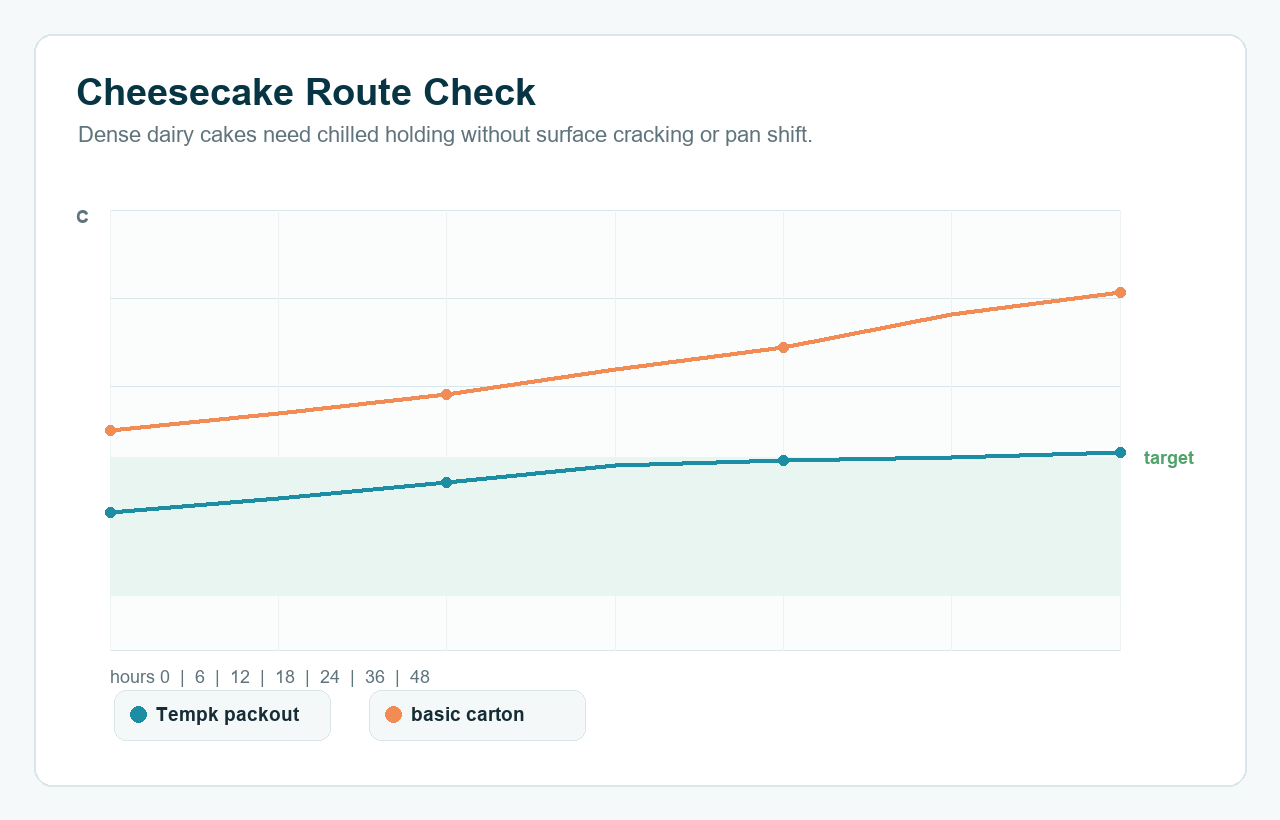
The center changes slowly
A cold surface does not guarantee the cheesecake core has stayed within the agreed refrigerated range.
Cheesecakes Cold Chain
Cheesecakes carry more mass than many bakery desserts. The packout should hold a stable refrigerated route, support the pan or board, protect the crust, and prevent condensation or frozen edges.
Product Risk
The right package has to protect receiving quality, not only keep a temperature logger cold. The risk points below determine the insulation choice, coolant position, product support, and validation checks.
A cold surface does not guarantee the cheesecake core has stayed within the agreed refrigerated range.
Rapid cold spots, vibration, or loose pan support can lead to cracks or edge defects.
Condensation and thawed coolant water can damage crust texture and bakery presentation.
A weak base allows bending, corner pressure, or side-wall rubbing during handling.
Route-Based Recommendation
These are practical starting points for sample planning. Final coolant weight and insulation thickness should be verified with the actual dessert, carton, route, and receiving standard.
| Shipment condition | Recommended Tempk package | Starting coolant direction | Coolant position | What to validate |
|---|---|---|---|---|
| Same-day chilled delivery 8-18h route, ambient below 22 C, pre-chilled cake | Insulated carton liner or compact EPS shipper, rigid base, pan or board support, liner bag, and absorbent sheet | About 0.4-0.9 kg total conditioned gel packs for a 1-3 kg chilled dessert payload. Dense cakes may need less pull-down but more stable insulation. | Side-wall placement with divider; avoid direct cold contact on pan edges or crust side. | Core and edge temperature, crust dryness, surface cracks, base stability, and remaining coolant state |
| Overnight parcel route 18-36h route, depot and van exposure, ambient 22-30 C | EPP or EPS insulated box, rigid base insert, moisture barrier, fixed pan fit, and stronger outer carton | About 0.9-1.6 kg total gel packs or chilled PCM for a small parcel. Validate core temperature, not only surface temperature. | Two side positions or side-plus-top with thick buffer layers and no top-load pressure. | Core logger trace, cold edge risk, crust softness, pan movement, and carton compression |
| Hot-weather or delay-prone route 30-35 C ambient, 36-48h risk, longer depot hold | Thicker EPP/EPS shipper, higher insulation margin, reinforced base, moisture barrier, and route logger | About 1.6-2.8 kg total coolant or a PCM system for a small parcel. Use buffer layers to prevent frozen edges. | Perimeter coolant layout with dividers on all product-facing sides; keep coolant away from crust contact points. | Peak core temperature, lowest edge temperature, sweating, cracking, crust condition, and receiving appearance |
Coolant mass is a starting point, not a guarantee. Adjust by product temperature at packing, cake or carton weight, box size, insulation material, coolant conditioning, route duration, ambient profile, and receiving checks. More ice can create wet cartons, frozen edges, or surface damage when support and buffering are wrong.
Packout Structure
Desserts need product support before coolant is added. Start with board, pan, carton, and surface clearance, then place coolant around the protected product.
Packing Process
A colder box cannot fix a dessert that starts warm, loose, tilted, or pressed against the lid. The packing process should remove those risks before sealing.
Dense cheesecakes need enough chilling time before packing; surface temperature alone can mislead.
Use a rigid base and limit void space so heavy desserts do not shift during parcel handling.
Choose conditioned gel packs or PCM and separate them from the product with dividers.
Inspect surface cracks, crust softness, moisture, pan movement, and logger data after receiving.
When to Change the Design
Improve pre-chilling, increase insulation margin, adjust coolant mass, and validate with a core-side logger.
Reduce direct coolant exposure, change coolant conditioning, or add thicker dividers.
Improve moisture barrier, absorbent layer, and coolant separation rather than only changing temperature.
Related Resources
Share cheesecake weight, pan or board format, carton size, product temperature, route duration, ambient range, and receiving checks. Tempk can help choose insulation, coolant layout, base support, and validation steps.
Request a packout reviewCustom packout support
For fixed carton sizes, payload limits, branding requirements, seasonal lanes, or validation targets, Tempk can adapt this solution into a custom cold-chain packout.