


Warmth can collapse texture
Mousse layers soften faster than dense cakes and can lose clean edges during delays.
Mousse Cakes Cold Chain
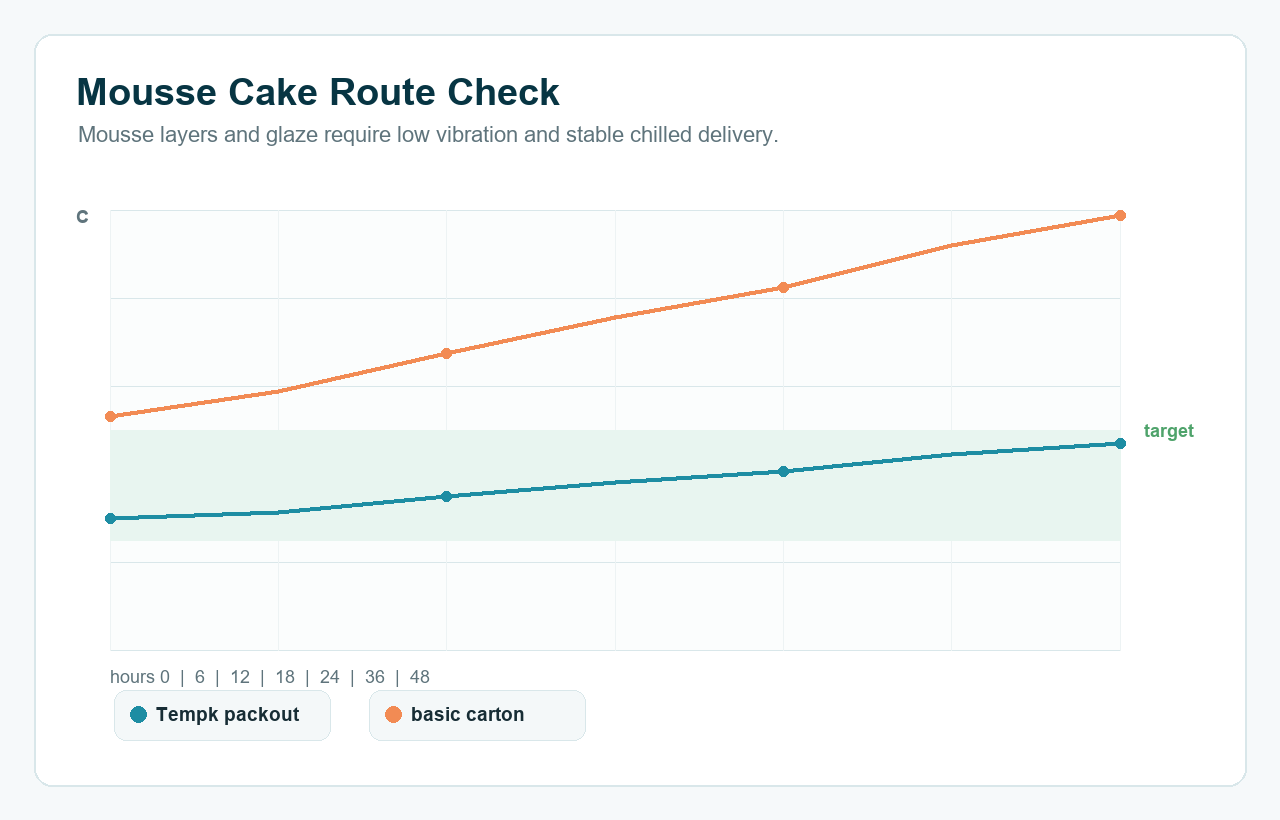
Mousse cakes are highly sensitive to warmth, vibration, tilt, and surface moisture. The packout should hold a chilled route while protecting delicate layers, mirror glaze, decorations, and box clearance.
Product Risk
The right package has to protect receiving quality, not only keep a temperature logger cold. The risk points below determine the insulation choice, coolant position, product support, and validation checks.
Mousse layers soften faster than dense cakes and can lose clean edges during delays.
Condensation can dull mirror glaze, spot decorations, or make the surface look mishandled.
Loose packaging can shift layers, smear sides, or damage decorations.
Hard coolant placed too close can create frozen spots and surface cracking.
Route-Based Recommendation
These are practical starting points for sample planning. Final coolant weight and insulation thickness should be verified with the actual dessert, carton, route, and receiving standard.
| Shipment condition | Recommended Tempk package | Starting coolant direction | Coolant position | What to validate |
|---|---|---|---|---|
| Same-day chilled delivery 8-18h route, ambient below 22 C, controlled handoff | Insulated carton liner or compact EPS shipper, rigid cake base, height spacer, dry liner, and absorbent sheet | About 0.5-1.0 kg total conditioned gel packs for a 1-3 kg chilled dessert payload. Use smaller, well-buffered packs instead of heavy top-load ice. | Side wall or corner placement with divider; keep coolant away from glaze and cake sides. | Cake temperature, glaze finish, side-wall smearing, box dryness, and remaining coolant state |
| Overnight parcel route 18-36h route, ambient 22-30 C, depot and van handling | EPP or EPS insulated box, rigid base insert, anti-tilt support, liner bag, and stronger outer carton | About 1.0-1.8 kg total gel packs or chilled PCM for a small parcel. Pair higher mass with strong separation to avoid frozen edges. | Two side pockets or perimeter layout with foam or corrugated buffer; no coolant on the cake lid. | Warmest product point, cold edges, glaze condensation, tilt evidence, and carton compression |
| Hot-weather or delay-prone route 30-35 C ambient, 36-48h risk, longer last-mile exposure | Thicker EPP/EPS shipper, higher insulation margin, rigid cake support, moisture barrier, and route logger | About 1.8-3.0 kg total coolant or a PCM system for a small parcel. Validate both temperature and presentation before scaling. | Perimeter coolant layout with dividers and fixed product base; keep package level during qualification. | Peak temperature, lowest edge temperature, glaze marks, layer movement, and receiving appearance |
Coolant mass is a starting point, not a guarantee. Adjust by product temperature at packing, cake or carton weight, box size, insulation material, coolant conditioning, route duration, ambient profile, and receiving checks. More ice can create wet cartons, frozen edges, or surface damage when support and buffering are wrong.
Packout Structure
Desserts need product support before coolant is added. Start with board, pan, carton, and surface clearance, then place coolant around the protected product.
Packing Process
A colder box cannot fix a dessert that starts warm, loose, tilted, or pressed against the lid. The packing process should remove those risks before sealing.
Let the mousse structure set before packing so the route does not begin with a soft product.
Fix the base and carton position first; a colder box will not fix a cake that slides.
Place coolant around the perimeter with dividers and keep top clearance free.
Check glaze, decorations, side walls, box dryness, tilt marks, and logger trace.
When to Change the Design
Improve moisture separation, coolant conditioning, and air gap before increasing coolant mass.
Improve base support, reduce void space, add anti-tilt inserts, and review route handling.
Increase insulation margin, adjust coolant mass, shorten route time, or use a higher-performance shipper.
Related Resources
Share cake height, glaze type, box size, product temperature, payload weight, route duration, ambient range, and arrival checks. Tempk can help choose insulation, coolant layout, anti-tilt support, and validation steps.
Request a packout reviewCustom packout support
For fixed carton sizes, payload limits, branding requirements, seasonal lanes, or validation targets, Tempk can adapt this solution into a custom cold-chain packout.