


Use the product requirement first
Start from the product label, food safety target, or frozen receiving requirement, then select insulation and coolant.
Parcel & Express Cold Chain
Parcel cold chain is different from a controlled truck lane. A useful packout must allow for sorting hubs, orientation changes, compression, warm last-mile dwell, weekend delay risk, and the way the receiver actually opens and accepts the shipment.
Category Decisions
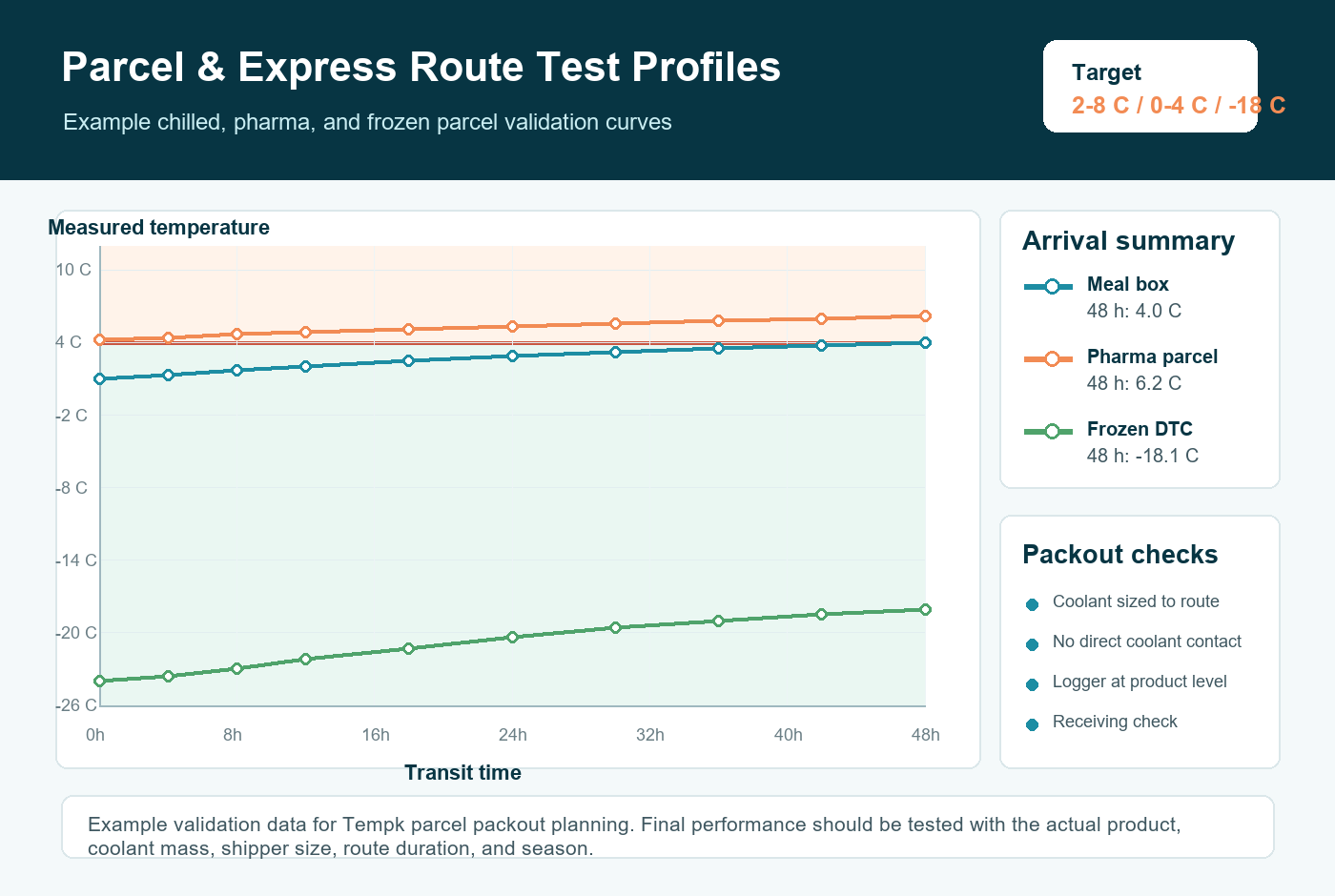
The same parcel lane can carry very different cold chain risks. Pharma parcels need a qualified temperature chamber and freeze protection, refrigerated meal boxes need clean arrival and food-safe chilling, while frozen DTC shipments need dry ice margin and customer-safe receiving. The category page should route buyers to the right product logic before they ask for a quotation.
Start from the product label, food safety target, or frozen receiving requirement, then select insulation and coolant.
Allow for sorting, turning, compression, warm vehicles, and customer receiving delay.
Conditioned PCM, gel packs, or dry ice should not press directly on sensitive products unless tested.
Temperature record, carton condition, moisture, product firmness, and remaining coolant should be clear at arrival.
High-Value Parcel Routes
Each page gives product-level packout scenarios, coolant starting ranges, placement rules, and receiving checks for a specific parcel program.
Qualified small-parcel packouts with conditioned PCM, freeze protection, product chamber separation, and logger placement.
View pharma parcel solution Chilled mealsFood parcel packouts focused on chilled holding, tray protection, condensation control, and clean unboxing.
View meal delivery solution Frozen DTCFrozen parcel packouts with dry ice planning, venting, retail pack protection, and customer receiving quality.
View frozen DTC solutionRoute Planning
A parcel packout should be designed around the route’s hottest dwell point, cold-source contact risk, product pressure tolerance, and the receiver’s decision criteria.
| Shipment type | Package direction | Coolant direction | What to verify |
|---|---|---|---|
| Chilled pharma parcel 2-8 C labelled product, receiver acceptance record required | Qualified EPS or EPP shipper, product chamber, PCM or conditioned coolant pockets, and logger position | Use conditioned PCM or gel packs with dividers; avoid direct frozen contact and document the product-level trace. | Warm excursion, freeze exposure, carton crush, logger placement, and receiver delay |
| Refrigerated meal box Chilled ready meals, sauces, produce, and customer unboxing | Insulated carton or EPS/EPP shipper, meal tray support, absorbent layer, liner, and coolant separation | Use gel packs or PCM sized for chilled food, with coolant away from delicate trays and labels. | Food temperature, condensation, tray leaks, label wet-out, carton strength, and doorstep dwell |
| Frozen DTC shipment Frozen consumer order, multi-item parcel, hard-frozen arrival | EPS/EPP shipper, dry ice chamber, vented outer carton, product dividers, liner, and logger when needed | Use dry ice or validated frozen coolant with separation and venting; leave enough remaining cold source at receipt. | Hard-frozen condition, remaining dry ice, package pressure, label rules, frost, and customer handling |
Supporting Parcel Guide
Fresh food subscription boxes sit between meal kits and chilled food parcels. Keep them as a supporting guide unless the product lane becomes a high-volume solution page.
Useful Internal Links
Share product type, required temperature range, payload weight, shipper size, courier service level, route duration, ambient range, and receiver checks. Tempk can help choose insulation, coolant layout, dividers, liners, and validation steps.
Request a parcel packout reviewParcel & Express Delivery shipments should not use one fixed box recipe for every product. Start with the required product temperature range, then separate products by heat load, packaging strength, and how they are received. For mixed programs, Tempk usually compares a short local route, an overnight parcel route, and the hottest expected season before confirming the shipper.
Use an insulated shipper with payload support, coolant separation, and receiving checks. The coolant plan should begin with gel packs, PCM, or dry ice selected by route time and product sensitivity. When the payload has delicate retail cartons, soft texture, live material, or medical documentation, protect the payload first and then add cooling capacity. If the shipment is delayed at packing, handoff, customs, or dock transfer, the route profile should be rechecked instead of only increasing coolant weight.
Validation should include logger evidence, packaging condition, and product quality after the actual route. A useful test records the warmest payload point, the coldest point near coolant, and the receiving condition after handling. This gives the operations team a practical packout instruction, not just a temperature chart.
Custom packout support
For fixed carton sizes, payload limits, branding requirements, seasonal lanes, or validation targets, Tempk can adapt this solution into a custom cold-chain packout.