


Customers notice texture damage
Frozen foods can refreeze and look hard while texture, shape, or quality has already changed.
Frozen DTC Shipments
Frozen DTC shipments need more than a cold source. The package should keep products hard frozen, separate dry ice from retail packs, allow gas to vent, protect labels and cartons, and make customer receiving safe and simple.
Product Risk
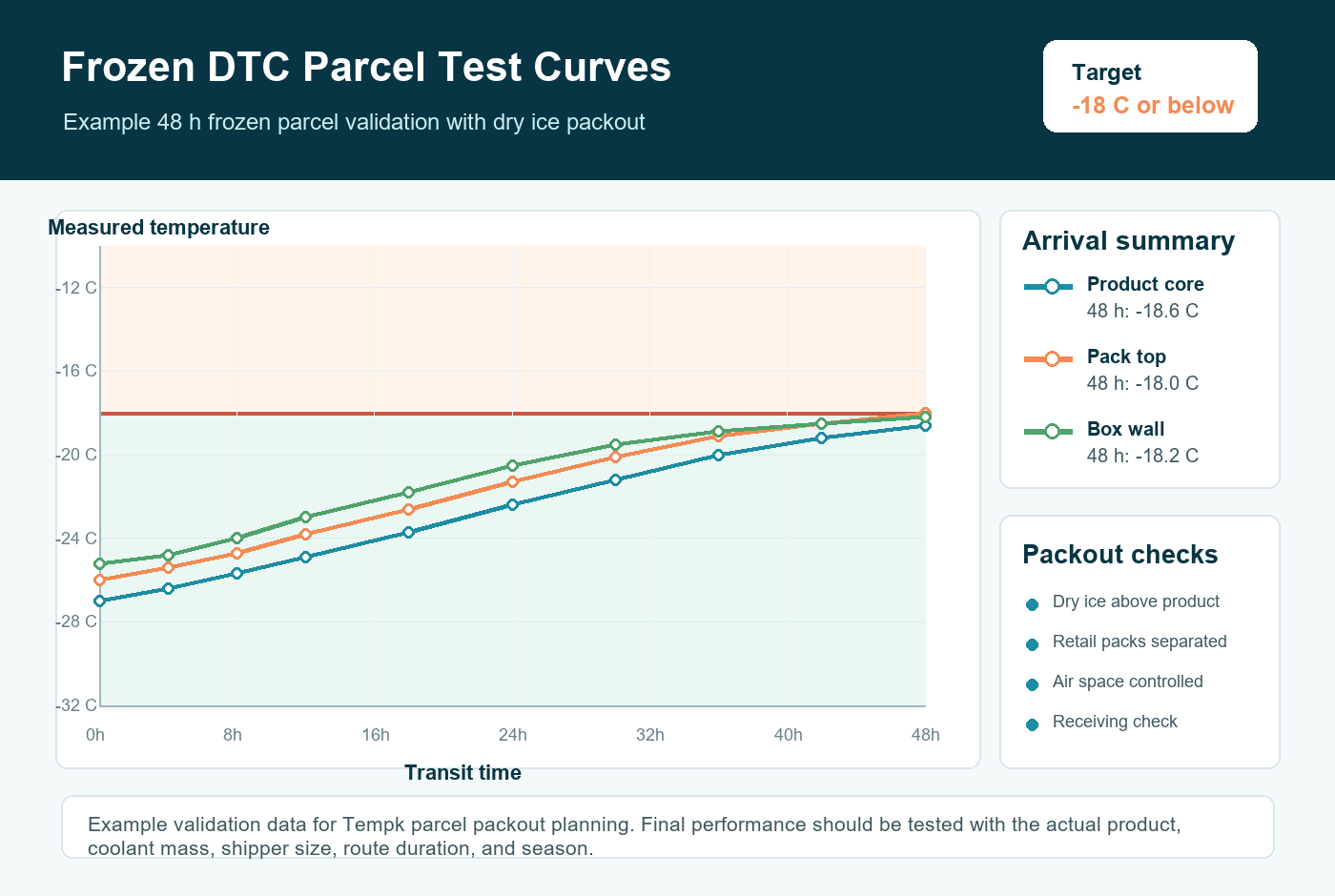
The right package has to protect the actual product and receiving decision, not only show a cold logger trace. These risks determine insulation, coolant choice, coolant position, inner support, and validation checks.
Frozen foods can refreeze and look hard while texture, shape, or quality has already changed.
Dry ice sublimates into gas and may require carrier-specific labeling and handling rules.
Frost, pressure, and wet cartons can damage labels and make the delivery look unsafe.
Boxes may include tubs, vacuum packs, trays, or pouches that respond differently to pressure and cold contact.
Route-Based Recommendation
These are practical starting points for sample planning. Final coolant mass, insulation thickness, and inner support should be validated with the actual payload, route, courier service, and receiving standard.
| Shipment condition | Recommended Tempk package | Starting coolant direction | Coolant position | What to validate |
|---|---|---|---|---|
| Same-day frozen delivery 8-18h route, ambient below 22 C, hard-frozen payload | EPS or EPP shipper, liner, product dividers, dry ice zone, and vented outer carton | About 1.5-2.5 kg dry ice for a 1-3 kg frozen payload as an initial test range. Use the dry ice calculator for actual route conditions. | Top or side dry ice zone with divider and headspace; keep dry ice away from fragile retail packs. | Hard-frozen condition, dry ice remaining, carton dryness, label condition, and customer-safe opening |
| Overnight DTC parcel 18-36h route, depot handling, ambient 22-30 C | Thicker EPS/EPP shipper, dry ice divider, fixed product rows, liner, logger, and strong outer carton | About 3.0-5.0 kg dry ice for a small parcel test. Adjust by product weight, box volume, insulation, route time, and carrier limits. | Top-plus-side dry ice layout with full divider coverage and vent path. | Peak temperature, dry ice remaining, product firmness, frost level, carton pressure, and retail pack condition |
| Hot-weather or delay-prone DTC route 30-35 C ambient, 36-48h risk, weekend hold possible | Higher-performance insulated shipper, larger dry ice chamber, reinforced carton, product dividers, and route logger | About 5.0-8.0 kg dry ice for extended small-parcel testing. Confirm headspace, venting, and carrier requirements before scaling. | Perimeter and top dry ice with dividers; avoid direct contact with labels, pouches, or fragile trays. | Delayed receiving condition, remaining dry ice, thaw evidence, carton wet-out, and customer handling clarity |
Coolant mass is a starting point, not a guarantee. Adjust by product temperature at packing, payload weight, shipper size, insulation material, coolant conditioning, route duration, ambient profile, carrier handling, and receiving checks. More coolant can create freezing, pressure damage, wet packaging, or unsafe dry ice handling when separation and instructions are wrong.
Packout Structure
Parcel packouts need product support, coolant separation, and receiving clarity before the shipper is closed. Start with the payload and acceptance criteria, then size insulation and coolant.
Packing Process
A stronger shipper helps, but loading condition, coolant separation, inner support, and receiving instructions usually decide whether the parcel is accepted.
Do not pack soft product and expect dry ice to restore quality.
Separate tubs, pouches, trays, or cartons so heavy items do not crush fragile packs.
Create a dry ice zone with dividers, headspace, and a safe gas path.
Inspect remaining dry ice, product hardness, frost, label condition, and clarity of handling instructions.
When to Change the Design
Improve dividers, liner, carton strength, and dry ice separation before changing dry ice mass.
Increase insulation margin, adjust dry ice mass, reduce route time, or change shipper size.
Improve dry ice warning, handling instructions, venting, and separation from retail packs.
Related Resources
Share product mix, frozen target, payload weight, box size, route time, ambient range, carrier mode, and customer receiving requirements. Tempk can help choose dry ice mass, insulation, dividers, venting, and validation steps.
Request a parcel packout reviewCustom packout support
For fixed carton sizes, payload limits, branding requirements, seasonal lanes, or validation targets, Tempk can adapt this solution into a custom cold-chain packout.