


Estimate coolant mass
Use payload weight, route time, box size, and seasonal ambient temperature before ordering the first test packout.
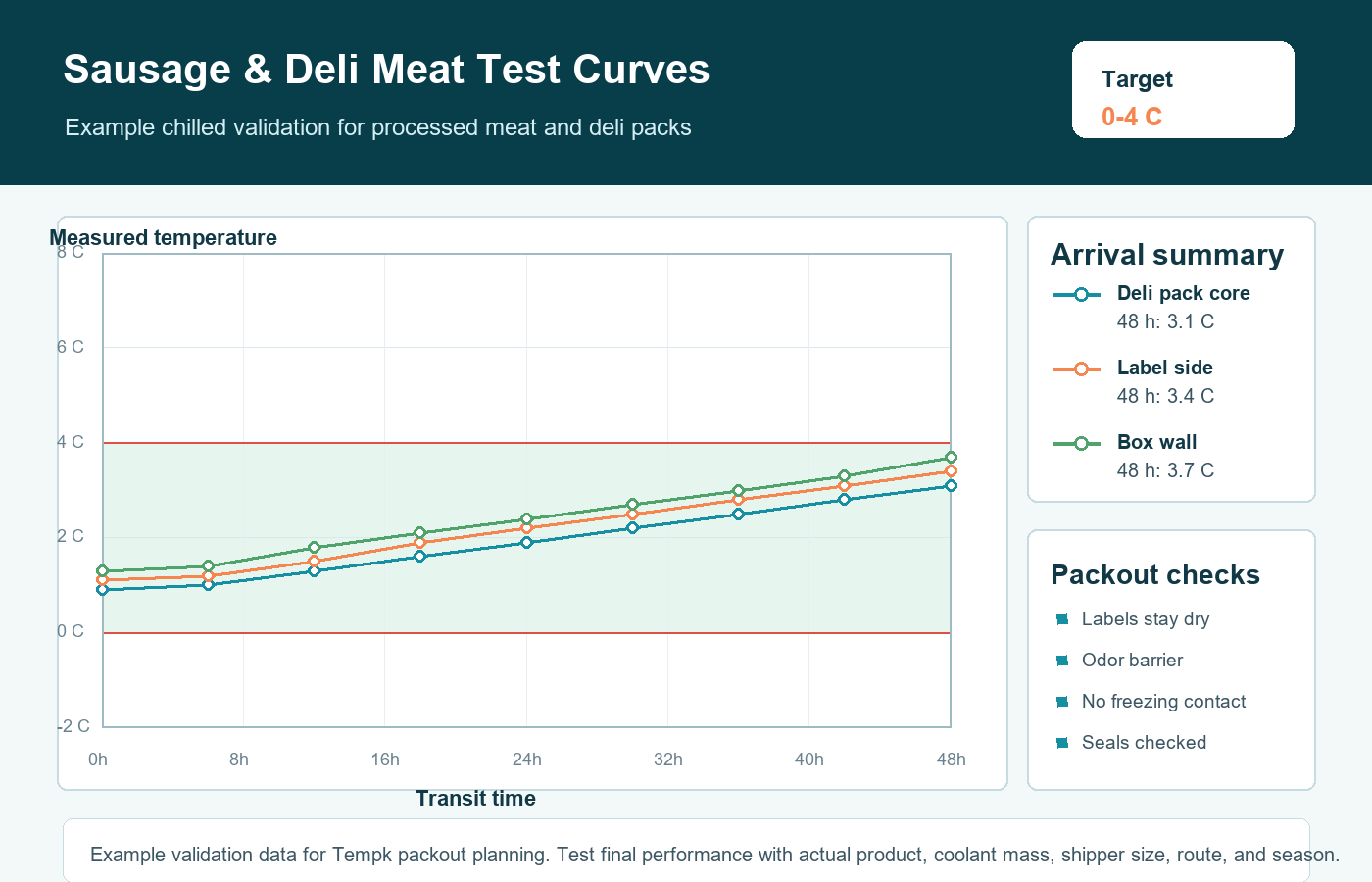
Sausages and deli meats are usually sold in branded retail packs, trays, chubs, or sliced packs. The packout must keep the product at 0-4 C, avoid surface freezing, protect labels from condensation, and prevent odor transfer inside the shipper.
The coolant amounts below are starting ranges for planning. Final packout should be validated with the exact payload, box size, carrier lane, and season.
| Route condition | Temperature intent | Tempk packaging setup | Coolant planning range | Coolant position |
|---|---|---|---|---|
| Retail pack delivery, 8-18 h | 0-4 C chilled | Insulated carton or EPP box, pouch or tray packs, condensation barrier, light void fill. | 0.6-1.2 kg conditioned gel packs or 0 C PCM for 1-4 kg payload. | Side coolant with divider; keep labels away from direct wet contact. |
| Overnight deli meat route, 18-36 h | 0-4 C with label protection | Thicker insulation, sealed liner, absorbent or humidity-control layer, logger in product air space. | 1.2-2.2 kg gel packs or PCM for 1-4 kg payload. | Use side and top coolant separated from retail packs; avoid crushing sliced packs. |
| Hot weather or delay risk, 36-48 h | Validated chilled lane | Higher insulation, reduced headspace, stronger carton, route risk check. | 2.2-3.6 kg gel packs or PCM for 1-4 kg payload. | If labels wrinkle or packs sweat, improve barrier layout before adding more coolant. |
For a tighter first estimate, use the Ice Pack Calculator. If the route is frozen, compare with the Dry Ice Calculator before testing.
The right sequence reduces warm dwell, leakage, coolant contact, and pack damage before the box reaches the receiver.
The route must hold temperature and still deliver a clean retail pack with readable labels.
Use a liner, divider, or absorbent layer so cold gel packs do not create wet label contact.
Keep smoked, cured, or strongly seasoned products sealed and separated from mixed grocery items.
Check temperature, label readability, condensation, odor, pack swelling, and any freeze damage.
Use these receiving checks when deciding whether to adjust coolant mass, liner structure, or insulation thickness.
Use the product page for the handling logic, then size the first trial with tools and validate the real route.
Use payload weight, route time, box size, and seasonal ambient temperature before ordering the first test packout.
Compare conditioned gel packs, 0 C PCM, and frozen-route dry ice logic before changing insulation size.
Review pickup dwell, last-mile delay, receiving window, and season before launching a meat route.
Share the product form, chilled or frozen target, payload weight, box size, route duration, season, and receiving checks. Tempk can help choose insulation, coolant mass, liner structure, and validation steps.
Custom packout support
For fixed carton sizes, payload limits, branding requirements, seasonal lanes, or validation targets, Tempk can adapt this solution into a custom cold-chain packout.