


Temperature intentPlan around 0-4 C or the product label requirement, with pre-chilled meals loaded quickly into the shipper.
Chilled Ready Meals Cold Chain Packaging Solution
Chilled ready meals often combine trays, sealed films, sauce compartments, sleeves, labels, and sometimes mixed protein or vegetable components. The packout needs reliable 0-4 C control without flexing trays, creating wet sleeves, or pressing frozen gel packs against the film lid.
What the package needs to control
Coolant ruleUse conditioned gel packs or 0 C PCM around the tray stack, separated by a spacer so the top tray is not pressed by frozen packs.
Packaging focusTray support, sauce control, label dryness, and consistent stacking are as important as the temperature curve.
Choose the packout by route condition
| Route condition | Packaging setup | Preliminary coolant range | Placement and receiving check |
|---|---|---|---|
| Local delivery, 4-8 h | Insulated carton or small EPP box, snug tray insert, liner, side gel packs. | 0.4-0.9 kg gel packs or PCM for a 1-3 kg payload. | Keep trays flat; place coolant on sides instead of directly on film lids. |
| Same-day or overnight, 8-24 h | EPP or insulated carton, tray divider, leak liner, top and side coolant with spacer. | 0.9-2.0 kg gel packs or PCM for a 2-5 kg payload. | Check meal core temperature, sauce cup seal, sleeve dryness, and tray movement. |
| Warm route or possible delay, 24-36 h | Thicker insulation, balanced side/top coolant, stronger tray support, absorbent layer. | 2.0-3.4 kg gel packs or PCM for a 2-5 kg payload, route tested before launch. | If sleeves get wet, improve liner and spacing before simply adding more coolant. |
Use these ranges as a starting point for packaging review. Confirm the final coolant mass with the product label, pre-chill state, shipper size, route duration, ambient profile, and a temperature logger test.
How Tempk would build the shipment
Pre-chill the meals and shipper area
Load chilled meals quickly so the coolant is maintaining temperature, not trying to pull down a warm tray stack.
Support the tray stack
Use a snug inner carton, paperboard divider, or molded insert so trays do not flex or rub during courier handling.
Separate coolant from film lids
Gel packs should cool the payload cavity without pressing directly on the top tray or freezing sauce areas.
Inspect quality, not just temperature
At receiving, record temperature, tray cracks, sauce leakage, sleeve dryness, label condition, and remaining coolant.
Common failure points to prevent
For prepared foods, a cold arrival is only part of the decision. The shipment also needs to look clean, stay dry, protect texture, and pass the receiver’s quality check.
- Tray seal failure or cracked corners from pressure.
- Sauce migration after side handling or vibration.
- Wet sleeves and unreadable labels from condensation.
- Cold spots where frozen gel packs touch the top tray.
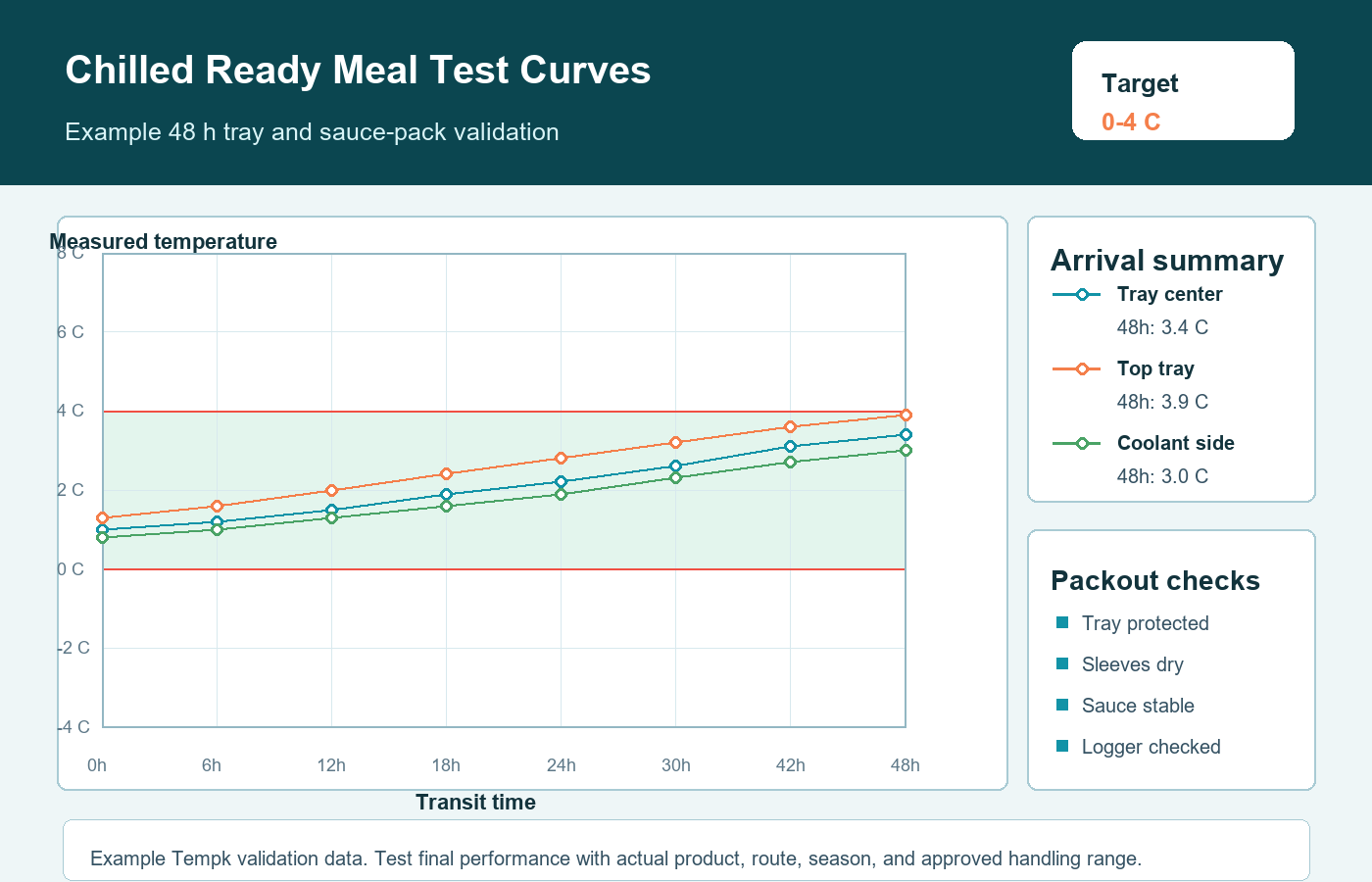
Validation curve and receiving evidence
Review the curve with the actual product, coolant mass, shipper size, lane duration, and season. Add arrival photos and receiving notes so the packout is judged by temperature and product condition together.
Related pages for packout planning
Practical route notes
Pack chilled ready meals by tray seal and sauce behavior
Chilled ready meals are often tray-sealed and sauce-heavy. The packaging should protect seals, prevent tray cracks, and keep the meal within the intended chilled serving shelf life.
Where this product usually fails
Common failures include sauce leakage, film lift, tray cracks, swollen packs, and cartons weakened by condensation.
Packaging setup to test first
Stack meals flat with corner support and a liner. Place chilled gel packs above and beside the stack with a divider so hard packs do not dent films.
Coolant choice
Use 0 C or chilled gel packs for short chilled routes. PCM can help when ready meals travel through warm urban delivery windows.
Route validation check
Check film seals, tray corners, sauce movement, and arrival temperature. The lightest meal should be used as the warmest-case sample.
Packout detail
Ready meal packaging should start with the weakest tray
Use case
For chilled ready meals, the weakest point is often the film seal or tray corner, not the insulation. A good test packout includes the lightest tray, the most liquid meal, and any paper sleeve that may soften during transit.
Packaging choice
Use chilled gel packs around the stack with a divider over the top tray. If the meal includes sauce, add a leak liner and avoid heavy coolant directly over film seals.
What Tempk should validate
Tempk can size a short route and an extended route version. The receiving check should include center temperature, film lift, tray cracks, sauce movement, sleeve moisture, and carton condition.
Custom packout support
Need this lane built around your product and route?
For fixed carton sizes, payload limits, branding requirements, seasonal lanes, or validation targets, Tempk can adapt this solution into a custom cold-chain packout.
Need this prepared food route checked before shipment?
Send the product format, target temperature, payload size, package dimensions, route duration, ambient condition, and receiving standard. Tempk can help compare insulation, gel pack or PCM layout, liners, dividers, and validation steps.
Request a packout review