


Chilled Ready Meals
Meal trays need 0-4 C protection without cracked seals, sauce migration, wet sleeves, or gel-pack pressure on the film lid.
Prepared foods need more than a cold box. The packout has to hold 0-4 C, protect trays and labels, control condensation, avoid direct freeze damage, and keep the product ready for retail, vending, meal delivery, or catering handoff.
Chilled ready meals, salads, and sandwiches share a refrigerated target, but they do not fail the same way. A useful Tempk packout starts with the food format, then adjusts insulation, gel pack mass, liner choice, divider position, and receiving checks.
Meal trays need 0-4 C protection without cracked seals, sauce migration, wet sleeves, or gel-pack pressure on the film lid.
Salads need chilled handling with low pressure, humidity control, dressing separation, and no direct frozen gel contact on leaves.
Sandwiches and wraps need cold filling control while protecting bread, paper wraps, labels, and stacked presentation.
| Product route | Temperature intent | Packaging setup | Preliminary coolant range | Check at receiving |
|---|---|---|---|---|
| Chilled ready meals, 8-24 h | 0-4 C, avoid frozen spots on trays and sauce cups. | Insulated carton or EPP box, snug tray insert, leak liner, conditioned gel packs or 0 C PCM on sides/top with a spacer. | About 0.8-2.0 kg gel packs or PCM for a 2-5 kg meal payload, adjusted by route and season. | Meal core temperature, tray seal, sauce leakage, sleeve dryness, gel pack movement. |
| Ready-to-eat salads, 6-18 h | 0-4 C or label-defined chilled range, while avoiding leaf freeze and excess moisture. | Low-pressure carton, clamshell support, absorbent or moisture-control liner, side coolant separated from leaves. | About 0.6-1.5 kg conditioned gel packs or 5 C PCM for a 1-3 kg salad payload. | Leaf bruising, frozen edges, condensation, dressing cup leakage, clamshell crush. |
| Sandwiches and wraps, 6-24 h | 0-4 C for fillings, with bread and wrap texture protected from condensation. | Insulated carton, inner tray or stack divider, moisture barrier, coolant on sides/top but not pressed into bread. | About 0.7-1.8 kg gel packs or PCM for a 1.5-4 kg payload; use more insulation for warm urban routes. | Bread sogginess, filling temperature, wrap shape, paper label condition, remaining coolant. |
These are planning ranges for packaging review. Final coolant mass should be checked with real product, pre-chill condition, shipper size, ambient profile, route time, and the receiving temperature standard.
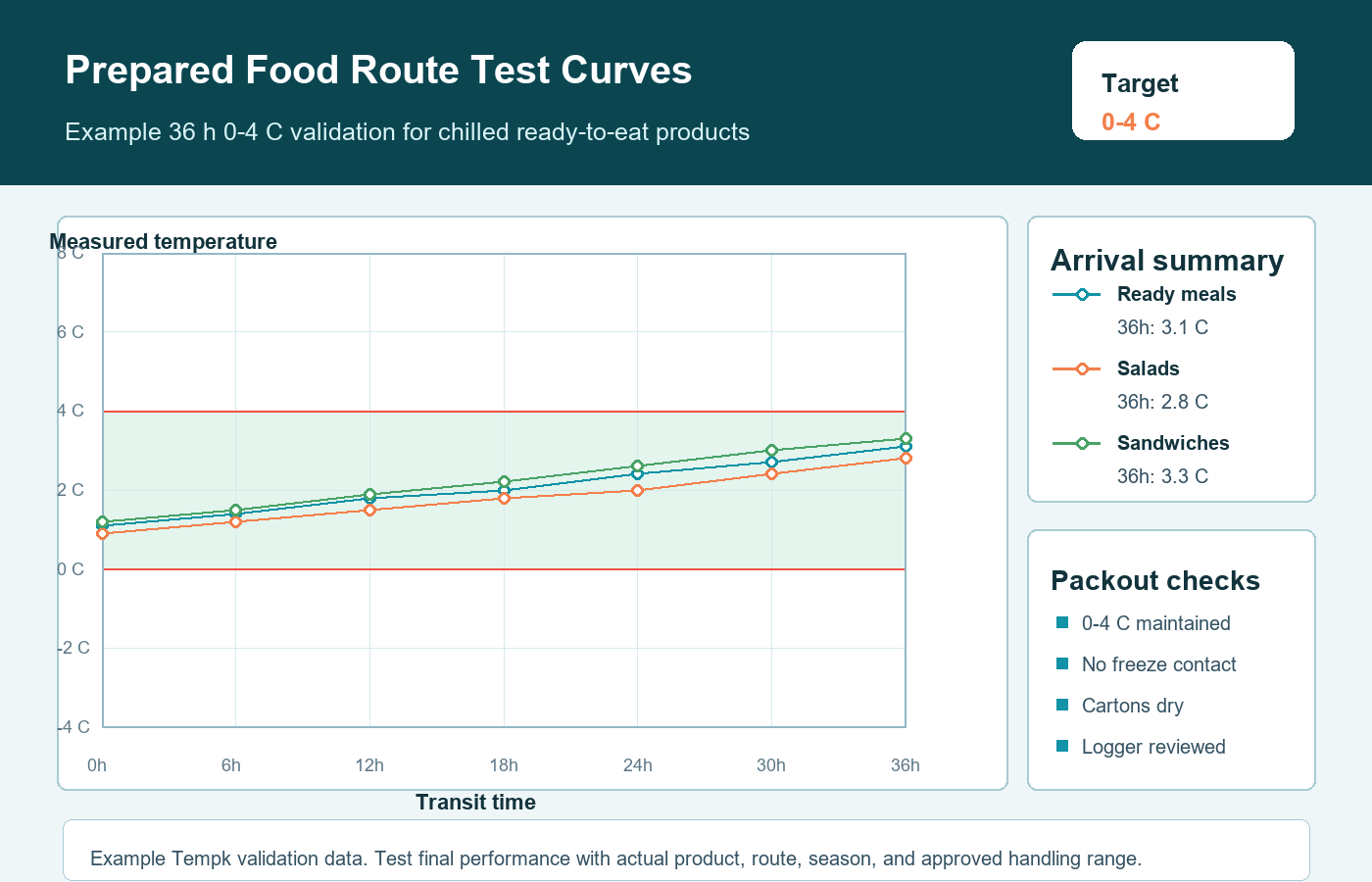
Use the validation curve with product inspection notes. A prepared food shipment can hold temperature but still fail because of wet packaging, crushed trays, wilted leaves, or poor presentation.
These articles support related product lanes without making the solution structure hard to maintain.
Use this guide when the product needs a focused packout note without creating another dedicated solution page.
Use this guide when the product needs a focused packout note without creating another dedicated solution page.
Use this guide when the product needs a focused packout note without creating another dedicated solution page.
Use these pages when route time, ambient condition, or coolant selection needs a quick check before the validation run.
Prepared Foods shipments should not use one fixed box recipe for every product. Start with 0-4 C chilled control for ready-to-eat meals, salads, sandwiches, and wraps, then separate products by heat load, packaging strength, and how they are received. For mixed programs, Tempk usually compares a short local route, an overnight parcel route, and the hottest expected season before confirming the shipper.
Use insulated cartons or liners with leak control, condensation management, and meal-pack support. The coolant plan should begin with conditioned gel packs or chilled PCM placed to remove heat without crushing the food pack. When the payload has delicate retail cartons, soft texture, live material, or medical documentation, protect the payload first and then add cooling capacity. If the shipment is delayed at packing, handoff, customs, or dock transfer, the route profile should be rechecked instead of only increasing coolant weight.
Validation should include check product texture, seal integrity, moisture, and final temperature after the real route. A useful test records the warmest payload point, the coldest point near coolant, and the receiving condition after handling. This gives the operations team a practical packout instruction, not just a temperature chart.
Custom packout support
For fixed carton sizes, payload limits, branding requirements, seasonal lanes, or validation targets, Tempk can adapt this solution into a custom cold-chain packout.
Share the food type, target temperature, payload size, tray or clamshell dimensions, route duration, ambient condition, and receiving checks. Tempk can help compare insulation, gel pack or PCM layout, liners, inserts, and the validation plan.
Request a packout review