


Temperature intentPlan around 0-4 C or the product label requirement, with salads pre-chilled and packed dry.
Ready-to-Eat Salads Cold Chain Packaging Solution
Ready-to-eat salads are sensitive to leaf bruising, condensation, dressing leaks, and direct freeze contact. The packout should hold a chilled route while keeping leaves crisp, clamshells intact, and dressing cups separated from the cold source.
What the package needs to control
Coolant ruleUse conditioned gel packs or 5 C PCM on the sides or above a spacer. Avoid direct frozen contact on leaves or clamshell tops.
Packaging focusLow pressure, humidity balance, dressing separation, and clean clamshell presentation drive acceptance.
Choose the packout by route condition
| Route condition | Packaging setup | Preliminary coolant range | Placement and receiving check |
|---|---|---|---|
| Local route, 4-8 h | Insulated carton, clamshell support, side coolant, dry liner. | 0.4-0.8 kg conditioned gel packs or PCM for a 1-2 kg payload. | Check leaf texture, dressing cup seal, and condensation on the clamshell. |
| Same-day route, 8-18 h | EPP or insulated carton, low-pressure stack divider, side/top coolant with spacer. | 0.8-1.6 kg conditioned gel packs or 5 C PCM for a 1-3 kg payload. | Avoid direct gel pack pressure on greens; inspect frozen leaf edges. |
| Warm city route, 18-24 h | Thicker insulation, moisture-control liner, balanced coolant around payload cavity. | 1.6-2.6 kg PCM or conditioned gel packs, adjusted by route testing. | If leaves wilt or freeze, adjust coolant temperature and spacing before increasing mass. |
Use these ranges as a starting point for packaging review. Confirm the final coolant mass with the product label, pre-chill state, shipper size, route duration, ambient profile, and a temperature logger test.
How Tempk would build the shipment
Pack salads cold and dry
Moist leaves and warm clamshells create condensation quickly. Pre-chill the product and avoid loading wet outer packaging.
Protect the clamshell stack
Use dividers or an inner tray so heavy coolant does not crush lids or bruise leaves.
Choose a gentler coolant layout
A 5 C PCM or conditioned gel pack can be better than a colder frozen pack when leaf freeze is the key risk.
Inspect texture at receiving
Record product temperature, leaf bruising, frozen edges, dressing leakage, clamshell cracks, and label dryness.
Common failure points to prevent
For prepared foods, a cold arrival is only part of the decision. The shipment also needs to look clean, stay dry, protect texture, and pass the receiver’s quality check.
- Frozen leaf edges from direct gel pack contact.
- Wilted greens after warm handoff or insufficient insulation.
- Dressing cup leakage during side handling.
- Clamshell crush, wet labels, or customer-facing condensation.
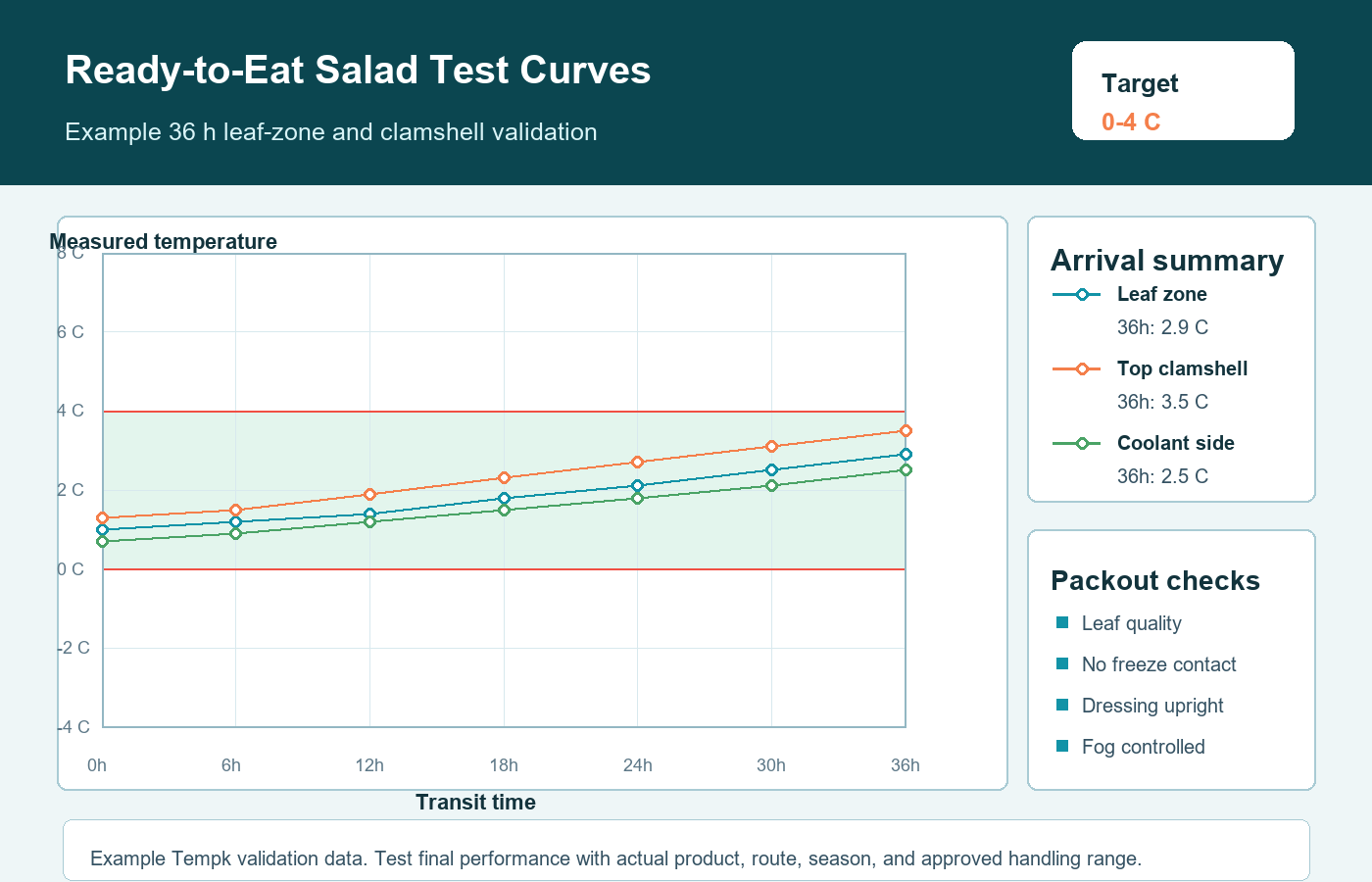
Validation curve and receiving evidence
Review the curve with the actual product, coolant mass, shipper size, lane duration, and season. Add arrival photos and receiving notes so the packout is judged by temperature and product condition together.
Related pages for packout planning
Practical route notes
Keep salads crisp without freezing leafy edges
Ready-to-eat salads need chill, ventilation, and protection from direct cold spots. Too much cold contact can damage leafy edges even when the overall pack looks acceptable.
Where this product usually fails
Leaf wilting, edge freeze, dressing leaks, wet labels, and crushed bowls are the main quality failures.
Packaging setup to test first
Use rigid salad bowls or clamshells with void control. Place gel packs around a divider and keep dressing cups upright and separated from leafy greens.
Coolant choice
Chilled gel packs are typically safer than frozen packs in direct contact. Use PCM when the route has high summer exposure or uncertain delivery dwell.
Route validation check
Inspect leaf texture, dressing cup seals, clamshell lids, and free water in the pack. A salad packout should include a visual freshness check.
Packout detail
Salad boxes need cold protection without leaf freeze
Use case
Ready-to-eat salads can be damaged by direct frozen-pack contact. Leafy edges may freeze while the center of the bowl stays within range, so coolant should be separated by a divider or placed in side channels.
Packaging choice
Keep dressing cups upright and away from leaves. If the route includes warm final-mile delivery, increase insulation or use PCM rather than pressing colder gel packs against the salad bowls.
What Tempk should validate
For Tempk testing, provide bowl size, greens mix, dressing cup position, pack count, and route duration. Check leaf crispness, edge freeze, free water, lid security, label dryness, and arrival temperature. For meal delivery or office catering, add a short post-delivery hold in the validation because salads often wait before being opened.
Custom packout support
Need this lane built around your product and route?
For fixed carton sizes, payload limits, branding requirements, seasonal lanes, or validation targets, Tempk can adapt this solution into a custom cold-chain packout.
Need this prepared food route checked before shipment?
Send the product format, target temperature, payload size, package dimensions, route duration, ambient condition, and receiving standard. Tempk can help compare insulation, gel pack or PCM layout, liners, dividers, and validation steps.
Request a packout review