


Temperature intentFollow the product label. FDA notes common insulin refrigerator storage around 36-46 F, about 2-8 C, and warns against freezing.
Insulin Pens Cold Chain Packaging Solution
Insulin pen shipments are small payloads, so the packout must avoid both heat exposure and overcooling from direct gel-pack contact. The goal is a product-label-first refrigerated route with protected cartons, stable pen position, and a clear temperature record at receiving.
What the package needs to control
Coolant ruleUse conditioned gel packs or 5 C PCM with a spacer. Keep pens and cartons away from direct frozen surfaces.
Packaging focusSmall payloads overcool easily, so carton support, buffer layers, label dryness, and logger placement are critical.
Choose the packout by route condition
| Route condition | Packaging setup | Preliminary coolant range | Placement and receiving check |
|---|---|---|---|
| Local pharmacy handoff, 4-8 h | Small insulated carton, pen carton in center, side coolant with paperboard spacer. | 0.3-0.7 kg conditioned gel packs or PCM for a 0.5-2 L payload. | Check no direct coolant contact and move into storage quickly. |
| DTC or courier parcel, 8-24 h | EPP or insulated carton, center payload cavity, conditioned side/top coolant, dry document sleeve. | 0.7-1.6 kg conditioned gel packs or PCM for a 0.5-3 L payload. | Check logger min/max, carton dryness, label clarity, and pen movement. |
| Warm route or possible delay, 24-36 h | Thicker insulation, balanced coolant, larger buffer zone, logger near product cavity. | 1.6-2.8 kg conditioned gel packs or PCM, validated before scaling. | If minimum temperature approaches freezing, add buffer or choose warmer PCM before adding more coolant. |
Use these ranges as a starting point for packaging review. Confirm the final coolant mass with the approved label, payload count, shipper size, route duration, ambient profile, logger placement, and internal quality procedure.
How Tempk would build the shipment
Load from the labeled storage condition
Start with the product label and pre-condition the shipper and coolant so the package maintains the range instead of correcting a warm payload.
Build a center cavity
Keep the pen cartons away from shipper walls and away from gel packs by using paperboard, foam, or molded inserts.
Control cold spots
Place the logger near the payload, not against coolant, and review the minimum temperature as carefully as the maximum.
Protect pharmacy paperwork and labels
Use a dry sleeve or outer document area so condensation does not damage labels, lot information, or patient-facing documents.
Common failure points to prevent
For medicine parcels, a cold-feeling package is not enough. The receiver needs a documented shipment that stayed inside the required range and protected the product package.
- Sub-zero exposure caused by direct frozen gel contact.
- Warm delivery after porch dwell or delayed handoff.
- Wet labels or cartons from condensation.
- Pen cartons moving inside an oversized shipper.
Validation curve and receiving evidence
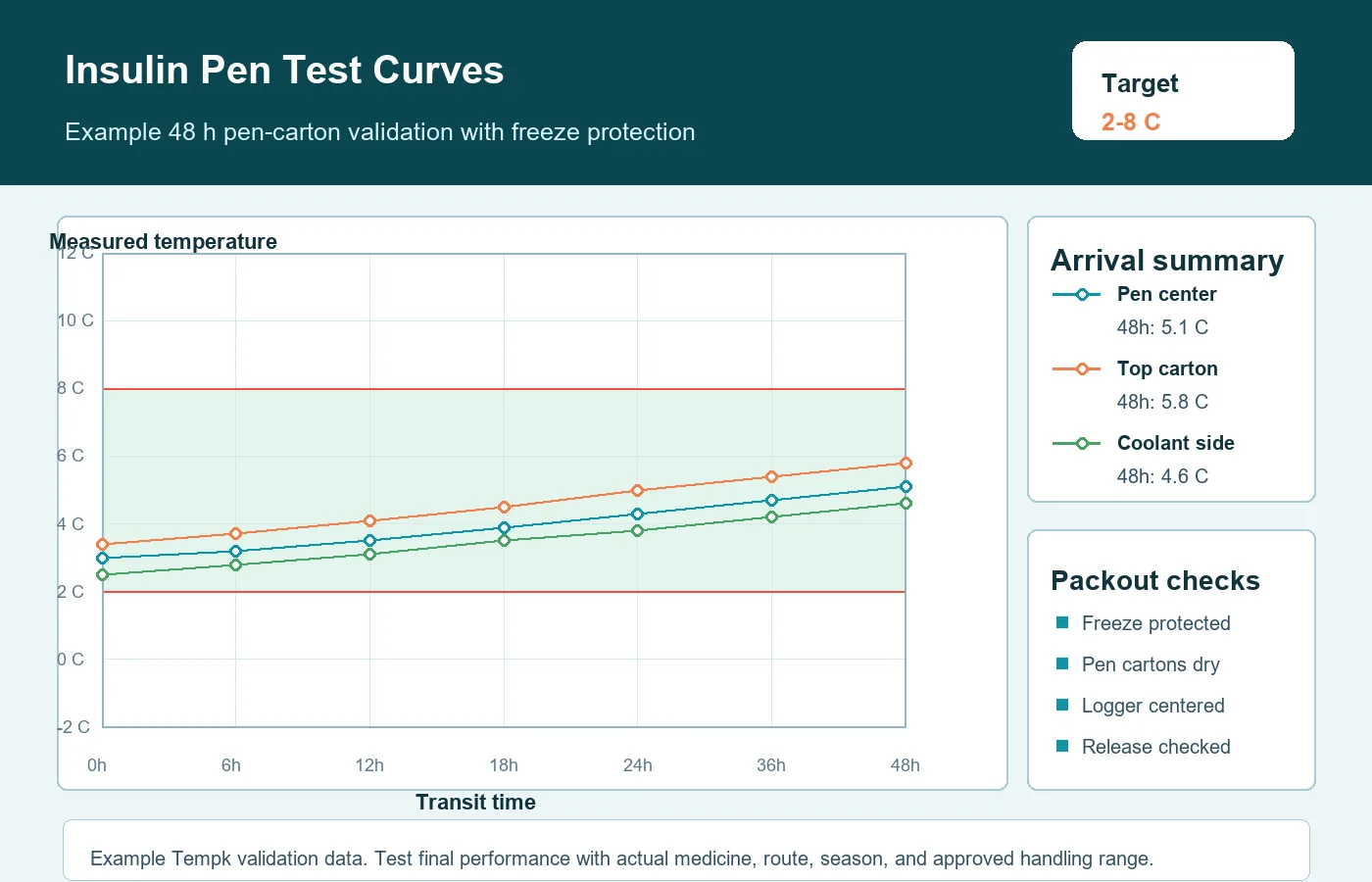
Review the curve with the actual payload, coolant mass, shipper size, lane duration, and season. Add receiving notes for carton condition, label clarity, product movement, and any direct coolant contact.
Related pages for packout planning
Practical route notes
Protect insulin pens from both heat and freezing
Insulin pens are usually shipped as patient-ready cartons. The packout should hold the labeled refrigerated range while preventing frozen gel packs from creating cold spots against the pen carton.
Where this product usually fails
The main risks are freeze exposure, delayed residential delivery, carton crush, and patients receiving a wet or confusing package.
Packaging setup to test first
Use a small payload sleeve or carton cavity with a clear buffer on each coolant-facing side. Add void fill so pen cartons cannot rattle against hard packs.
Coolant choice
Use 2 to 8 C PCM or carefully conditioned gel packs for overnight and two-day routes. Avoid dry ice and avoid unconditioned frozen packs beside insulin cartons.
Route validation check
Test hot and cold seasons separately. Place the logger beside the pen carton and check minimum temperature, carton dryness, and patient opening experience.
Packout detail
Insulin pen parcels need patient-safe instructions
Use case
Insulin pens are often shipped to homes, so the packaging has to protect the product and make the patient confident at opening. The payload should be clean, dry, and separated from coolant by a visible buffer.
Packaging choice
For overnight or two-day lanes, use 2 to 8 C PCM or conditioned gel packs in a validated layout. Avoid dry ice and avoid direct frozen-pack contact because freezing can be more damaging than a short mild warm exposure.
What Tempk should validate
Tempk should test the actual pen carton count, smallest payload, largest payload, and residential dwell. Review minimum temperature, maximum temperature, carton dryness, and whether the instructions are easy to follow.
Custom packout support
Need this lane built around your product and route?
For fixed carton sizes, payload limits, branding requirements, seasonal lanes, or validation targets, Tempk can adapt this solution into a custom cold-chain packout.
Need this medicine route checked before shipment?
Send the product label temperature, payload size, carton dimensions, service level, ambient condition, delivery handoff, and logger requirement. Tempk can help compare insulation, conditioned gel packs, PCM, buffer layers, inserts, and validation steps.
Request a packout review