


Insulin Pens
Insulin pen shipments need product-label-first refrigerated handling, no freezing, protected cartons, and simple receiving evidence for pharmacy or home delivery.
Temperature-sensitive medicines should be planned from the product label outward. For many refrigerated medicines, the package must protect a 2-8 C route, prevent freezing, support small cartons or pens, protect labels, and make the receiving temperature record easy to review.
Medicine parcels are often small, so a few frozen gel packs can overcool the payload if they touch the carton. Tempk designs the shipper around conditioned coolant, PCM choice, buffer layers, pen or vial support, route duration, and the receiving evidence the pharmacy, clinic, or patient service needs.
Insulin pen shipments need product-label-first refrigerated handling, no freezing, protected cartons, and simple receiving evidence for pharmacy or home delivery.
GLP-1 pens are small, high-value parcels where direct gel-pack contact, delivery dwell, and carton crush can become bigger risks than gross shipper temperature.
Fertility injection shipments need careful vial or syringe support, 2-8 C control, no freeze exposure, and clear handoff timing for clinic or patient delivery.
| Product route | Temperature intent | Packaging setup | Preliminary coolant range | Check at receiving |
|---|---|---|---|---|
| Insulin pen pharmacy or DTC parcel, 8-24 h | Use product label requirements; commonly refrigerated 2-8 C and avoid freezing. | Small EPP or insulated carton, pen cartons in a center cavity, conditioned gel packs or 5 C PCM separated by spacer board. | About 0.6-1.6 kg conditioned gel packs or PCM for a 0.5-3 L medicine payload. | Logger minimum and maximum, carton dryness, pen movement, label clarity, and delivery dwell. |
| GLP-1 pen home-delivery parcel, 12-36 h | Product-label-first 2-8 C route with strong freeze prevention for small payloads. | Rigid inner tray, label/document sleeve, center payload cavity, conditioned coolant on sides/top with buffer layer. | About 0.8-2.4 kg conditioned gel packs or PCM for a 0.5-3 L payload, adjusted by route and season. | Minimum temperature, carton crush, direct coolant contact, porch dwell, and remaining coolant state. |
| Fertility injection clinic or patient delivery, 8-24 h | Usually planned around 2-8 C when the product label requires refrigeration; protect from freezing and shock. | Vial or syringe support, upright/divider insert where needed, insulated carton or EPP shipper, conditioned coolant separated from product. | About 0.5-1.8 kg conditioned gel packs or PCM for small vial or syringe payloads. | Handoff time, logger record, vial/syringe support, carton condition, and any sub-zero risk. |
These are planning ranges for packaging discussion, not medicine release criteria. Final packout should follow the approved label, shipper size, payload count, lane duration, ambient profile, monitoring requirement, and internal quality procedure.
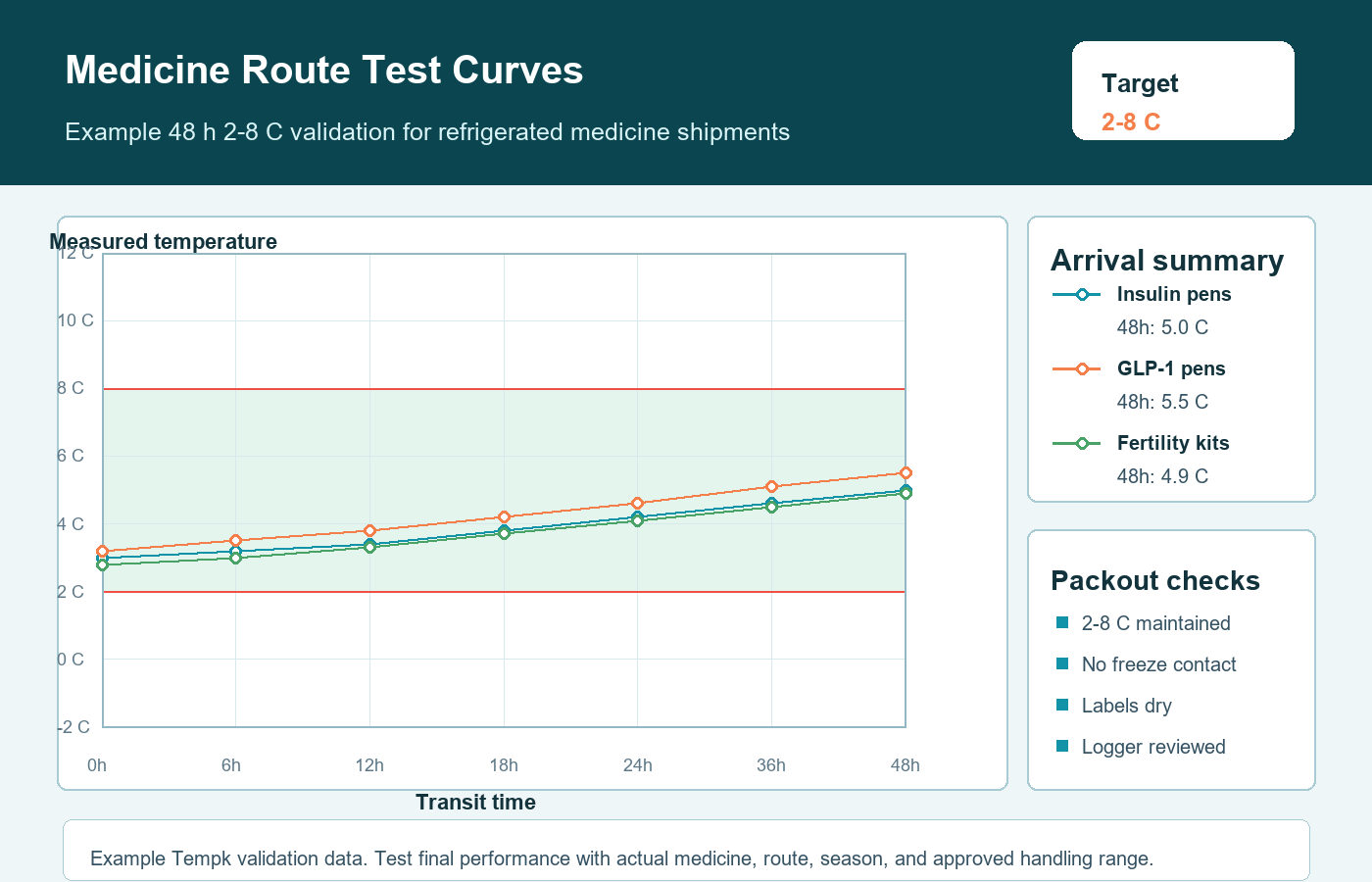
Use the validation curve with receiving notes. For medicine shipments, the minimum temperature and direct coolant contact risk can matter as much as the final arrival temperature.
These articles support related medicine lanes while keeping the solution structure manageable.
Use this guide for a focused medicine packout reference without adding another dedicated solution page.
Use this guide for a focused medicine packout reference without adding another dedicated solution page.
Use this guide for a focused medicine packout reference without adding another dedicated solution page.
Use this guide for a focused medicine packout reference without adding another dedicated solution page.
Use these pages to compare coolant choice, route risk, and insulation before the validation run.
Medicines shipments should not use one fixed box recipe for every product. Start with 2-8 C control for refrigerated medicines, with controlled room temperature alternatives only when the label allows, then separate products by heat load, packaging strength, and how they are received. For mixed programs, Tempk usually compares a short local route, an overnight parcel route, and the hottest expected season before confirming the shipper.
Use qualified parcel shipper, spacer system, tamper-aware closure, and logger-supported handoff. The coolant plan should begin with pharma-grade gel packs or PCM selected to avoid both warm excursions and freeze exposure. When the payload has delicate retail cartons, soft texture, live material, or medical documentation, protect the payload first and then add cooling capacity. If the shipment is delayed at packing, handoff, customs, or dock transfer, the route profile should be rechecked instead of only increasing coolant weight.
Validation should include check minimum and maximum temperature, patient delivery time, and carton condition at receipt. A useful test records the warmest payload point, the coldest point near coolant, and the receiving condition after handling. This gives the operations team a practical packout instruction, not just a temperature chart.
Custom packout support
For fixed carton sizes, payload limits, branding requirements, seasonal lanes, or validation targets, Tempk can adapt this solution into a custom cold-chain packout.
Share the product label temperature, payload count, carton dimensions, route duration, ambient condition, delivery handoff, and receiving checks. Tempk can help compare insulation, conditioned gel packs, PCM, buffer layers, inserts, and logger placement.
Request a packout review