


Vitamin C Serum
Control summer heat, reduce light exposure, protect glass bottles and droppers, and keep labels dry without placing frozen gel packs directly against the product.
Premium skincare shipments are not only about staying cool. Vitamin C serum, retinol cream, probiotic skincare, and preservative-free formulas can be affected by heat spikes, sunlight, condensation, cap leakage, label damage, and direct cold contact. Tempk builds the packout around the formula risk, the retail package, the route, and the way your customer receives the parcel.
A cosmetic carton may be small, but the risk is often very specific. A glass serum bottle needs different protection from a cream jar or a probiotic skincare tube. These product pages show how Tempk adjusts coolant, insulation, buffer layers, and receiving checks for each route.
Control summer heat, reduce light exposure, protect glass bottles and droppers, and keep labels dry without placing frozen gel packs directly against the product.
Protect active-positioning skincare from heat and light while keeping jars, tubes, cartons, and cream texture stable during parcel handling.
Match the brand storage requirement, manage humidity and condensation, and use a buffered cool or chilled packout for warm-weather delivery.
| Product route | Temperature intent | Packaging setup | Preliminary coolant range | Check at receiving |
|---|---|---|---|---|
| Vitamin C serum, e-commerce or retail replenishment, 8-24 h | Use the brand storage instruction first. For hot routes, many brands use a cool-chain target such as 8-15 C; if the label requires chilled handling, plan around that range. | Insulated carton or EPP box, bottle support insert, moisture sleeve, conditioned gel pack or PCM on side/top positions with a spacer so cold surfaces do not touch glass or labels. | About 0.5-1.5 kg conditioned gel packs or PCM for a 0.5-3 kg skincare payload; increase insulation before adding excess frozen mass to small parcels. | Color or odor change cues, bottle movement, cap leakage, label dryness, carton moisture, and minimum route temperature. |
| Retinol serum or cream, warm-weather parcel route, 8-24 h | Cool the parcel against heat and sunlight while avoiding freeze contact. Follow the product label if a tighter temperature range is required. | Light-protective inner carton, jar or tube divider, upright support where needed, conditioned coolant buffered away from tubes and cream jars. | About 0.6-1.8 kg conditioned gel packs or PCM for a 0.5-3 kg payload, adjusted by ambient temperature and dwell time. | Cream separation, tube deformation, jar seal, carton crush, label wetting, and direct coolant pressure marks. |
| Probiotic skincare, active-positioning route, 8-24 h | Use the brand storage requirement. Some products need chilled handling; others need heat protection without freezing. | Insulated carton or compact EPP shipper, moisture control sleeve, product in the center cavity, gel pack or PCM separated by corrugated or foam buffer. | About 0.6-2.0 kg conditioned gel packs or PCM for a small parcel, with route validation for hot seasons and weekend risk. | Logger record when used, carton dryness, product seal, cream or gel texture, and remaining coolant state. |
These ranges are starting points for packaging discussion, not release rules. Final coolant mass and shipper size should be checked with the actual product count, carton dimensions, target temperature, route duration, ambient profile, and customer receiving process.
We separate heat-sensitive, light-sensitive, chilled, and moisture-sensitive products before choosing coolant. This keeps the packout aligned with what can actually damage the product.
Serum bottles, jars, tubes, labels, pump caps, and printed cartons need support. A small spacer or sleeve can prevent frozen-pack marks, label wetting, and cap movement.
For skincare parcels, conditioned gel packs or PCM are usually placed on side or top positions with a buffer layer. The goal is to absorb heat without pressing a cold surface against the cosmetic pack.
For summer lanes, weekend dwell, or premium DTC parcels, test the shipper with the actual payload and check both temperature and customer-facing quality: dry labels, clean cartons, stable texture, and intact caps.
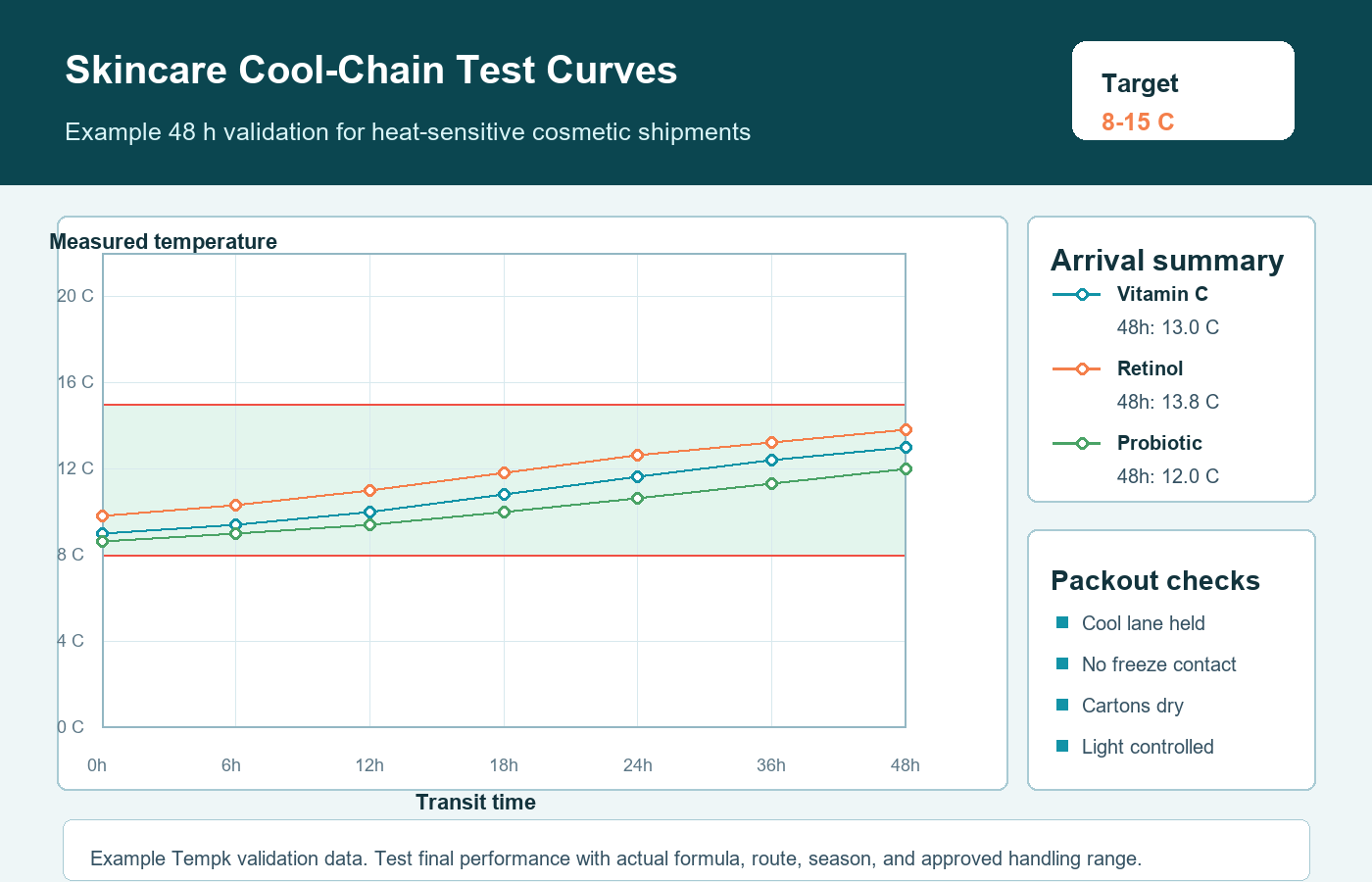
The curve helps compare a cool-chain skincare route against a warmer lane and a chilled product requirement. For cosmetic parcels, read the curve together with label moisture, bottle support, and product appearance checks.
Use this guide for a related product where formula stability, jar protection, and condensation control matter, but a dedicated solution page is not needed yet.
Plan chilled or cool delivery around microbial-risk awareness, jar protection, moisture control, and coolant separation.
Use these pages to compare coolant choice, route risk, and insulation before the validation run.
Skincare products do not all need the same cold chain. Vitamin C is oxidation-sensitive, retinol is heat and light-sensitive, and probiotic formulas may need tighter refrigerated control.
Customer-visible failures include color shift, separated emulsions, swollen cartons, wet labels, and texture changes after warm delivery.
Protect glass and airless pumps with dividers, then choose coolant placement based on formula and packaging. Keep cold packs away from labels and thin cartons.
Use chilled gel or PCM for heat-sensitive cosmetics. Reserve 2 to 8 C systems for formulas that truly require refrigerated handling.
Check appearance, viscosity, label adhesion, pump operation, and carton dryness after the route. Cosmetic receiving needs a visual QA step.
Skincare cold chain should be selected by formula claim and presentation risk. A vitamin C serum may need heat reduction to slow color shift, while retinol usually needs protection from heat, light, and pump pressure. Probiotic skincare may need a true refrigerated lane if the formula claim requires it. The category page should guide users to compare formula stability, packaging format, glass or pump protection, label sensitivity, and customer opening experience. A beauty product can be technically within range but still fail if cartons arrive wet or the bottle feels damaged.
Custom packout support
For fixed carton sizes, payload limits, branding requirements, seasonal lanes, or validation targets, Tempk can adapt this solution into a custom cold-chain packout.
Share the formula type, label storage instruction, bottle or jar size, payload count, carton dimensions, route duration, ambient condition, and delivery handoff. Tempk can help compare insulation, conditioned gel packs, PCM, buffer layers, and receiving checks.
Request a packout review