


Rapid warming
Liquid payloads can warm quickly during dock time, delivery-vehicle dwell, or doorstep handoff.
Fresh pasteurized milk needs a chilled packout that keeps bottles upright, limits warm dwell, separates coolant from the liquid, and protects caps, labels, and cartons from leakage or condensation.
A dairy shipment should be judged by both temperature and arrival condition. The packout below gives a practical starting point before lane testing and customer handoff checks.
Liquid payloads can warm quickly during dock time, delivery-vehicle dwell, or doorstep handoff.
Bottles can shift in parcel handling, stressing caps and seams unless the cavity keeps them upright.
Condensation or small leaks can hide receiving information and make the package look unacceptable.
| Route condition | Temperature intent | Packaging setup | Preliminary coolant range | Receiving check |
|---|---|---|---|---|
| Local chilled route, 4-8 h | Maintain a chilled route around the product requirement, commonly 0-4 C or 2-8 C depending on the operation; avoid freezing. | Insulated carton, upright bottle divider, absorbent liner, 1-2 conditioned gel packs or PCM with a spacer. | About 0.6-1.2 kg for a 1-3 L milk payload. | Bottle temperature, cap seal, label dryness, liner condition, and quick handoff. |
| Warm parcel route, 8-24 h | Chilled delivery with extra protection against vehicle heat and receiving delay. | EPP or insulated carton, bottles in a center cavity, side/top conditioned coolant, absorbent layer, optional logger. | About 1.2-2.8 kg for a 2-6 L payload. | Minimum temperature, no direct freeze contact, leakage, carton moisture, and remaining coolant. |
| Hot route or delay risk, 24-36 h | Validated chilled route with enough dwell allowance and no local freezing near coolant. | Higher-performance EPP or thick insulated carton, larger coolant mass, bottle dividers, absorbent liner, logger near center and cold side. | About 2.8-5.0 kg for a compact milk shipper; confirm by route test. | Logger curve, cap leakage, bottle movement, label readability, and remaining coolant state. |
Use these ranges for sampling and quotation. Final coolant mass should be confirmed with the actual product temperature, unit count, package size, shipper volume, route duration, ambient profile, and receiving requirement.
Do not rely on the shipper to pull down warm product. Pack from stable chilled storage so the coolant is used to hold the route.
Use dividers, trays, or molded support so bottles cannot roll into a gel pack or press against each other.
Conditioned gel packs or PCM usually work best on side and top positions with a separator, not directly against caps or bottle walls.
Receiving checks should cover product temperature, cap condition, wet labels, absorbent liner, and remaining coolant.
These are the visible and operational issues the packout should reduce before the shipment reaches the receiver.
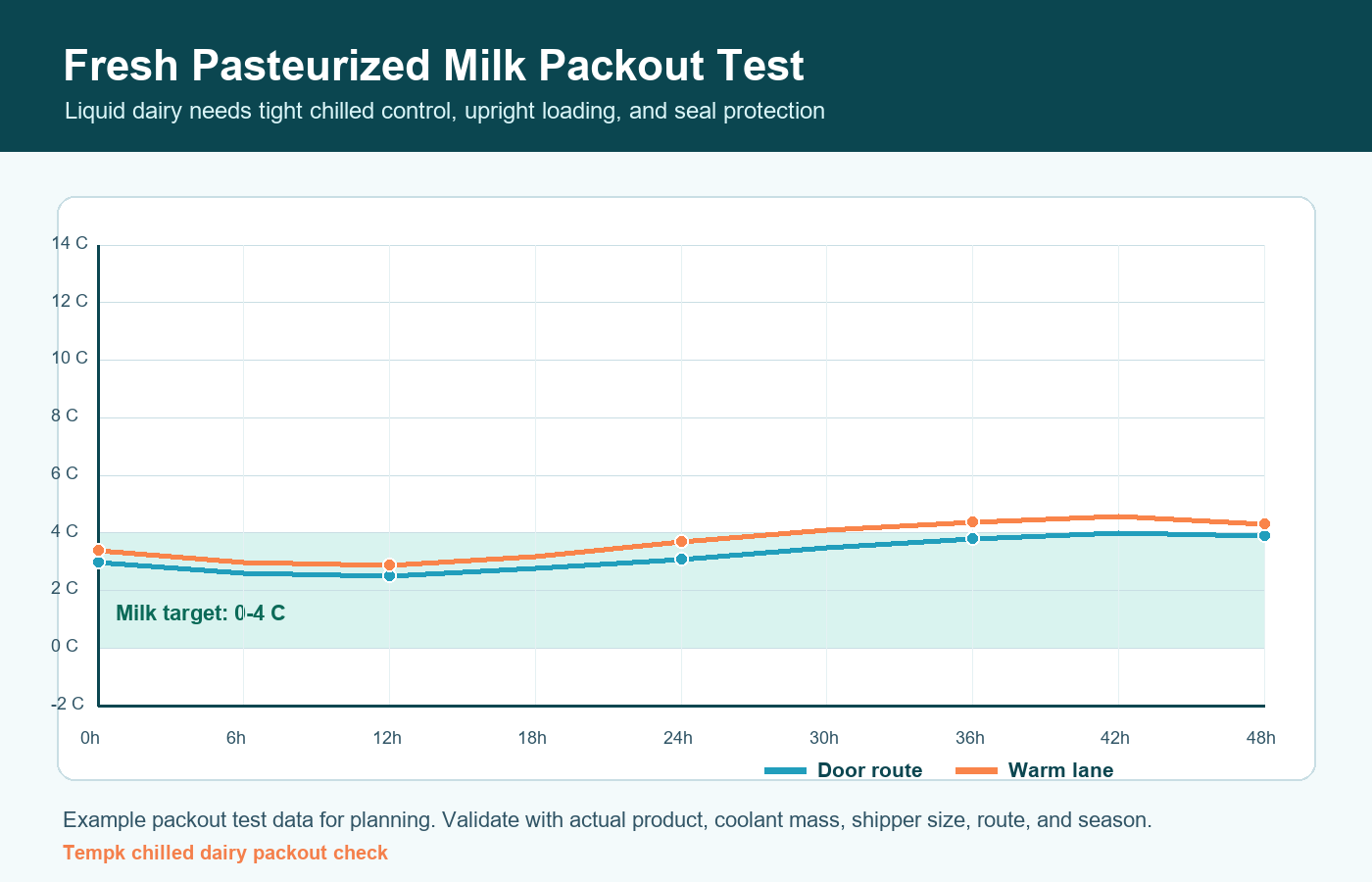
Use the test curve as a working comparison, then validate with the actual product, coolant mass, insulation, route duration, and season. For dairy, also check leakage, condensation, package pressure, texture, odor, and remaining coolant.
Use these pages to compare nearby dairy routes, select coolant, and check route risk before sampling.
Fresh pasteurized milk has high leak impact and short shelf-life pressure. The packout must keep bottles or cartons upright and cold without letting condensation weaken the shipper.
The main failures are cap leakage, carton softening, sour odor, label wetting, and warm top bottles in a stack.
Use upright cells or dividers, a leak liner, and absorbent support under bottles. Place gel packs around the sides and top so the full liquid mass cools evenly.
Use 0 C or chilled gel packs for short chilled routes. PCM can help for residential delivery where the carton may wait before opening.
Check cap torque, leakage, product temperature, carton dryness, and odor after the route.
Fresh pasteurized milk should be packed to prevent cap leakage and top-bottle warming. Start with upright dividers, a leak liner, absorbent support, and chilled gel packs around the sidewalls and top.
If the route is longer than overnight, test whether the center bottle warms faster than the edge bottles. Adding coolant only to the top may leave the middle of a dense liquid stack underprotected.
Tempk validation should include bottle size, fill weight, cap style, carton count, and final-mile dwell. Check temperature, cap leakage, odor, label condition, and outer carton stiffness.
Custom packout support
For fixed carton sizes, payload limits, branding requirements, seasonal lanes, or validation targets, Tempk can adapt this solution into a custom cold-chain packout.
Share the product form, target temperature, payload count, carton size, route duration, ambient condition, courier handoff, and receiving checks. Tempk can help compare gel packs, PCM, EPP, insulated cartons, liners, inserts, and logger placement.
Request a packout review