How to Choose a Manufacturer Dry Ice Pack for Fruit Shipping
Fruit-shipping damage often begins with a reasonable but incomplete instruction: “add more ice.” More refrigerant can extend cooling, yet it can also freeze outer fruit, trigger chilling injury, create condensation, occupy airflow space, and add handling cost. Choosing a manufacturer dry ice pack for fruit shipping requires a more disciplined sequence. Define the commodity and route, identify whether the product is true solid-carbon-dioxide dry ice or a water-activated hydrate sheet, design the entire packout, and prove it with both temperature and fruit-quality evidence. Then lock the result to factory and packing-site controls so harvest-season volume behaves like the approved sample.
Establish the Commodity’s Safe Operating Window
Use the fruit owner’s specification and authoritative postharvest guidance to define the shipment condition. USDA Agriculture Handbook 66 provides individual commodity summaries because fruits vary in optimal temperature, humidity, chilling sensitivity, ethylene behavior, respiration, maturity, and storage potential. Cultivar, harvest maturity, growing conditions, and destination can refine that guidance.
Describe the fruit in commercial terms as well as thermal ones. Record commodity and cultivar where relevant, whole or fresh-cut state, maturity, pre-cooling method, pulp condition at dispatch, packaging, case vents, payload mass, and intended sale window. Identify unacceptable outcomes: freezing, pitting, failure to ripen, shrivel, decay, bruising, color change, wet cartons, or crushed retail packs.
Separate chilling from freezing. Some tropical and subtropical commodities suffer physiological injury at nonfreezing temperatures below their tolerance. Symptoms may not appear at receipt; they can emerge during ripening or warmer display. A qualification plan may therefore need a post-shipment holding assessment instead of judging fruit immediately.
Keep pre-cooling distinct from shipment maintenance. Commodity-appropriate pre-cooling removes field heat before the parcel is assembled. A passive shipper should generally begin with fruit at its approved dispatch condition. Using frozen packs to cool warm fruit can produce a cold exterior, warm center, condensation, and reduced endurance against the route.
Make the Supplier Name the Coolant
Actual dry ice is carbon dioxide, solid. It is extremely cold and passes directly into gas as it warms. That combination can be inappropriate for fresh fruit unless a product-specific process justifies it. Direct contact can freeze tissue, and the gas must escape from the package. Handling requires cold protection and ventilation. Air transport can invoke UN 1845 marks, labels, quantity declarations, documentation, training, and carrier checks.
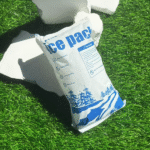
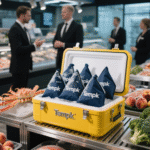
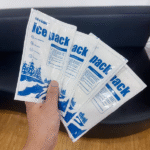
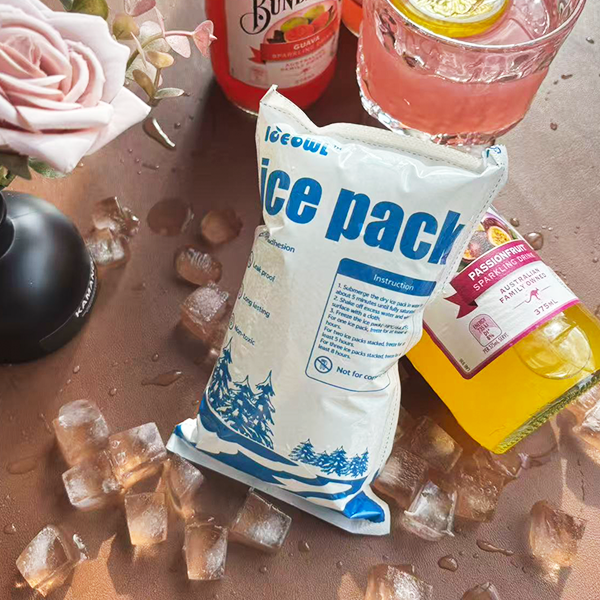
A hydrate “dry ice pack” is not carbon dioxide. It is a flat sheet containing an absorbent structure, activated with water and conditioned in a freezer. The cells spread thermal mass and allow flexible placement. It does not create CO2 or inherit solid-dry-ice transport rules. It does introduce process needs: controlled hydration, drainage, freezing, clean storage, and seam inspection.
Other candidates include pre-filled gel packs, rigid water packs, and formulated PCMs. Their fill, transition behavior, conditioning, geometry, and film construction differ. Ask the manufacturer for technical identity and instructions instead of inferring performance from words such as ice, PCM, food grade, or long-lasting.
| Decision question | Strong supplier answer | Weak answer |
|---|---|---|
| What is the refrigerant? | Names solid CO2, water-based hydrate, gel, or defined PCM | “Advanced dry ice technology” |
| What determines duration? | Identifies coolant mass, insulation, payload, ambient profile, and range | Gives one number for all boxes |
| Is it suitable for fruit? | Requests commodity limits and packout testing | Claims universal produce suitability |
| Is it food appropriate? | Provides documents for materials and intended contact scenario | Uses “food grade” without scope |
| Can it be reused? | Describes inspection, cleaning, and retirement boundaries | Promises unlimited refreezing |
| Is it qualified? | Identifies the exact system, protocol, load, and criteria | Transfers a test logo to the component |
This early clarification protects both engineering and logistics. It avoids exposing chilling-sensitive fruit to unnecessarily cold CO2 and prevents teams from placing dangerous-goods labels on ordinary hydrate sheets.
Design the Thermal, Moisture, and Airflow Interfaces
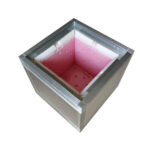
The passive package is a connected assembly. The outer carton handles distribution loads. Insulation slows outside heat. Coolant absorbs energy. Fruit cases, vents, liners, pads, and dunnage manage airflow, moisture, movement, and contact. A change to one layer can alter the rest.
Map likely thermal bridges at lid joints, corners, and compressed insulation. Distribute coolant to manage warm regions without placing a deeply conditioned surface against fruit. If a buffer is needed, define its material, thickness, and location. Ensure it cannot collapse, shift, or become saturated during handling.
Preserve intended produce ventilation. Blocking clamshell holes or case vents may change cooling, gas exchange, and condensation. Conversely, excessive open headspace can permit packs and fruit to move. Use fitted inserts that restrain the load while retaining the airflow path assumed in testing.
Plan water vapor. Cold packs can cause condensation when exposed to humid air. A liner may protect insulation and carton, while absorbent material can collect liquid. These layers can also trap moisture or alter heat flow. Test them with actual labels, trays, bags, and fruit rather than treating moisture control as a cosmetic add-on.
Mechanical and thermal effects should be challenged together. A rigid brick can bruise fruit or crush a clamshell. A thawed flexible sheet can slide after inversion. A damaged corner can create a heat leak. Distribution testing and route trials should confirm that the refrigerant remains in its mapped position.
Qualify for the Route, Not the Brochure
Write the route as a sequence of custody events: removal from cold storage, assembly, closed-carton staging, pickup, vehicle, sorting hub, line haul, final mile, doorstep, and receiving. Add credible delays, seasonal conditions, dispatch-day risks, and any customs or inspection dwell.
Choose external challenges that represent this risk. ISTA 7E provides recognized temperature profiles for parcel-delivery thermal packaging and can support standardized comparison. Route profiling adds local information. One successful profile does not guarantee every climate, service, or commodity.
Build a controlled test packout with the production carton, insulation, fruit package, coolant model and count, buffer, liner, dunnage, closure, and logger locations. Record fruit and coolant starting conditions. Limit packing time. Include minimum and maximum payload configurations that will actually be sold.
Map both warm and cold points with calibrated instruments. A probe in free air, a surface-attached sensor, and a pulp probe measure different things. State which one drives acceptance. Review individual sensor traces; an acceptable average cannot cancel a frozen edge or warm corner.
Add fruit-quality assessment. Score the producer’s relevant attributes at receipt and, where needed, after a defined holding or ripening period. Note condensation, package damage, movement, and refrigerant leakage. A technically “cold” package that causes delayed pitting, bruising, or poor ripening is not qualified for the commercial purpose.
Use trial shipments to confirm real handling after controlled testing. Record route events and deviations. A trial without delay is evidence for that trip, not proof of contingency. Adjust the design or narrow its intended use when results do not meet criteria.
Convert the Approved Prototype Into Factory Supply
The purchase specification should identify model and revision, materials, dimensions and tolerances, cell pattern, fill or absorbent attributes, dry and activated criteria where relevant, seam and leak standards, preparation instructions, storage, lot coding, and carton packing. Link the qualification report to this version.
Helpful decision tools
Check the details before you choose packaging
These quick tools can help you compare route risk, sizing needs, coolant choices, and packaging details before you request a quote.
Ice Pack Calculator
Estimate gel ice pack quantity for chilled shipments and practical route planning.
Estimate ice packsPackaging Selector
Compare insulated packaging options by product, route, and temperature need.
Find packagingRoute Risk Checker
Review lane conditions before selecting packaging for real operating requirements.
Check route riskAsk how the manufacturer controls attributes that influence performance. Seal settings affect seam integrity. Absorbent or fill dosing affects thermal mass. Cutting affects fit. Film changes may alter strength, permeability, or flexibility at low temperature. The manufacturer should be able to explain relevant inspection and traceability without making unsupported performance promises.
Connect sample approval to production. Request representative samples, inspect them using the intended plan, and activate hydrate sheets at the packing site. Verify that the production item fits the qualified arrangement. Agree on advance notice for changes in raw material, formulation, dimensions, seam pattern, process, site, or instructions.
Seasonal supply planning reduces risky substitutions. Discuss forecast, order quantities, packing format, lead-time planning, lot release, and continuity before peak harvest. Qualify an alternate intentionally if one is needed. Matching external dimensions do not establish equivalent water uptake, thermal mass, or contact behavior.
Incoming inspection should be risk-based. Confirm identity, revision, lot, carton condition, cleanliness, selected dimensions or mass, seam appearance, and documents. Quarantine mixed models, contamination, or leakage. Trend issues by lot and share activation records and photos with the manufacturer.
Control Activation and Packing at Harvest Volume
Hydrate sheets shift inventory volume into site operations. Define clean water source, activation method, drainage, batch size, freezer arrangement, conditioning readiness, conditioned storage, and maximum holding conditions. Measure process variation during a full-scale pilot, not only with a few sheets in an empty freezer.
Freezer airflow and recovery can change when racks are crowded. Packs may freeze together if not drained or separated. Different workers may interpret readiness differently. Use a measurable or clearly observable criterion established by the process, and segregate product by model and status.
At the packing bench, pre-stage components and keep fruit out of storage for a controlled period. Use visual layer instructions showing coolant count, orientation, buffer, case vents, dunnage, logger, and closure. Prevent cold packs from resting on delicate retail packaging. Hold completed cartons under the condition assumed by route qualification while waiting for pickup.
Actual dry ice belongs in a separate trained process with cold-contact protection, ventilation, a package that releases gas, and verified transport documents. Do not let the similarity of product names mix solid CO2 with hydrate inventory or work instructions.
At receipt, inspect time, damage, wetness, pack leakage, fruit condition, and the approved temperature measure. Move fruit to the correct environment quickly. An alarm or quality defect should trigger segregation and authorized review. A frozen or thawed pack alone does not determine disposition.
Reduce Environmental Impact Without Moving Risk
First prevent fruit loss. Then examine each packaging function and remove excess with evidence. Right-sized cartons can reduce insulation, refrigerant, freight cube, and empty space, but they must preserve commodity ventilation and buffer geometry. Develop controlled modules for common order sizes instead of an oversized universal box.
Hydrate sheets store flat before activation, which can reduce inbound and warehouse volume compared with a pre-filled pack of similar active size. The total environmental result also includes material, water, freezing energy, outbound mass, product protection, reuse, returns, and disposal. Limit claims to the boundary supported by data.
Reuse is a route property as much as a product property. A closed grocery loop may recover most packs; an open consumer network may not. Returned units need quarantine, cleaning, inspection for puncture and contamination, reconditioning, tracking, and retirement. Count actual successful uses. If return transport and losses are high, a right-sized single-use solution may perform better overall.
Ask the manufacturer for material identification and disposal instructions. Local recycling systems may not accept multilayer films or absorbent contents. Do not print a broad recyclable, compostable, or biodegradable claim without evidence for the full item and destination.
Measure site waste. Track damaged dry sheets, failed activation, unused conditioned packs, freezer space, packaging rejects, and fruit claims. These observations reveal improvements that a unit-level material comparison misses.
Frequently Asked Questions
What is the first sample a fruit shipper should request?
Request the exact construction proposed for production in dimensions that fit the planned carton. Ask for its specification, activation instructions, material documents, and lot identity. Use it first for fit and preparation trials, then evaluate it in the complete packout under defined thermal and quality criteria.
Is solid dry ice appropriate for berries or tropical fruit?
Do not decide by category alone, but true dry ice creates an extremely cold boundary and a substantial local freezing risk for fresh fruit. Tropical fruit may also suffer nonfreezing chilling injury. Use product-specific postharvest requirements and testing; a milder coolant is often a more logical candidate for refrigerated fresh produce.
Can one ambient test cover the entire year?
Only if the selected profile and configuration are justified for both relevant heat and cold exposure. Many lanes need separate seasonal challenges or conditioning approaches. Route data, service changes, and delivery patterns should be reviewed over time, and changes may require reassessment. Review this decision annually.
What does “food grade” mean for a coolant sheet?
It should refer to defined materials and an intended contact scenario supported by relevant documentation. The sheet normally remains outside intact fruit packaging. Buyers should review outer materials, leaks, printing, cleanliness, and destination requirements rather than treating the phrase as universal permission for direct food contact.
How should a buyer compare total cost?
Measure unit price, inbound and storage volume, activation labor and water, freezer capacity and energy, rejects, packing time, outbound weight and box size, return handling, disposal, and fruit claims. Use a pilot with the actual workflow rather than a supplier’s unverified savings percentage. Include quality-loss costs as well.
Conclusion
A manufacturer dry ice pack for fruit shipping is suitable only when its material, geometry, and preparation align with a specific commodity and route. Protect the fruit’s lower and upper limits, maintain ventilation and moisture balance, and include physical quality in qualification. Bind the approved design to factory specifications, change control, peak-volume conditioning, and receiving evidence. Finally, improve environmental performance through right-sizing, measured reuse, efficient activation, and accurate end-of-life information. The objective is not maximum cold; it is maximum arrival quality within a controlled process.
About Tempk
Tempk’s published hydrate-pack range consists of water-activated flexible coolant sheets supplied flat before preparation and frozen for use with insulated packouts. We can help a fruit shipper discuss cell layout, custom dimensions, activation workflow, sample-to-order definition, and volume packing. Commodity temperature limits, route evidence, fruit-quality acceptance, and final qualification remain the responsibility of the producer and its quality partners.
Share the commodity brief, case and vent design, load matrix, route profile, conditioning capacity, and sustainability boundary with Tempk to request a targeted sample configuration.