How to Specify an Insulated Lunch Bag Foil Lined
The best way to choose an insulated lunch bag foil lined inside is to write the use case before reading the feature list. State what must fit, where the packed meal travels, the warmest credible exposure, which cold sources will be used, and where refrigeration resumes. Then evaluate the bag as a complete assembly. The reflective liner may help with radiant heat, but the insulation, closure, seams, payload, and user routine decide whether the product is fit for the job. This method turns a vague catalogue purchase into a specification that can be sampled, tested, and repeated.
Write a One-Sentence Performance Brief
A practical brief should name the contents, route, handling, and end point. “Carry one sealed chilled meal, a drink, and two conditioned cold sources from home to an office refrigerator during a normal morning commute” is useful. “Keep lunch fresh all day” is not. The first statement can be measured and observed; the second has no defined temperature, time, environment, or food type.
Build the brief with six inputs:
- List the exact containers and their packed orientation.
- Identify perishables and the food-safety guidance that applies.
- Map each environment, including vehicles, lockers, desks, outdoors, and refrigerators.
- Define the cold sources and how users will condition and place them.
- Describe opening, cleaning, drying, and storage behaviour.
- Decide what evidence is required before an order is approved.
This exercise often changes the product choice. A bag intended only to bridge a short commute may prioritise compact refrigerator fit. A bag for a field crew may need to give way to a more substantial cooler and a controlled storage plan. A school programme may value an intuitive zip and easy-clean interior more than decorative features.
The brief also sets a boundary. An everyday lunch carrier is not automatically a qualified temperature-controlled shipper, a medicine carrier, or a commercial food-transport system. Product-specific and regulated applications may require different packaging, monitoring, qualification, and professional review.
Read the Bag From the Outside In
The outer shell handles abrasion, dirt, branding, and load transfer. Check whether its weave, coating, and seams suit the setting. A soft promotional fabric may be appropriate for an office giveaway but short-lived on a worksite floor. Handles should be anchored into load-bearing areas, and the packed bag should remain balanced when lifted.
Behind the shell is the main insulating layer. It may be foam, fibrous insulation, trapped-air structure, or another material. Its value comes from both material and continuity. Feel around the base, lid, corners, and zip line. Thin, compressed, or missing regions form easier paths for heat. Wall thickness alone cannot predict duration because the material, construction, geometry, and full packout also matter.
The inner face is commonly described as foil, but the word is imprecise. The shiny surface might be aluminium foil, metallised polymer, metallic printing, or a reinforced laminate. Ask for a layer-by-layer description when direct food contact, repeated cleaning, recyclability, or durability affects the purchase. A reflective appearance cannot disclose adhesive type, backing film, puncture resistance, or the way edges are sealed.
Finally, inspect the closure. A full zip can still leave gaps at corners or distort when the bag is packed. A flap needs enough overlap. A roll top needs room to roll correctly. Close the sample with the actual containers and cold sources inside, then look and feel around the perimeter. The loaded inspection is the one that counts.
Understand What the Reflective Liner Can and Cannot Do
Heat reaches a cold meal in three main ways. It conducts through the walls and contact points, moves with air entering and circulating, and transfers by radiation between surfaces. The reflective face addresses part of the radiant component when it faces an air space. Official guidance on radiant barriers notes that an adjacent air space is necessary for that mechanism. When the liner is pressed directly against a container, the conditions differ.
The insulating core slows conduction. The closure limits convective air exchange. Cold sources absorb incoming heat. Starting food temperature sets the initial thermal load. These roles are complementary, which is why one feature cannot establish a safe holding time.
Consider a cold container placed beside a room-temperature drink. The drink adds heat inside the bag. A partly thawed cold pack has less available cold capacity than one conditioned as intended. A zip opened repeatedly allows warm air in. Direct sun adds radiant load at the exterior. The same bag can therefore produce different temperature histories across two ordinary days.
Avoid the phrase “keeps cold for X hours” unless the claim is attached to a defined configuration. The relevant evidence should state the exact bag, ambient profile, payload, coolant, starting temperatures, sensor locations, opening schedule, limit, and pass rule. Without that context, a duration is marketing shorthand rather than a transferable performance result.
Make the Packout Safe and Repeatable
For cold perishable lunches, begin with food already chilled. Insulation is designed to slow change; it should not be expected to cool a warm meal quickly. Use closed food containers, which reduce direct contact with the liner and make cleaning easier. Keep the bag away from heat sources and move it into a refrigerator at the destination whenever one is available.
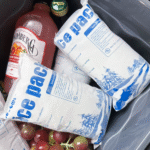
Official U.S. food-safety guidance advises holding cold perishables at 40°F, about 4°C, or below and using at least two cold sources in an insulated lunch bag. Buyers and users in other markets should follow their responsible local food-safety authority. The number of packs is not the only issue: the sources must be conditioned as intended, fit without forcing the closure, and be placed around the perishable items.
A repeatable sequence could be:
- chill the food and drink in advance;
- condition the cold sources according to their instructions;
- place one source below or beside the perishable container and another above or on the opposite side;
- fill unnecessary voids with the planned contents rather than unrelated warm items;
- close the bag fully and minimise opening;
- refrigerate on arrival when possible;
- clean, dry, and inspect the bag after use.
This routine is more useful than a generic promise because it tells users what to control. It also exposes a size problem immediately. If the bag cannot close with the containers and cold sources in their intended positions, it is too small for that packout regardless of the catalogue volume.
Use a Buyer Scorecard That Rewards Evidence
| Decision area | Approval question | Strong evidence | Reason to pause |
|---|---|---|---|
| Functional fit | Does the loaded bag close and carry comfortably? | Trial with representative containers, drink, utensils, and cold sources | Fit judged from external dimensions or an empty sample |
| Construction | Are insulation and liner continuous at critical points? | Finished sample inspection and controlled material description | Unexplained gaps, exposed foam, or vague “thermal foil” wording |
| Thermal claim | Does evidence match the intended scenario? | Defined test article, packout, ambient profile, measurements, and acceptance rule | Headline duration without conditions |
| Food-contact boundary | Is food loose or inside closed containers? | Intended-use statement and relevant documents for the exact contact surface | Generic “food grade” statement with no article or conditions |
| Hygiene | Can the bag be cleaned and dried by the real user? | Written care method confirmed for the assembled product | Deep inaccessible folds, retained moisture, or unsupported wash claims |
| Repeat order | Will production match the approved sample? | Controlled specification, lot identification, and change notification | Supplier may substitute liner, foam, adhesive, or zip without review |
| Environmental claim | Is the wording supported for the complete product and market? | Specific substantiation and realistic end-of-life instructions | Broad “eco” or “fully recyclable” language based on one component |
The scorecard gives evidence more weight than visual cues. It also keeps different questions separate: thermal performance does not prove food-contact suitability, and food-contact documentation does not prove duration. A supplier may need to answer both, but the records should not be blended into a vague certificate request.
For small personal purchases, not every row needs a formal dossier. For school, workplace, food-service, retail, or promotional programmes, controlled specifications and written answers protect the buyer when the product is reordered or distributed to many users.
Helpful decision tools
Check the details before you choose packaging
These quick tools can help you compare route risk, sizing needs, coolant choices, and packaging details before you request a quote.
Compliance Checklist Generator
Build a practical checklist for packaging review, shipping, and documentation.
Build checklistIce Pack Calculator
Estimate gel ice pack quantity for chilled shipments and practical route planning.
Estimate ice packsCoolant & PCM Reference
Compare coolant and PCM options when a route needs added temperature support.
Compare optionsSet the Food-Contact Boundary Before Reviewing Documents
The simplest operating choice is to keep food in sealed containers. The bag then acts primarily as secondary containment, reducing the intended direct-contact area. Spills may still occur, so the liner should remain cleanable and appropriate for its stated use, but the lunch bag is not the food vessel.
If loose food is intended to touch the liner, the compliance review becomes more specific. The exact surface, backing layers where migration may be relevant, adhesive, foods, contact duration, temperature, repeated-use condition, and destination market all matter. The supplier’s evidence must cover the finished construction and the intended conditions, not merely a raw film sold under a similar name.
Within the European Union, Regulation (EC) No 1935/2004 establishes general safety and inertness principles for food-contact materials. Regulation (EC) No 2023/2006 covers good manufacturing practice, and specific measures such as Regulation (EU) No 10/2011 may apply to plastic layers. Other jurisdictions use their own frameworks. Procurement teams should have the appropriate quality or regulatory function decide which documents are needed.
Do not treat CE marking as a general food-contact certificate. CE marking is required only for product categories covered by EU rules that specifically mandate it; an ordinary lunch bag does not become compliant merely by displaying the mark. The correct review follows intended use and applicable product rules.
Design Reuse Around Care and Retention
An insulated bag may combine textiles, foam, films, foil or metallisation, adhesive, zip tape, thread, ink, labels, and reinforcements. Bonded multilayer construction can make material separation difficult. Recyclability should never be inferred from the shiny liner, a recycling symbol on one component, or the theoretical recovery of a raw material.
A more credible sustainability plan starts with usefulness. Choose a geometry people will carry, artwork that will not become obsolete after a short campaign, and a closure that survives the intended handling. Remove pockets, decorative layers, and individual packaging that do not serve the performance brief. Provide care instructions that help users keep the bag clean and dry without damaging the laminate.
For an organisation-owned programme, define when bags are inspected and removed from service. Repair may be appropriate for an external strap if it can be performed safely, while a cut food-side liner or inaccessible contamination may require retirement. End-of-life instructions should reflect actual local collection options rather than a universal statement.
Reuse becomes an environmental benefit only when it happens. A more modest bag used regularly can be a better programme choice than an elaborate item that users leave at home. Pilot distribution provides evidence about retention, cleaning, and failure modes before a large order locks in unnecessary material.
Run a Sample-to-Production Gate
Approve three things separately: the construction, the artwork, and the packout. The construction sample confirms dimensions, materials, workmanship, closure, and care. The artwork sample confirms colour, placement, legibility, and any claims. The packout trial confirms that the real meal and cold sources fit and that ordinary users can operate the bag correctly.
Record the accepted sample and specification. Identify critical components that cannot change without review, including liner, insulation, adhesive, shell, closure, and load-bearing stitching. Define visible defect criteria for delamination, exposed edges, odour, contamination, missed stitching, zip operation, and print defects. For performance claims, connect the claim to the exact tested configuration.
At receipt, inspect a reasonable selection from the production order according to the buyer’s quality plan. Compare dimensions and construction with the reference, operate closures under representative load, and check packaging and care labels. If a material or process has changed, pause the release until the effect on performance and documentation is understood.
FAQ
What is the first specification to confirm?
Confirm the internal fit of the complete packout. The food containers, drink, utensils, and intended cold sources must fit in their working orientation while the closure shuts normally. Once fit is proven, compare insulation continuity, liner construction, hygiene, and evidence behind claims.
Is aluminium foil better than metallised film?
Not as a universal rule. The best structure depends on radiant behaviour, backing layers, puncture and flex resistance, cleaning, food-contact conditions, weight, durability, and manufacturing quality. Obtain the layer description and evaluate the finished bag for the intended use rather than choosing by material name alone.
Can the bag safely remain in a car until lunch?
Do not assume so. Vehicle interiors can create severe heat exposure, and a test performed in a mild room may not apply. Use refrigeration or another suitable control where possible, follow local food-safety guidance, and require scenario-relevant evidence before making a duration claim.
How do I verify a “food-grade liner” statement?
Ask which finished surface and construction the statement covers, the intended foods and contact conditions, the applicable jurisdiction, and the supporting declaration or test records. A raw-material certificate may not cover adhesives, printing, seams, or a changed laminate in the assembled bag.
What makes an order genuinely reusable?
The product must be useful enough to retain, durable enough for the intended handling, and cleanable under a method users will follow. The programme also needs inspection and end-of-life guidance. “Reusable” on a product page does not prove that repeated use will occur.
Approve the Job, Not the Shine
A dependable lunch-bag decision follows a clear sequence: define the meal and route, verify the loaded fit, understand the multilayer construction, review claims against test conditions, set the food-contact boundary, and control cleaning and repeat orders. The foil-lined surface can be a useful part of the assembly, but it neither creates cold nor guarantees a duration. When product and routine are designed together, the bag supports safer food handling, better user acceptance, and more credible reuse.
About Tempk
Tempk is the brand of Shanghai Tempk Industrial Co., Ltd. We support B2B buyers with the selection of insulated and cold-chain packaging and related temperature-control packaging products. Our contribution to a lunch-bag project is requirement-focused: clarifying contents, packout, exposure, material questions, and the operational boundary between a convenience carrier and a controlled packaging system. Buyers remain responsible for applying the food-safety, compliance, testing, and claim-review processes appropriate to their markets.
Send Tempk your one-sentence performance brief, container dimensions, cold-source arrangement, cleaning expectations, and order context to begin a practical comparison.