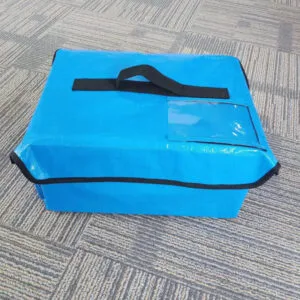
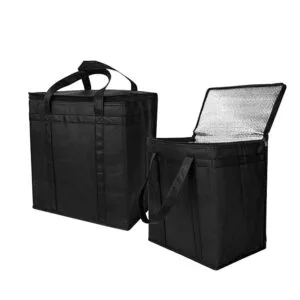
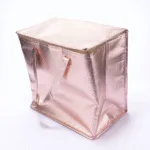
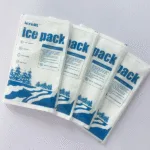
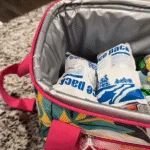
Do not place solid dry ice in a sealed plastic bag. For any plastic component proposed in a dry-ice packout, establish its purpose, manufacturer-permitted use and the complete assembly’s gas-release design. Drilling a few holes in an unidentified bag is not evidence of compatibility or transport acceptance.
Identify the component’s actual purpose
A plastic component may be a product’s primary package, a spill liner, an insulated-container liner or a coolant enclosure. Those roles are different. A food package sealed around its contents is not the same as a bag sealed around solid CO₂.
Record actual polymer or construction information, model, seams and closure. The terms “heavy-duty,” “food grade” or “dry ice bag” do not establish every cold-exposure, strength or transport requirement. Ask for instructions for the intended use.
Check permission before modifying the bag
FedEx US: dry ice shipment preparation explicitly warns against placing dry ice in sealed plastic bags in its US-facing guidance. Follow the applicable carrier instructions and container design rather than treating a generic shopping bag as approved packaging.
49 CFR 173.217: carbon dioxide, solid addresses gas-release packaging for applicable US air and water dry-ice transport. A path through one liner is insufficient if another layer or an added outer wrap obstructs the intended release.
Do not invent a universal hole diameter, perforation count, polymer thickness or fold method. Use the manufacturer’s specified configuration, and seek a suitable component if the proposed use is unsupported.
Review the complete layered package
| Layer or function | What to establish |
|---|---|
| Product primary package | Suitable containment for the actual contents. |
| Plastic liner | Its intended function and permitted cold exposure. |
| Dry-ice location | Compatible positioning and required separation. |
| Insulation and closure | Gas release remains as intended in the loaded state. |
| Outer package | Protection and acceptance for the selected carrier. |
| Added film or tape | No unassessed obstruction or compression. |
Containment, insulation and gas release must work together. Do not remove a necessary product seal to solve an unsuitable dry-ice enclosure; review the package design and each component’s role.
Helpful decision tools
Check the details before you choose packaging
These quick tools can help you compare route risk, sizing needs, coolant choices, and packaging details before you request a quote.
Route Risk Checker
Review lane conditions before selecting packaging for real operating requirements.
Check route riskIce Pack Calculator
Estimate gel ice pack quantity for chilled shipments and practical route planning.
Estimate ice packsInsulation Material Reference
Compare insulation material choices for different cold chain packaging needs.
Compare materialsDefine the decision when evidence is missing
- Identify the exact component and proposed contents.
- Request permitted-use and handling information.
- Check relevant carrier packaging requirements.
- Assess representative loading and handling.
- Document the supported configuration.
- Replace or redesign an unsupported component.
Assess tearing, seam damage and movement along with thermal evidence. A bag that looks intact at room temperature may not have been assessed for the planned exposure. A thermal trial alone does not establish transport acceptance.
Keep staff handling and surrounding ventilation within the site’s dry-ice procedure. Gas released from the package still needs a suitable environment.
Frequently asked questions
Can I just punch holes in a freezer bag?
Do not use an improvised hole pattern as proof of suitability. Obtain an appropriate component and supported design.
Does thicker plastic always make a safer dry-ice bag?
No. Construction, compatibility, function and gas release need assessment.
Can primary food packaging remain sealed?
Its containment role is separate from enclosing solid CO₂. Use a complete design that meets both product and dry-ice requirements.
Review the intended application
Use the frozen-meat containment guide for meat package roles, and the supplier evidence checklist before choosing a bag.