Thermal Pallet Blankets for Blood Products Within a Qualified Logistics System
The safest way to buy thermal pallet blankets for blood products is to stop treating the blanket as the temperature-control system. It is an outer passive component. It may slow heat entering or leaving a pallet, but only the complete, qualified configuration can be evaluated against a blood component’s requirements. Refrigeration, frozen packouts, platelet handling, monitoring, traceability, and quality release remain separate controls.
A practical selection method connects one component state to one lane and one operating envelope. It then passes through seven gates: requirement, role, geometry, thermal design, evidence, routine operation, and lifecycle control. If a proposal cannot pass a gate, a larger order should wait.
Gate 1: name the component and its state
Do not begin a specification with “blood pallet.” Write the full component and state: stored whole blood, liquid red cells, platelets under their approved process, frozen plasma, thawed plasma, or another specifically labeled component. Note processing or modification that affects conditions. State the applicable label, blood-establishment procedure, national rules, and destination requirements.
WHO blood cold-chain guidance distinguishes refrigerated whole blood and red cells, platelets held under controlled conditions with agitation during storage, and frozen plasma. U.S. FDA regulations also specify product-by-product conditions; the numbers and contexts are not identical to every WHO training statement or another country’s rules. That is expected. A global logistics program needs a requirements matrix, not a universal temperature copied into every protocol.
The matrix should include allowed range or frozen-state criterion, maximum process time where applicable, agitation or other non-temperature needs, packaging and labeling constraints, visual inspection, monitoring, and disposition authority. It should also state whether the requirement applies to storage, shipment, processing, post-thaw holding, or issue for transfusion. These stages must not be conflated.
Mixed-component loads usually fail this gate unless the products share compatible, approved conditions and physical segregation. A reflective outer cover cannot make refrigerated red cells compatible with controlled room-temperature platelets or a dry-ice frozen-plasma packout.
Gate 2: assign one narrow job to the blanket
Write a sentence that describes the blanket’s task without using “maintain” or “control” unless supported by system evidence. For example: “Provide an evaluated outer insulating layer around qualified red-cell transport boxes during indoor dock staging and vehicle loading.” The sentence names the protected configuration and exposure.
Possible jobs include buffering a planned handover, adding an evaluated outer layer to a passive pallet packout, reducing radiant load during a brief transfer, or supporting a prequalified emergency movement. Unsuitable jobs include replacing a blood-bank refrigerator, storing platelets without required agitation, converting an ordinary truck into a refrigerated vehicle, keeping plasma frozen with insulation alone, or extending a delay beyond the qualified duration.
Define the failure action in the same sentence set. If staging reaches its limit, the pallet returns to approved equipment, transfers to a validated alternative, or enters an escalation decided by the quality procedure. The blanket is not allowed to create an undefined grace period.
This narrow assignment also helps with compliance language. The complete configuration may be qualified for a specified use; the blanket itself should not be called universally “FDA compliant,” “WHO approved,” or suitable for all blood products. Ask suppliers to state construction and supporting tests precisely.
Gate 3: capture the real pallet and lane
Pallet drawings should reflect the wrapped production load. Record outer dimensions, minimum and maximum height, box layout, overhang, corner boards, voids, total payload range, labels, seals, refrigerant locations, and base. A full pallet and a half pallet can have different surface-area-to-mass ratios and internal air paths, so both may need evaluation.
Map the lane minute by minute from the last controlled point to the next controlled point. Include dispatch reconciliation, elevator waits, dock staging, door cycles, security, loading, vehicle preconditioning, airport acceptance, transfer, customs, receiving, and logger retrieval. Mark surfaces beneath the pallet and radiant exposures above it. Identify the longest credible delay and the recovery path.
Air temperature alone may not represent the challenge. Direct sun, a hot roof, a cold metal deck, wind, precipitation, and adjacent frozen loads can create local effects. If outdoor use is possible, examine securement, water behavior, and safe handling. A loose skirt or saturated blanket may be a worker and contamination hazard.
Human factors belong in the lane file. Who installs the cover? What protective clothing is worn? Can one person reach the top? Are labels visible? Can forklifts enter without touching the skirt? Does removal risk striking brittle frozen-plasma boxes? Trial these tasks with the intended personnel and equipment.
Gate 4: design all heat paths and internal sources
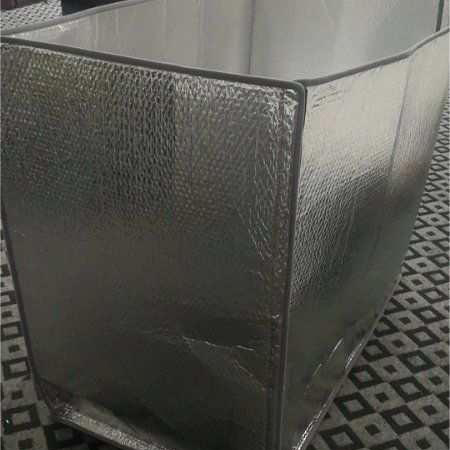
Conduction, convection, and radiation occur simultaneously. The blanket’s insulating core resists heat through its panels. A reflective surface can reduce radiant exchange under relevant conditions. Flaps and skirts can limit moving air. Seams, gaps, compressed folds, and the uncovered base can bypass these functions.
Think of the pallet as a six-sided boundary. A five-sided cover leaves the underside connected to the pallet and floor. A base pad may reduce this path but can affect stability, hygiene, fork access, and qualification. Make that choice before the test configuration is frozen.
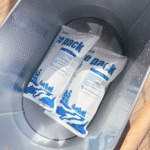
The blanket also interacts with internal refrigerants. Cool packs or phase-change materials absorb energy but can create cold spots if too cold, poorly conditioned, or placed against red-cell boxes. Dry ice supports certain frozen systems but releases carbon dioxide gas and brings dangerous-goods, ventilation, handling, and material-compatibility concerns. Insulation may prolong both the desired and undesired influence of a refrigerant.
Platelets again require separate logic. A blanket cannot deliver continuous agitation in storage. It also should not obstruct controlled airflow around platelet equipment. Any transport configuration must follow the approved platelet process; adding generic chilled gel packs would be an unsafe assumption.
Moisture is part of the design. A cold pallet entering humid air can collect condensation. Water may weaken boxes, damage labels, hide leaks, create slippery floors, or enter insulation through damaged seams. Define installation location, vapor and water considerations, drainage, drying, and inspection. “Waterproof” does not answer condensation behavior.
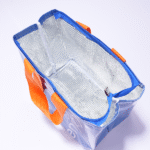
Request a complete construction description: outer layer, insulation, reinforcement, inner liner, seams, closures, handles, dimensions, tolerances, and orientation. Material coupon values support comparison but do not predict complete-system duration. Test the finished blanket around the proposed load.
Gate 5: create evidence that matches the claim
The evidence plan should move from fit to controlled thermal testing and then to operational confirmation. A fit trial can eliminate unsafe or poorly sized concepts before expensive chamber work. It should challenge all approved pallet heights, labels, equipment clearance, closure reach, installation time, and removal.
The thermal protocol states the component criterion, surrogate justification, payload range, starting distribution, packout and refrigerant conditioning, blanket and base configuration, environmental profile, duration, handling events, sensor system, placement, repeats, and acceptance rules. It should include both hot and cold risk when applicable.
Helpful decision tools
Check the details before you choose packaging
These quick tools can help you compare route risk, sizing needs, coolant choices, and packaging details before you request a quote.
Coolant & PCM Reference
Compare coolant and PCM options when a route needs added temperature support.
Compare optionsInsulation Material Drop Resistance
Review drop resistance and handling factors before choosing insulation materials.
Check resistanceCompliance Checklist Generator
Build a practical checklist for packaging review, shipping, and documentation.
Build checklist| Required evidence | What it should identify | Decision it supports |
|---|---|---|
| Construction record | Finished layers, seams, closures, dimensions, tolerances, production identity | Whether tested and supplied units are comparable |
| Lane or facility profile | Time, ambient, humidity where relevant, surfaces, radiation, handovers, delays | Whether the challenge represents intended use |
| Qualification protocol and report | Payload, packout, sensors, calibration, profiles, repetitions, criteria, results | Whether the complete configuration supports the operating envelope |
| Handling assessment | Installation, securement, labels, worker reach, equipment interaction | Whether the method is repeatable and safe |
| Change-control agreement | Supplier and internal changes requiring review | Whether evidence remains applicable after change |
Sensor placement should investigate extremes. Include outer top and corner regions, the lower floor interface, positions near refrigerants, closures, and the load core as justified. An ambient logger interprets the challenge; it does not represent product temperature. Calibration, range, response, resolution, interval, time synchronization, and attachment method should be documented.
ISTA thermal profiles and qualification processes can inform certain packaging studies. Their official scope must be checked. Parcel-delivery profiles do not automatically represent palletized blood on an airport apron or in hospital staging. A standard reference is useful only when the test article, profile, method, and deviations are disclosed.
A pass under one ambient profile does not prove all seasons and lanes. Establish whether bracketing or separate seasonal tests are scientifically justified. If a supplier offers a duration, keep the payload, criterion, starting condition, profile, and sensor locations attached to it.
Gate 6: make routine operation observable
Qualification succeeds only if dispatch and receiving reproduce the critical configuration. Convert the report into a short packout instruction with photographs, numbered steps, and clear limits. Control coolant conditioning, box arrangement, pallet pattern, base, blanket orientation, closure sequence, logger position, label pouch, seal, and timestamps.
At dispatch, staff verify component status, approved load family, starting condition, blanket identity and inspection, logger readiness, and shipment documentation. At each handover, time and custody are recorded. The blanket remains closed unless the SOP defines access. If a delay, location, or physical condition exits the operating envelope, the named escalation begins.
At receiving, staff inspect the covered pallet before dismantling, record damage or moisture, reconcile component units, retrieve data, and place product in the correct controlled equipment. Data review follows the blood establishment’s procedure. A green indicator, intact blanket, or remaining refrigerant is not an independent release decision.
For an exception, quarantine as required and preserve all records. Review logger calibration and placement, time history, blanket and packout integrity, refrigerant state, product label, physical observations, and applicable regulatory criteria. Only authorized personnel decide release, reissue, additional evaluation, or discard.
Training should include wrong-use examples. Staff need to recognize a blanket selected for the wrong component, an open lower edge, direct refrigerant contact, a hidden label, a wet core, expired logger calibration, and a delay beyond the envelope. Periodic drills are especially useful for emergency configurations that are rarely used.
Gate 7: control reuse, change, and end-of-life
A reusable blanket becomes part of the quality-supporting asset pool. Give it a unique ID where appropriate and establish clean-ready, issued, returned, cleaning, drying, repair, quarantine, and retired statuses. Define compatible cleaning agents and methods, inspection lighting, seam and closure criteria, wet-insulation rules, permitted repairs, and record retention.
No universal reuse count can replace inspection and verification. Abrasion changes reflective surfaces; folds compress insulation; closures collect debris; cleaning can affect bonds; repairs can create thermal bridges. Select aged units for periodic technical review based on use severity, failures, and risk. Retire units that cannot be restored to the approved condition.
Supplier change control is equally important. A new film, alternate foam, different adhesive, relocated closure, changed stitch, or dimensional tolerance can affect performance or safety. Agree which changes require advance notice and what evidence supports equivalence. Internally, changes to boxes, pallet load, refrigerants, loggers, vehicles, or routes may require review.
Sustainability should be calculated per successfully completed, conforming pallet movement. Count manufacturing, packaging, reverse logistics, cleaning, drying, repair, loss, monitoring, qualification, and disposal. Compare those burdens with a single-use system across the same function. Closed hospital loops may favor reuse; one-way emergency or international routes may not.
Track actual cycles, return rate, damage, repair, cleaning resources, loss, and retirement cause. Verify whether local recyclers accept the assembled materials. A theoretical material claim is not an end-of-life program. Above all, do not reduce monitoring or thermal assurance to improve an environmental metric; loss of a donated blood component carries its own clinical and resource consequences.
Conclusion: The final approval package
Before scale-up, the technical file should answer four questions without relying on sales language:
Which component, state, pallet configuration, lane, and seasonal conditions are approved?
What exact function does the blanket perform, and what functions remain with other equipment?
Which protocol and data support the operating envelope, including warm and cold locations?
How do staff inspect, install, monitor, receive, investigate, clean, repair, and retire the system?
If any answer is missing, the next purchase step may be a sample, mapping exercise, or qualification run rather than a production order.
Thermal pallet blankets for blood products can be useful at the vulnerable boundaries of a blood network. Their safest value comes from precision: one defined component state, one representative lane, one complete configuration, and one controlled operating process. That precision keeps a passive layer from being confused with blood-storage equipment and gives quality teams evidence they can defend.
About Tempk
Shanghai Tempk Industrial Co., Ltd. operates Tempk, a provider of cold-chain packaging solutions. Its official products include thermal pallet covers, insulated packaging and boxes, coolants, and PCMs. Official solution content covers packout review, logger-position planning, and validation-plan support, giving us a defined basis for a component-to-lane packaging discussion for a stated blood logistics use. Tempk does not approve blood requirements, qualification, compliance, monitoring procedures, reuse status, or product disposition; those controls remain with the responsible blood establishment.
Send the component-state matrix, full pallet configuration, route profile, monitoring logic, and reuse boundary to Tempk. We can discuss which packaging questions the evaluation plan needs to answer.