


Do not load warm produce
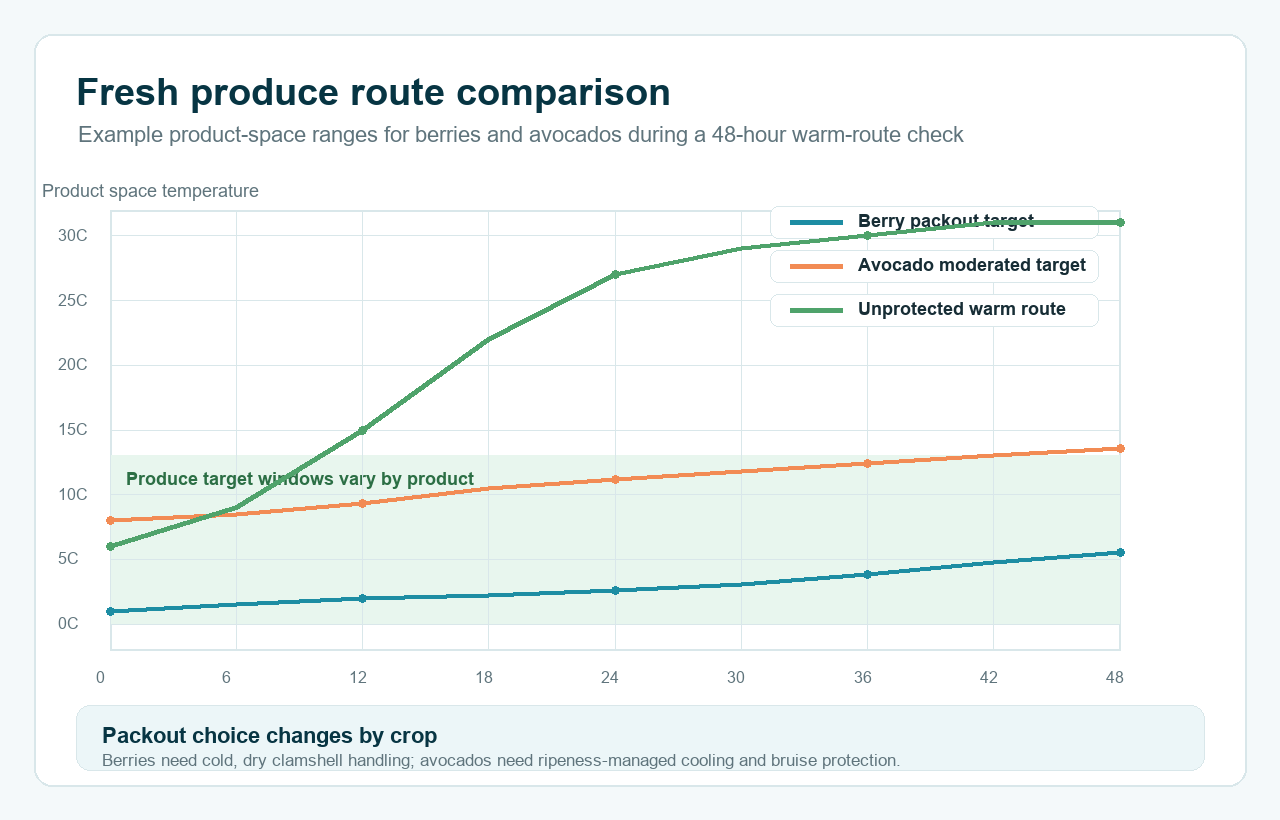
Extra gel packs cannot fully correct warm fruit. Pre-cooled product lowers heat load and keeps the cold lane stable.
Fruits & Vegetables Cold Chain
Fresh produce shipments need more than cold air. A practical packout has to control pre-cooling, humidity, airflow, compression, condensation, and route time without freezing the product or damaging retail packs.
Category Decisions
Fruit and vegetable packouts fail for different reasons. Berries bruise and leak, blueberries lose bloom and firmness, avocados need ripeness control, and mushrooms or asparagus can be damaged by moisture and airflow mistakes. The best package is built around the product’s temperature sensitivity, respiration rate, pack format, and receiving checks.
Extra gel packs cannot fully correct warm fruit. Pre-cooled product lowers heat load and keeps the cold lane stable.
Use absorbent pads, liner bags, and airflow gaps to prevent dehydration and condensation marks.
Frozen packs can flatten clamshells, mark fruit, or block vents when the payload is not supported.
Arrival checks should include firmness, dryness, bruising, leak, bloom, stem condition, and carton strength.
High-Value Product Routes
These pages give product-level packout advice, coolant starting ranges, pre-cooling requirements, and validation checks for the three produce routes already built into this solution group.
Pre-cooled clamshell shipments focused on bruising, leaks, condensation, and cold holding without freeze contact.
View strawberry solution Small berryVented clamshell packouts that protect bloom, firmness, airflow, and dry retail presentation.
View blueberry solution Ripeness-sensitiveTemperature-managed routes focused on maturity, bruising, chilling-injury risk, and carton support.
View avocado solutionRoute Planning
The same shipper can perform differently when the payload is a vented berry clamshell, a ripening avocado carton, or a high-moisture mushroom tray. Use these route choices as a starting point before product testing.
| Shipment condition | Typical package direction | Coolant direction | What to verify |
|---|---|---|---|
| Same-day chilled delivery Pre-cooled product, short city route, limited dock time | Insulated carton liner or compact EPS shipper with product dividers and absorbent pad | Conditioned gel packs on side walls or top corner, buffered away from clamshell vents | Product center temperature, package dryness, berry bruising, vent clearance, and remaining coolant state |
| Overnight parcel route Depot exposure, van heat, 18-36h delivery window | EPP or EPS insulated box, liner bag, stronger outer carton, and fixed coolant pockets | Gel packs or chilled PCM selected by target range, payload mass, box size, and ambient condition | Warmest point in the payload, cold-spot risk near coolant, condensation, and retail pack compression |
| Hot-weather or delay-prone route High ambient, weekend hold risk, longer handoff | Thicker insulation, higher coolant margin, logger, and reduced free space inside the shipper | Perimeter coolant layout with dividers; avoid adding hard frozen weight directly on product | Peak temperature, freeze risk, moisture recovery, carton strength, and product-specific arrival defects |
Supporting Produce Guides
These supporting guides help buyers compare nearby produce risks without turning every product into a separate solution page.
Useful Internal Links
Share product type, pulp or product temperature at packing, pack format, payload weight, route duration, summer ambient range, and receiving checks. Tempk can help choose the shipper, coolant layout, buffer layers, and validation plan.
Request a produce packout reviewCustom packout support
For fixed carton sizes, payload limits, branding requirements, seasonal lanes, or validation targets, Tempk can adapt this solution into a custom cold-chain packout.