A cold chain is a controlled supply chain that keeps a temperature-sensitive product within its approved conditions across a defined journey. It connects storage, handling, transport, packaging, monitoring, people, procedures, records, and decisions. The chain is only as strong as its handoffs: a refrigerated warehouse or an insulated shipper does not create a cold chain by itself.
Cold chain logistics is the planning and operation of that controlled flow. It assigns requirements, equipment, responsibilities, evidence, and response rules from the first controlled point to the receiving decision. This page defines the system and its control boundaries. For route execution, use the separate cold chain transport planning guide; for detailed operating stages, see how the cold chain process works.
1. Use a definition that can guide a decision
A useful cold chain definition must identify four things: the product condition to protect, the start and end of the controlled scope, the controls used at each stage, and the evidence required to release or reject the product. If one of those elements is missing, “keep it cold” is only an intention.
Official definitions vary by sector because the products and risks differ. The Codex cold-chain guidance for quick-frozen foods describes continuity of temperature control through receiving, processing, transport, storage, and retail. The CDC vaccine cold-chain guidance describes a temperature-controlled supply chain that includes equipment and procedures from manufacturing storage through administration. These are sector examples, not universal temperature specifications for every product.
2. Distinguish the cold chain from related terms
| Term | What it covers | What it does not prove |
|---|---|---|
| Cold chain | The end-to-end controlled system for a temperature-sensitive product | That one temperature band or one technology fits every product |
| Cold chain logistics | Planning and operating storage, movement, handoffs, monitoring, and response | That the logistics provider alone owns every quality decision |
| Cold chain transport | The controlled movement between locations, including route and transfer risks | That storage, packing, receiving, and excursion decisions are covered |
| Temperature-controlled packaging | A passive or active packaging configuration used to protect a payload | That the complete route and operating process are qualified |
| Cold storage | A controlled facility or unit used during part of the chain | That product conditions were maintained before arrival or after dispatch |
This distinction prevents keyword-level confusion from becoming an operating error. A vehicle, storage room, logger, coolant, or box can be one control within the system; none of them alone defines the entire cold chain.
3. Draw the system boundary before selecting controls
The boundary should start where the product enters a controlled state and end where the receiving party makes the next documented decision. That may be administration to a patient, transfer to retail storage, delivery to a laboratory, or acceptance by another distribution site. Write the boundary in operational terms rather than assuming that “door to door” means the same thing to every party.
| Boundary question | What to define | Evidence to retain |
|---|---|---|
| What is protected? | Product, approved conditions, sensitivities, orientation, and release authority | Product specification and acceptance criteria |
| Where does control begin? | Starting location, starting condition, staging limit, and custody | Preparation and dispatch record |
| What stages are included? | Storage, packing, loading, transport legs, hubs, transfers, and receiving | Route map and responsibility matrix |
| Where can control be lost? | Open doors, unmonitored dwell, equipment change, delay, damage, or power loss | Risk review and contingency procedure |
| Where does control end? | Receiver, location, condition check, data review, and release decision | Receipt and disposition record |
A practical boundary statement can be short, but it should be testable. For example: “Control begins after the payload has reached its approved starting condition at the packing site; it includes packing, dispatch staging, carrier custody, any planned transfer, final delivery, monitor review, and the receiver’s documented acceptance; it ends only after that acceptance.” The exact wording will vary, yet it gives each party the same start point, end point, included handoffs, and release event.
Also record what sits outside the boundary. Upstream manufacturing, customs storage, last-mile transfer, or post-receipt storage may be controlled by another procedure or organisation. Excluding a stage from one document does not remove its risk; it identifies where another owner and control record must take over. Gaps usually appear where one party assumes that another party owns an unrecorded dwell or transfer.
4. Define the six control layers
- Product requirement: approved conditions, sensitivities, allowable excursions, and the authority that decides disposition.
- Physical environment: storage units, vehicles, containers, insulation, cooling media, and protection from light, humidity, vibration, or contamination when relevant.
- Operating process: conditioning, packing, staging, loading, transfer, receiving, maintenance, cleaning, and reuse.
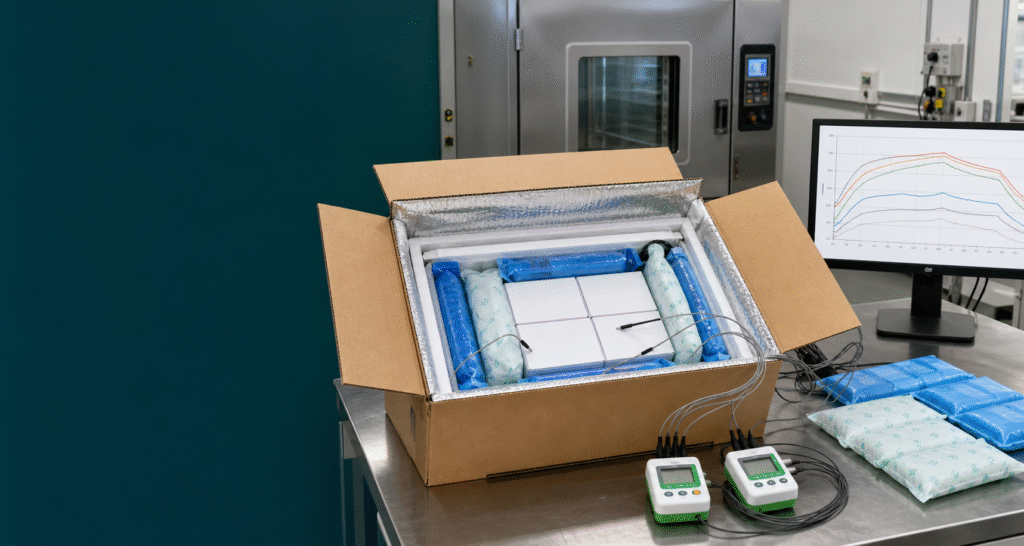
- Monitoring: device type, location, interval, alarm logic, calibration, data retrieval, and record ownership.
- People and handoffs: trained roles, custody changes, communication, escalation, and backup responsibility.
- Quality evidence: qualification, mapping, route trial, inspection, deviation investigation, release, and change control.
The exact controls depend on the product and market. WHO’s model guidance for time- and temperature-sensitive pharmaceutical products focuses on safe storage and distribution in that sector. It should not be presented as a universal food or consumer-product rule.
5. Set product conditions before choosing a temperature band
There is no single cold chain temperature. Chilled, frozen, controlled room temperature, ultra-cold, and other conditions can all belong to different cold chains when the product requirement supports them. The responsible product, quality, food-safety, or regulatory owner must define the approved condition and the decision process for an excursion.
Avoid copying a familiar range from a different sector. A vaccine requirement, a quick-frozen food specification, and a biological sample protocol can have different limits, exposure rules, light sensitivity, monitoring expectations, and release authority. The job of the cold chain is to maintain the defined product condition, not to force every product into a generic range.
Helpful decision tools
Check the details before you choose packaging
These quick tools can help you compare route risk, sizing needs, coolant choices, and packaging details before you request a quote.
Packaging Selector
Compare insulated packaging options by product, route, and temperature need.
Find packagingInsulation Material Drop Resistance
Review drop resistance and handling factors before choosing insulation materials.
Check resistanceRoute Risk Checker
Review lane conditions before selecting packaging for real operating requirements.
Check route risk6. Connect every control point to an owner and record
| Control point | Typical operational owner | Minimum decision record |
|---|---|---|
| Requirement approval | Product or quality owner | Approved limits and acceptance criteria |
| Storage readiness | Facility and operations | Mapping, monitoring, maintenance, and alarm status |
| Packout release | Packaging and trained operator | Configuration, component, conditioning, and inspection record |
| Transport handoff | Shipper and carrier | Custody, route, service, condition, and exception instructions |
| Receipt | Receiving and quality | Arrival condition, monitor data, damage, and acceptance result |
| Excursion disposition | Authorized quality or product owner | Data review, impact assessment, decision, and corrective action |
For medicinal products, the EU Good Distribution Practice guidelines connect product quality to organisational structure, procedures, resources, acceptable transport conditions, risk-based planning, monitoring, and deviation handling. Market-specific obligations still need review by the responsible team.
7. Treat monitoring as evidence, not the whole control system
A temperature logger can show what happened at its sensing location. It does not by itself prove that every product unit experienced the same condition, that the device was placed correctly, or that an excursion is acceptable. Monitoring must be connected to the approved requirement, the configuration, sensor position, time base, calibration status, alarm rule, and a documented review.
Storage mapping, equipment qualification, packaging qualification, route profiling, and shipment monitoring answer different questions. Select the evidence that supports the decision being made. The cold chain transport validation guide explains how test scope, acceptance criteria, and change control work together.
8. Recognize a break and control the recovery
A cold-chain break is not limited to a high or low reading. It can include an unapproved starting condition, missing data, equipment failure, a blocked air path, an unplanned transfer, damaged packaging, a delayed handoff, or loss of custody. A shipment may look cold and still lack the evidence needed for release.
- Protect and identify the affected product without assuming it is acceptable or unusable.
- Preserve logger data, time stamps, route events, configuration records, and physical observations.
- Confirm the approved product limits and the person authorized to make the disposition decision.
- Reconstruct when, where, and how control may have been lost.
- Assess the data against the product-specific procedure, not a generic internet temperature range.
- Record the release, quarantine, rejection, or other authorized decision.
- Investigate the cause across equipment, process, people, packaging, and handoffs.
- Implement corrective and preventive actions proportional to the risk.
- Review whether the route, configuration, training, or qualification must change.
9. Use a release and change-control checklist
Before declaring a cold chain “controlled,” confirm that the product requirement, system boundary, roles, equipment, packaging, monitoring, evidence, and deviation process agree with one another. Use the Route Risk Checker to identify route variables, the Packaging Selector to compare initial packaging directions, and the Compliance Checklist Generator to organise review points. These are planning aids, not qualification or regulatory approvals.
When packaging is the open decision, use the cold chain packaging systems guide or the logistics packaging request framework. When the shipment needs a defined insulated configuration, the cold chain box specification guide provides a component-level approach.
Reassess the system when a change can alter thermal exposure, custody, or the meaning of the evidence. Typical triggers include a new product or pack size, revised acceptance criteria, a different insulation or coolant, a new packing pattern, seasonal extremes, a carrier or service change, a new hub, longer dwell, monitoring changes, equipment maintenance, repeated alarms, or a route disruption. The review should decide whether document revision, risk assessment, testing, requalification, retraining, or enhanced monitoring is needed before routine use.
10. Frequently asked questions
What is the simplest meaning of cold chain?
It is a controlled supply chain that keeps a temperature-sensitive product within its approved conditions across a defined journey. It includes equipment and packaging, but also people, procedures, monitoring, records, and decisions.
Is cold chain the same as refrigerated transport?
No. Refrigerated transport is one possible control during movement. A cold chain can also include preparation, packing, cold storage, temporary staging, transfers, receiving, monitoring, and excursion decisions.
Does every cold chain use the same temperature range?
No. The approved condition depends on the product, sector, market, and responsible authority. The cold chain must be designed around that requirement rather than a universal temperature band.
What proves that a cold chain worked?
The evidence depends on risk, but it commonly connects an approved requirement with a defined configuration and process, suitable qualification or mapping, monitoring records, documented handoffs, physical inspection, and an authorized release decision.