A cold chain box should be specified as a complete temperature-controlled shipping system, not as an empty insulated container. A usable specification connects the product’s approved temperature limits, payload and route to the box, insulation, coolant, separators, packout instructions, monitoring, acceptance evidence and change control. Without those links, a wall thickness or claimed duration cannot show that the shipment will remain within its limits.
1. Define the cold chain box as a complete system
A cold chain shipping box can be passive or active. A passive system uses insulation and conditioned thermal media such as water-based packs or phase change material. An active system uses powered heating or cooling. This guide focuses on passive temperature controlled packaging, but the same discipline applies: the container, every component and the operating procedure must be treated as one configuration.
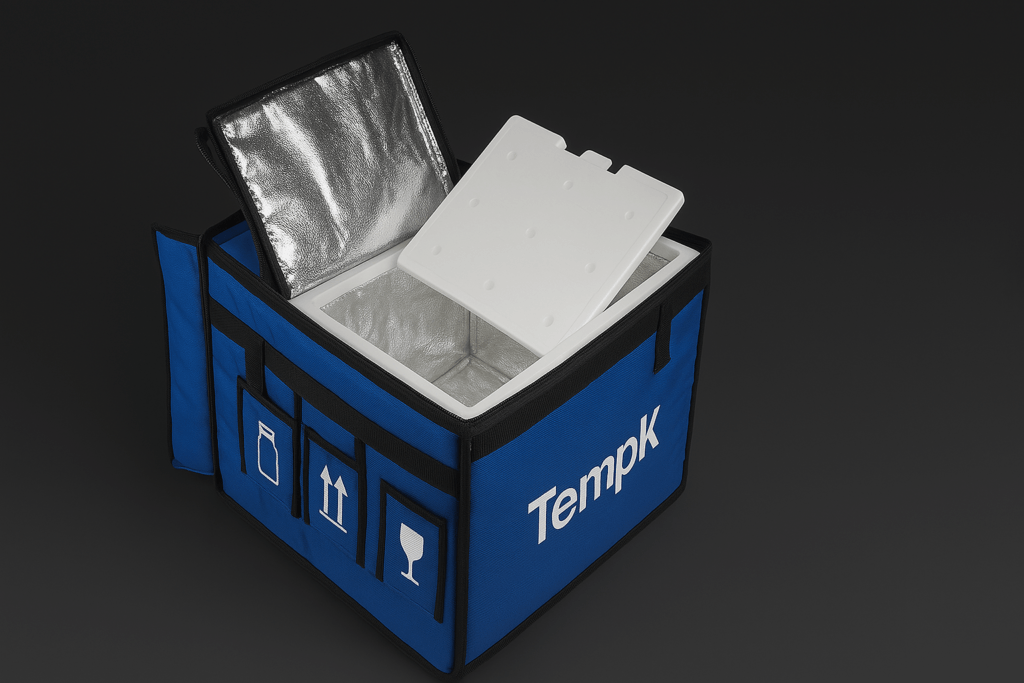
The word box is therefore shorthand. The released system may include an outer carton or reusable shell, insulation panels, an inner payload chamber, coolant, spacers, absorbent material, a temperature monitor, seals, labels and written preparation and loading instructions. Replacing one item can change heat flow, payload space or handling even when the new item looks similar.
2. Define the shipment before choosing a box
Begin with acceptance criteria. “Keep cold” is not a measurable requirement. Record the product’s approved storage and transport limits, whether freezing or overheating creates a separate risk, the allowable excursion decision process and who can release the product after transport.
Then describe the shipment the box must protect. The cold chain transport planning guide covers the wider route and handoff process; the box specification should capture the inputs that directly affect the packout.
| Input | Record before selection | Why it changes the system |
|---|---|---|
| Product limits | Approved range, freeze sensitivity, light or orientation restrictions | Sets acceptance criteria and the cold-source boundary. |
| Payload | Dimensions, mass, count, starting condition and required void space | Changes thermal mass, airflow and available coolant volume. |
| Route | Door-to-door time, planned stops, customs dwell, handoffs and recovery margin | Defines how long the package must protect the product. |
| Environment | Expected hot and cold extremes, season, direct sun and storage conditions | Sets the external challenge applied during qualification. |
| Operations | Pack location, staff, equipment, opening events and receiving capability | Determines whether the approved configuration can be reproduced. |
Use the Route Risk Checker to organize early route risks. It is a planning aid, not a substitute for product requirements or qualification evidence.
3. Write a component-level system specification
A temperature controlled shipping box specification should identify every item that affects fit, thermal behavior or handling. Use controlled part numbers or another unambiguous identifier rather than generic descriptions such as “foam insert” or “large gel pack.”
| Component | Specification fields | Release check |
|---|---|---|
| Outer container | Internal and external dimensions, closure, load limit, water resistance and reuse status | No damage that changes closure, geometry or protection. |
| Insulation | Material, thickness, panel arrangement, joints, orientation and protective layer | Correct pieces, intact surfaces and complete fit. |
| Payload chamber | Usable dimensions, payload limit, spacers, dividers and orientation | Released payload fits without compressing required layers. |
| Coolant | Type, phase-change point where applicable, count, mass, conditioning method and placement | Conditioning status, count and layout match the packout. |
| Monitor and labels | Device type, location, start method, alarm limits, identifier and required shipping labels | Device is active and the package is traceable. |
The VIP packaging range shows one insulation option. A vacuum insulation panel can reduce heat transfer and wall thickness, but it is not automatically the best choice for every lane. Puncture protection, panel joints, cost, reuse inspection and local packout capability still matter.
4. Match insulation and coolant to the route
Choose the insulation and cold source together. More coolant is not a universal fix: it can reduce payload space, increase weight and create cold spots. A colder source can also damage a product that must remain chilled rather than frozen.
| Shipping need | Possible design direction | Evidence required before release |
|---|---|---|
| Chilled, freeze-sensitive payload | Conditioned coolant or a suitable PCM with defined separation | Cold-spot data, starting-condition limits and a repeatable layout. |
| Frozen payload | Frozen coolant or solid CO₂ where compatible and permitted | Product compatibility, safe handling, venting where required and mode-specific rules. |
| Long or uncertain route | Higher-performance insulation, recovery margin or a qualified replenishment plan | Representative duration, dwell and external-temperature evidence. |
| Reusable lane | Durable shell and replaceable controlled components | Inspection criteria, cleaning, life-cycle limits and requalification triggers. |
Use the Packaging Selector to compare an initial direction. The Ice Pack Calculator and Dry Ice Calculator can support early estimates, but they do not release a route or replace a documented packout.
5. Convert the route into a qualification profile
A box claim has meaning only when its test conditions match the decision you need to make. Define payload, starting temperatures, packout, external profile, duration, orientation and sensor positions. Include credible dwell and handoff conditions rather than testing only the scheduled transit time.
The World Health Organization’s technical supplement on qualification of shipping containers provides a useful framework for time- and temperature-sensitive pharmaceutical products. The EU Good Distribution Practice guidelines likewise connect container selection to product requirements, payload space, external temperature extremes, maximum transport time and qualification status.
These documents do not make every cold chain box a pharmaceutical solution. They show why the user must link evidence to the actual product and route. For a practical evidence workflow, see the cold chain transport validation guide.
Helpful decision tools
Check the details before you choose packaging
These quick tools can help you compare route risk, sizing needs, coolant choices, and packaging details before you request a quote.
Insulation Material Drop Resistance
Review drop resistance and handling factors before choosing insulation materials.
Check resistanceInsulation Material Reference
Compare insulation material choices for different cold chain packaging needs.
Compare materialsCoolant & PCM Reference
Compare coolant and PCM options when a route needs added temperature support.
Compare options6. Pack the system in ten controlled steps
- Verify the released configuration. Match the box, insulation, coolant, dividers, monitor and labels to the current specification.
- Inspect all components. Reject damaged shells, wet cartons, punctured panels, leaking packs or parts that no longer fit.
- Confirm product and payload. Check identity, quantity, starting condition, orientation and any freeze-sensitive separation requirement.
- Condition thermal media. Follow the defined temperature, time, equipment and handling method; appearance alone is not proof of conditioning.
- Prepare the box. Install insulation and protective layers in the specified order and orientation.
- Load the first coolant layer. Use the released count, position and separator; do not improvise around a missing component.
- Place the payload and monitor. Keep the payload arrangement and sensor location consistent with the qualified configuration.
- Complete the coolant and void-fill layout. Control movement without compressing the insulation or blocking a required vent path.
- Close and identify the package. Apply the specified closure, tamper evidence, orientation marks and transport labels.
- Record and release. Capture pack time, component identifiers, coolant conditioning, monitor status, operator and route documents.
The packout should be usable at the workbench. If an operator must infer quantity, placement or conditioning from experience, the instruction is not complete.
7. Ask for evidence that matches the decision
A specification sheet shows what the supplier intends to provide. A test report shows what one configuration did under stated conditions. A route qualification or operational record shows how the released system performs in a defined use. Keep these evidence types separate.
- Component evidence: dimensions, material identification, drawings, tolerances and incoming inspection criteria.
- Thermal evidence: complete configuration, payload, preconditioning, profile, duration, sensor positions, raw data, acceptance criteria and deviations.
- Operational evidence: training, packing records, monitor data, receiving records and investigation outcomes.
Do not rely on an isolated statement such as “96 hours,” “validated” or “regulatory approved.” Ask what exact system was tested, against which profile, with what payload and acceptance criterion. The current CDC Vaccine Storage and Handling Toolkit, for example, distinguishes qualified containers and packouts from ordinary food or beverage coolers for vaccine transport. That is a product-specific example, not a universal rule for every payload.
8. Plan monitoring, receiving and excursions
Monitoring begins with the product requirement and the decision process. Define the device, calibration status, logging interval, sensor location, start and stop method, alarm or review limits and data owner. A logger placed for convenience may not represent the warmest or coldest product location.
At receipt, staff should confirm package identity and condition, retrieve the monitor data when required and move the product to approved storage without unnecessary delay. If data fall outside the approved limits, quarantine or otherwise control the affected product and follow the product owner’s excursion assessment. Do not release or discard solely from a generic article.
Air shipments may add carrier, labeling, documentation and handling requirements. Consult the current carrier rules and the current IATA Temperature Control Regulations where they apply.
9. Use a release and change-control checklist
Approve the system only when the specification, evidence and operating process agree. Use the Compliance Checklist Generator to organize a review, then apply the requirements of the product, organization, route and jurisdiction.
- Product limits, payload and route profile are defined.
- Every system component has an identifier and acceptance criterion.
- Coolant conditioning, placement and quantity are explicit.
- The qualification configuration matches the released packout.
- Monitor placement and the receiving decision process are documented.
- Operators have controlled instructions and training.
- Reuse inspection, cleaning and retirement criteria are defined where applicable.
- Changes are reviewed before routine use expands.
Review changes to the box, insulation, coolant, supplier, payload, loading pattern, monitor location, closure, route, carrier, duration or external profile. The review should decide whether the existing evidence still applies, whether a comparison test is enough or whether requalification is required. For food and frozen delivery applications, the insulated-box guide for frozen food provides a separate application view.
Frequently asked questions
Is a cold chain box the same as a refrigerated container?
Not necessarily. Many cold chain shipping boxes are passive systems that use insulation and conditioned coolant. A refrigerated or active container uses powered temperature control. The specification should state which system is being used and what happens during unpowered periods or handoffs.
How long will a temperature controlled shipping box hold temperature?
There is no universal duration. Hold time changes with insulation, coolant, payload, starting conditions, external temperatures, openings and test method. Use evidence for the complete configuration and a profile that represents the route.
Can I change the coolant or insulation without retesting?
Do not assume that equal size or thickness means equal performance. Review the material, thermal properties, geometry, placement and operational effect. Document whether the existing qualification remains applicable and test again when the change could affect acceptance.
What should I send when requesting a cold chain box recommendation?
Provide the product temperature limits, freeze sensitivity, payload dimensions and mass, starting condition, route time and dwell, external temperature range, shipping mode, opening events, monitoring needs, reuse plan and required evidence. That information supports a defensible recommendation; a product name alone does not.