


Estimate coolant mass
Use payload weight, box size, route duration, and ambient season before the first lane test.
Seafood subscription boxes need chilled temperature control, drip containment, odor protection, and a clean unboxing experience. Fresh fish, shellfish, and mixed seafood packs should stay cold without direct coolant pressure, standing meltwater, or carton wet-out.
The coolant amounts below are starting ranges for planning. Final packout should be validated with the exact order mix, shipper size, carrier lane, and season.
| Route condition | Temperature intent | Tempk packaging setup | Coolant planning range | Coolant position |
|---|---|---|---|---|
| Fresh seafood box, 8-18 h | 0-2 C or 0-4 C chilled route | Insulated carton or EPP box, leak liner, absorbent pad, odor barrier, separated gel packs or 0 C PCM. | 0.8-1.6 kg gel packs or PCM for 1-4 kg payload. | Top/side coolant with divider; avoid direct pressure on fish packs. |
| Overnight seafood subscription, 18-36 h | Near-ice chilled route | Thicker insulation, sealed liner, absorbent base, logger in product air space. | 1.6-3.0 kg gel packs or PCM for 1-4 kg payload. | Perimeter coolant plus separated top layer; keep seafood out of standing liquid. |
| Hot lane or delay risk, 36-48 h | Validated chilled lane | Higher insulation, double leak containment, reduced headspace, route risk check. | 3.0-4.8 kg gel packs or PCM for 1-4 kg payload. | If drip or odor escapes, improve liner and absorbent design before adding coolant. |
Use the Ice Pack Calculator for chilled routes. For frozen boxes, compare with the Dry Ice Calculator before testing.
A good subscription box should hold temperature and still arrive clean, readable, separated, and easy for the customer to unpack.
Fish fillets, shellfish, and mixed seafood boxes have different pressure, moisture, and odor risks.
Use a liner, absorbent pad, and sealed inner layer so drip does not reach the outer carton.
Place gel packs or PCM above and around the seafood chamber with a divider to prevent freeze marks or pressure damage.
Check temperature, drip, odor, label condition, carton wet-out, and whether coolant shifted during parcel handling.
Use these checks when adjusting coolant quantity, liner structure, insulation thickness, or fulfillment timing.
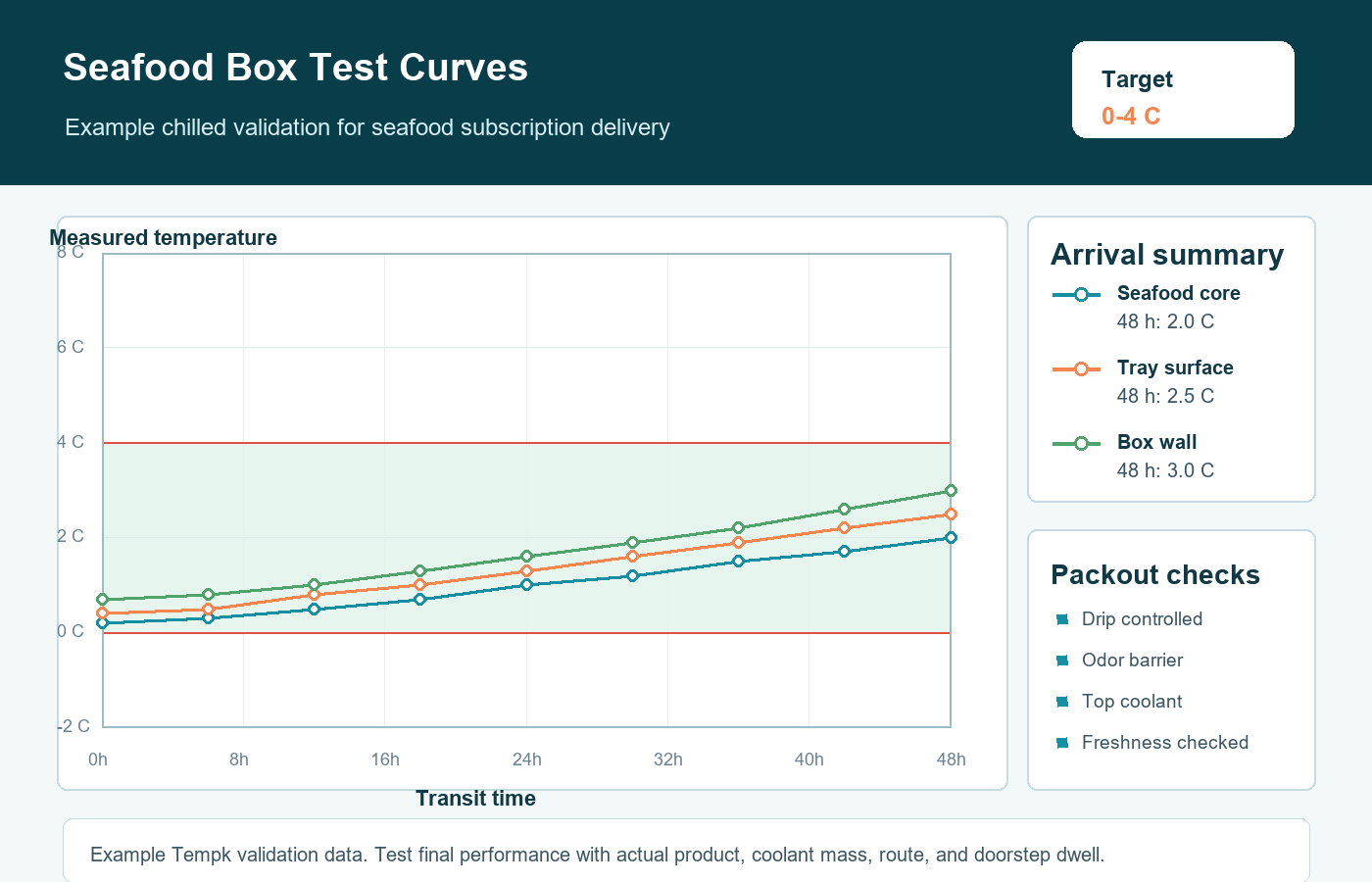
Use the product page for handling logic, then size the first trial with tools and validate the real parcel route.
Use payload weight, box size, route duration, and ambient season before the first lane test.
Compare conditioned gel packs, 0 C PCM, and dry ice where frozen delivery is required.
Review fulfillment dwell, pickup delay, last-mile exposure, and receiving window before launch.
Share the product mix, payload weight, box size, fulfillment dwell time, route duration, season, and receiving standard. Tempk can help choose insulation, coolant mass, liner structure, and validation checks.
Custom packout support
For fixed carton sizes, payload limits, branding requirements, seasonal lanes, or validation targets, Tempk can adapt this solution into a custom cold-chain packout.