


Salmon Fillets
Protect chilled texture, skin-side presentation, drip control, and carton dryness without letting frozen gel packs touch the fish pack directly.
Seafood shipments fail for different reasons: fresh fillets can leak and lose texture, tuna steaks need tighter warm-dwell control, oysters must stay cold without freezing, and frozen seafood needs a separate frozen-route plan. This page helps match seafood type to insulation, coolant placement, moisture control, and route validation.
Fresh fish, live shellfish, and frozen seafood need different coolant behavior. The packout should protect temperature, moisture, leakage, odor, and product pressure at the same time. For fully frozen lanes, see frozen foods cold chain packaging solutions.
Protect chilled texture, skin-side presentation, drip control, and carton dryness without letting frozen gel packs touch the fish pack directly.
Control warm dwell, surface color, odor transfer, and pressure marks for histamine-sensitive tuna programs that move through parcel or air routes.
Keep oysters cold, damp, and protected from freezing, standing meltwater, crushing force, and unreadable shellfish tags.
These planning ranges help decide which Tempk packout to validate first. Final coolant mass should be tested with the actual payload, box size, lane temperature, and service level.
| Seafood route | Common target | Packaging structure | Coolant starting point | Watch first |
|---|---|---|---|---|
| Fresh fillets, 8-18 h | Hold close to 0-2 C for quality while staying within the shipper’s food safety program. | Leak liner, absorbent pad, product tray or vacuum bag, side/perimeter coolant, EPP or insulated carton. | About 0.6-1.2 kg conditioned gel packs or 0 C PCM for 1-3 kg payload. | Direct freeze marks, drip, wet cartons, odor transfer. |
| Fresh fish, 18-36 h | Near-ice chilled route with less warm dwell at pickup and delivery. | Stronger insulation, sealed inner liner, separated top and side coolant, logger in product air space. | About 1.2-2.4 kg gel packs or PCM for 1-3 kg payload. | Coolant contact, box compression, receiving temperature. |
| Live shellfish, 8-30 h | Cold and damp, but not frozen or submerged in meltwater. | Breathable or non-airtight shipper design as required, damp liner, shell protection, separated coolant above or beside product. | About 0.5-1.8 kg conditioned gel packs, adjusted to shellfish volume and season. | Freezing injury, standing water, shell breakage, tag readability. |
| Frozen seafood | -18 C or below when the route is specified as frozen. | Frozen shipper, dry ice or frozen coolant plan, vapor gap, label and carrier checks. | Use dry ice planning by box size, payload, route time, and carrier limit. | Dry ice sublimation, regulatory marking, thaw at last mile. |
Use these as planning ranges, then validate. For frozen seafood pallets, see Frozen Seafood Pallets.
A seafood route check should show both temperature control and product condition at receiving: drip, odor, shell or fillet pressure, label condition, and whether coolant stayed separated from the product.
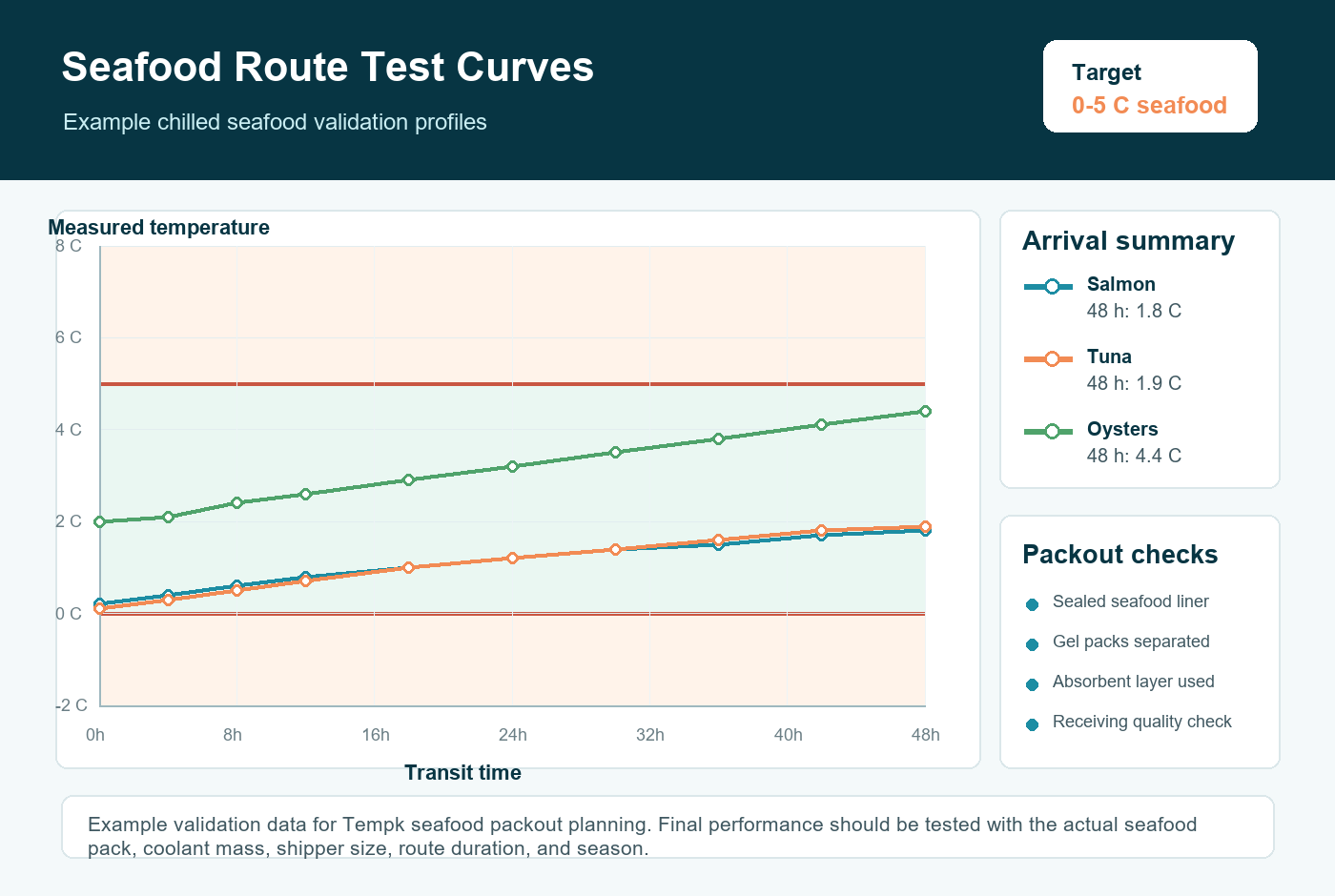
Use these product notes when the seafood type is not one of the three priority pages but still needs different moisture, pressure, or coolant placement decisions.
For smaller seafood programs that still need product-specific handling notes, review the packout guide before building the lane test.
For smaller seafood programs that still need product-specific handling notes, review the packout guide before building the lane test.
For smaller seafood programs that still need product-specific handling notes, review the packout guide before building the lane test.
For smaller seafood programs that still need product-specific handling notes, review the packout guide before building the lane test.
For smaller seafood programs that still need product-specific handling notes, review the packout guide before building the lane test.
Run a first calculation, choose the coolant family, and then validate the route with the actual seafood packout. For parcel and express lanes, see parcel and express delivery cold chain solutions.
Related programs: Seafood Subscription Boxes and all cold chain solutions.
Share the seafood form, payload weight, box size, service level, origin temperature, lane season, and receiving window. Tempk can help compare insulation, coolant mass, placement, and validation steps.
Seafood shipments should not use one fixed box recipe for every product. Start with 0-2 C chilled control for fresh seafood or -18 C control for frozen formats, then separate products by heat load, packaging strength, and how they are received. For mixed programs, Tempk usually compares a short local route, an overnight parcel route, and the hottest expected season before confirming the shipper.
Use a leak-resistant liner, absorbent layer, insulated shipper, and outer carton with clear orientation control. The coolant plan should begin with gel ice packs for chilled seafood, dry ice or frozen PCM only when the product is sold frozen. When the payload has delicate retail cartons, soft texture, live material, or medical documentation, protect the payload first and then add cooling capacity. If the shipment is delayed at packing, handoff, customs, or dock transfer, the route profile should be rechecked instead of only increasing coolant weight.
Validation should include check drip loss, odor control, surface dryness, and logger records at the warmest product point. A useful test records the warmest payload point, the coldest point near coolant, and the receiving condition after handling. This gives the operations team a practical packout instruction, not just a temperature chart.
Custom packout support
For fixed carton sizes, payload limits, branding requirements, seasonal lanes, or validation targets, Tempk can adapt this solution into a custom cold-chain packout.