


Temperature intentFollow the approved product label and build the route around the labeled refrigerated range, commonly 2-8 C where required.
GLP-1 Pens Cold Chain Packaging Solution
GLP-1 pen shipments are often high-value, small-payload parcels with demanding customer expectations. The packout should protect the labeled refrigerated range, prevent freezing, support the carton, and reduce risk from delivery dwell or direct coolant pressure.
What the package needs to control
Coolant ruleUse conditioned gel packs or PCM around a protected payload cavity; do not let frozen packs touch pen cartons.
Packaging focusSmall carton support, label protection, delivery dwell risk, and clear unboxing evidence matter for DTC programs.
Choose the packout by route condition
| Route condition | Packaging setup | Preliminary coolant range | Placement and receiving check |
|---|---|---|---|
| Local or pharmacy courier, 4-8 h | Small EPP or insulated carton, rigid inner tray, side coolant and spacer. | 0.3-0.8 kg conditioned gel packs or PCM for a 0.5-2 L payload. | Confirm carton corners, logger position, and fast handoff. |
| DTC parcel, 8-24 h | Insulated carton or EPP shipper, center cavity, side/top coolant, label/document protection. | 0.8-1.8 kg conditioned gel packs or PCM for a 0.5-3 L payload. | Check minimum temperature, carton crush, label condition, and porch dwell. |
| Extended parcel route, 24-36 h | Thicker insulation, balanced coolant, larger buffer area, stronger inner tray. | 1.8-3.2 kg conditioned gel packs or PCM, qualified by route and season. | If direct cold spots appear, revise spacer design before increasing coolant mass. |
Use these ranges as a starting point for packaging review. Confirm the final coolant mass with the approved label, payload count, shipper size, route duration, ambient profile, logger placement, and internal quality procedure.
How Tempk would build the shipment
Protect the small carton first
Use a rigid inner tray or center cavity so coolant and parcel handling do not crush the pen carton.
Separate coolant from product
Conditioned gel packs or PCM should surround the payload cavity while spacer layers prevent direct frozen contact.
Plan for delivery dwell
Home-delivery lanes can sit at the door. Validate the warmest expected dwell, not only the carrier transit time.
Make receiving simple
Use clear logger placement, protected labels, and a neat unboxing sequence so the receiver can review the shipment quickly.
Common failure points to prevent
For medicine parcels, a cold-feeling package is not enough. The receiver needs a documented shipment that stayed inside the required range and protected the product package.
- Freeze excursion from direct gel-pack contact.
- Warm exposure during final delivery dwell.
- Crushed pen cartons in small parcel handling.
- Unclear receiving evidence when logger placement is not defined.
Validation curve and receiving evidence
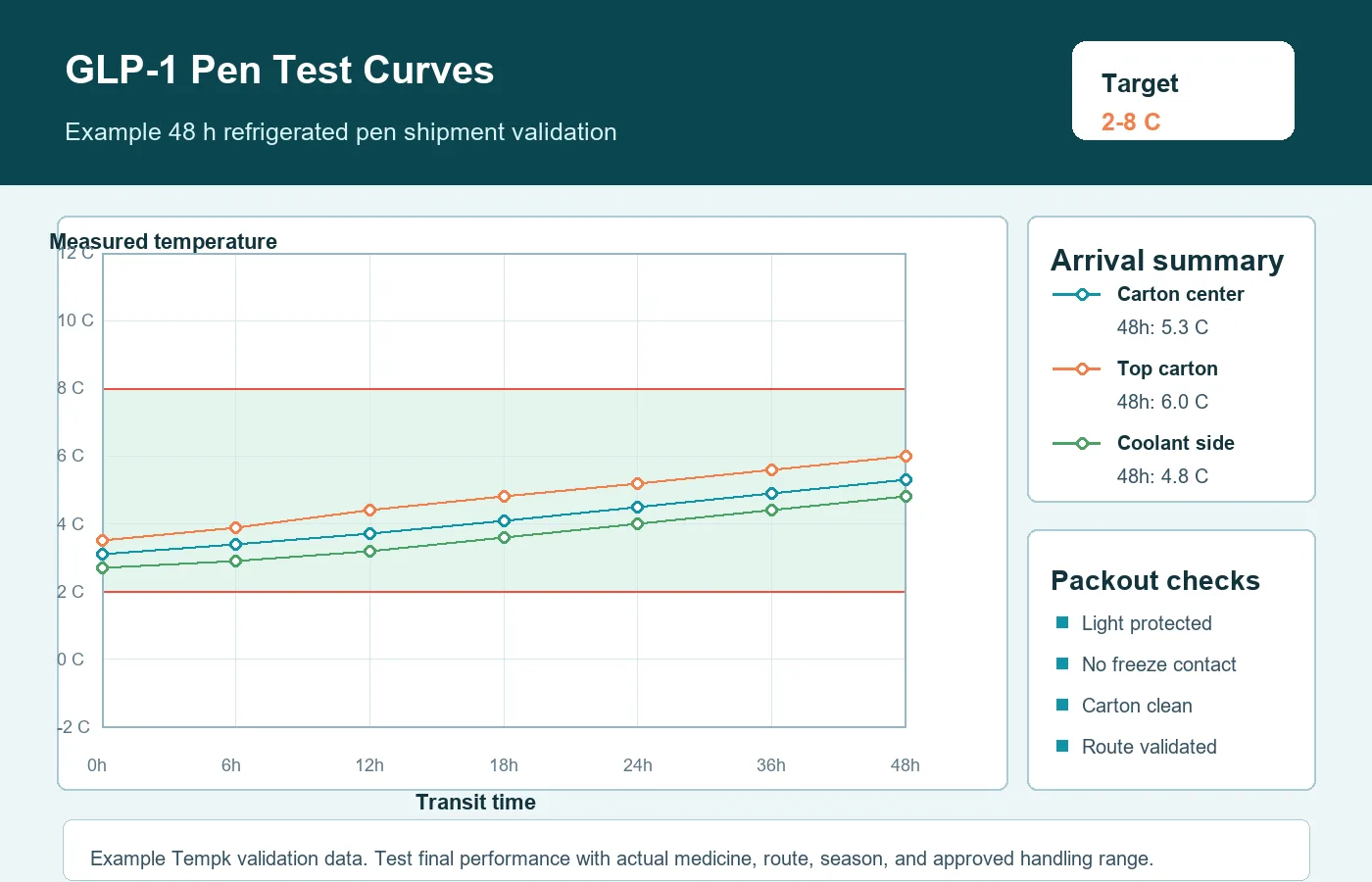
Review the curve with the actual payload, coolant mass, shipper size, lane duration, and season. Add receiving notes for carton condition, label clarity, product movement, and any direct coolant contact.
Related pages for packout planning
Practical route notes
Build GLP-1 pen shipments for refill reliability
GLP-1 pen programs often ship as recurring refills, so the packaging must perform consistently across summer, winter, weekends, and residential delivery holds.
Where this product usually fails
Failures show up as freeze alarms, warm excursions after missed delivery, damaged injector boxes, and customer uncertainty about whether the medicine is still usable.
Packaging setup to test first
Use a formed payload bay or insert that holds injector boxes upright. Separate coolant with a spacer and include clear receiving instructions for refrigeration on arrival.
Coolant choice
Use qualified 2 to 8 C PCM for difficult lanes or carefully conditioned gel packs for validated shorter routes. Add insulation rather than colder direct-contact packs.
Route validation check
Validate refill box sizes, not only one sample. Review logger data, carton condition, and the delivery-to-refrigerator time that real customers experience.
Packout detail
GLP-1 refill shipments need consistent repeat performance
Use case
GLP-1 pen programs often ship repeatedly to the same customer base. A packout that is difficult for warehouse staff to repeat can create inconsistent temperature results even when the first lab test passed.
Packaging choice
Use a fixed insert, defined coolant conditioning time, and a clear pack sequence. For long summer lanes, qualified 2 to 8 C PCM is often more predictable than simply adding more frozen gel mass.
What Tempk should validate
Tempk validation should include refill carton sizes, weekend risk, residential handoff, and both hot and cold ambient profiles. Check logger data, carton condition, customer opening experience, and the delivery-to-refrigerator gap. If the program uses subscription fulfillment, test the smallest refill box as well as the promotional bundle size.
Custom packout support
Need this lane built around your product and route?
For fixed carton sizes, payload limits, branding requirements, seasonal lanes, or validation targets, Tempk can adapt this solution into a custom cold-chain packout.
Need this medicine route checked before shipment?
Send the product label temperature, payload size, carton dimensions, service level, ambient condition, delivery handoff, and logger requirement. Tempk can help compare insulation, conditioned gel packs, PCM, buffer layers, inserts, and validation steps.
Request a packout review