


Cup-lid pressure
Stacked cups and parcel vibration can stress lids, foil seals, and multipack cartons.
Yogurt shipments need chilled control plus cup, lid, and texture protection. The packout should prevent warm dwell, freezing, carton softening, and lid pressure from stacked cups.
A dairy shipment should be judged by both temperature and arrival condition. The packout below gives a practical starting point before lane testing and customer handoff checks.
Stacked cups and parcel vibration can stress lids, foil seals, and multipack cartons.
Warming and local freezing can both affect the expected texture and customer-facing quality.
Cold packs can create moisture that weakens carton board and hides lid damage.
| Route condition | Temperature intent | Packaging setup | Preliminary coolant range | Receiving check |
|---|---|---|---|---|
| Short chilled route, 4-8 h | Keep the yogurt chilled according to the product requirement; avoid direct frozen contact on cup lids. | Insulated carton, cup tray, liner, small conditioned gel pack or PCM separated from the lid area. | About 0.8-1.6 kg for 6-12 retail cups. | Cup lids, carton dryness, product temperature, and handoff time. |
| Warm e-commerce route, 8-24 h | Chilled route with condensation and stack-pressure control. | EPP or insulated carton, tray/divider insert, side/top coolant with buffer, moisture-control layer, optional logger. | About 1.6-3.2 kg for 12-24 cups, adjusted by carton size. | Lid condition, texture, carton compression, label wetting, and remaining coolant. |
| Hot season or 24-36 h route | Validated chilled route with additional dwell allowance and no local freezing. | Higher-performance insulation, tray support, conditioned gel packs or PCM around the carton, logger near center and cold side. | About 3.0-5.0 kg for a larger multipack shipper; confirm by test. | Logger curve, cup/lid pressure marks, texture, carton dryness, and remaining coolant state. |
Use these ranges for sampling and quotation. Final coolant mass should be confirmed with the actual product temperature, unit count, package size, shipper volume, route duration, ambient profile, and receiving requirement.
Pack from normal chilled storage. If the cups enter warm, the parcel has to remove heat and route risk increases.
Use a tray, divider, or carton insert so the top layer does not crush the lower layer during courier handling.
Place conditioned coolant around the tray with a buffer layer so it cools the air space without pressing on lids.
Receiving should review temperature, lid seal, carton dryness, texture, label clarity, and remaining coolant.
These are the visible and operational issues the packout should reduce before the shipment reaches the receiver.
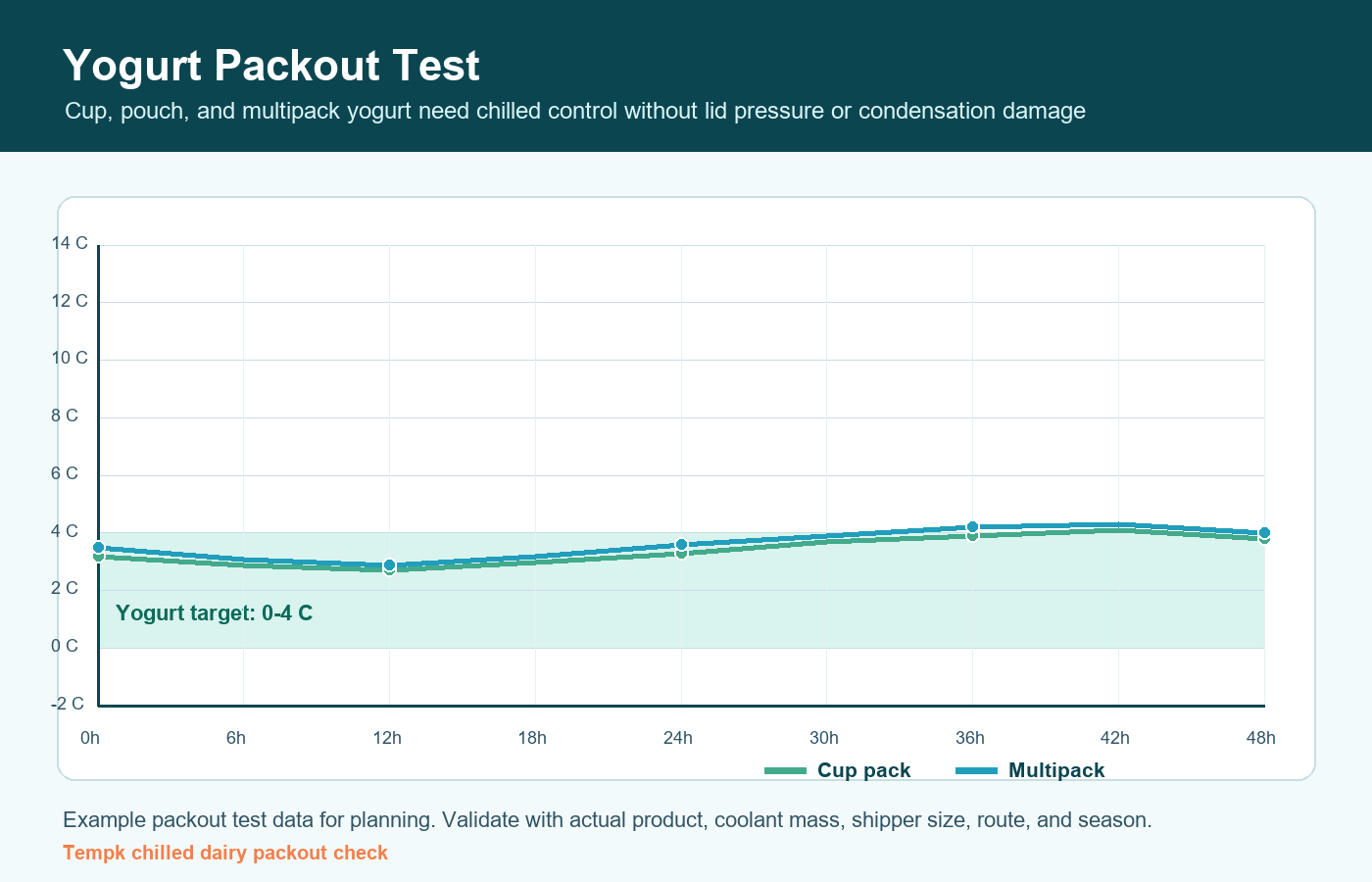
Use the test curve as a working comparison, then validate with the actual product, coolant mass, insulation, route duration, and season. For dairy, also check leakage, condensation, package pressure, texture, odor, and remaining coolant.
Use these pages to compare nearby dairy routes, select coolant, and check route risk before sampling.
Yogurt needs chilled temperature and gentle handling. Freezing can damage texture, while warm periods can cause whey separation and customer rejection.
Typical issues are cup seal lift, whey separation, crushed multipacks, label wetting, and off-odor after delayed receiving.
Keep cups upright in trays or dividers. Use a flat buffer before top coolant so lids do not flex under pack weight.
Use chilled gel or PCM for 2 to 6 C handling. Avoid direct frozen packs against yogurt cups because texture can be damaged by local freezing.
Inspect seal integrity, syneresis, cup deformation, and temperature. Let one sample rest before checking texture.
Yogurt can be rejected when it freezes locally, separates, or arrives with flexed lids. The coolant should hold the chilled lane while avoiding direct cold spots on cups and multipacks.
Use upright trays, a top divider, and conditioned gel packs around the product stack. If summer delivery is long, consider PCM rather than colder direct-contact packs.
Tempk should test cup size, multipack format, payload count, and route duration. The receiving check should include temperature, seal condition, whey separation, cup deformation, and label dryness.
Custom packout support
For fixed carton sizes, payload limits, branding requirements, seasonal lanes, or validation targets, Tempk can adapt this solution into a custom cold-chain packout.
Share the product form, target temperature, payload count, carton size, route duration, ambient condition, courier handoff, and receiving checks. Tempk can help compare gel packs, PCM, EPP, insulated cartons, liners, inserts, and logger placement.
Request a packout review