


Freeze contact at the coolant face
Frozen gel packs or ice bricks can create a cold spot that does not appear in a center-only logger reading.
Red blood cell shipments need refrigerated control without freezing the component or pressing bags against hard coolant. The packout should protect the component, the label, the document set, and the temperature record at the same time.
Blood product shipments should be judged by temperature history and by receiving condition. The details below are packaging planning guidance; final handling must follow your facility procedure and local requirements.
Frozen gel packs or ice bricks can create a cold spot that does not appear in a center-only logger reading.
Door-open transfer, courier wait time, and receiving delay can lift the outer payload faster than expected.
Tight inserts, heavy coolant, or condensation can damage bags, labels, and paperwork needed at receiving.
| Route condition | Temperature intent | Packaging setup | Coolant or dry ice planning | Receiving check |
|---|---|---|---|---|
| Controlled vehicle or short courier, 0-6 h | Maintain refrigerated handling and avoid freezing; align with the facility procedure for red cells. | Pre-conditioned insulated medical shipper, absorbent liner, bag cradle, one logger near payload, coolant separated by divider. | Often no frozen coolant against payload. For a 3-8 L parcel, test 0.8-1.5 kg conditioned 2-8 C gel or PCM behind a barrier. | Temperature curve, no cold marks, dry label, bag support, and handoff time. |
| Standard parcel or summer route, 6-24 h | Refrigerated route with stronger warm-side protection and no direct ice contact. | EPP or insulated carton shipper, thicker divider, absorbent secondary containment, two loggers for warm and cold positions. | Start trials around 1.5-3.5 kg conditioned 2-8 C gel or PCM for small parcels; increase only after cold-spot review. | Warm edge, cold face, condensation, label readability, and receiving delay. |
| Cold winter route or air transfer | Prevent freezing from ambient exposure while still holding refrigerated control. | High-insulation shipper, coolant reduced or buffered, non-direct contact layout, payload wrapped in support sleeve. | Use conditioned PCM rather than frozen gel where chill risk is high. Test the lowest expected ambient before live shipment. | Minimum temperature, cold-spot location, bag flexibility, outer carton dryness, and courier dwell time. |
Use these ranges as a starting point for sampling and quotation. Final coolant, PCM, dry ice, insulation, and monitoring choices should be validated with the real payload, shipper size, route duration, carrier process, season, and receiving procedure.
The component should enter a stable refrigerated packout. Do not rely on the box to pull a warm payload back into range.
Use a divider, foam spacer, or payload sleeve so gel packs or PCM cannot touch bags directly.
Place documents outside wet zones and use absorbent or leak-resistant containment around the payload.
Place one sensor near the likely warm edge and another near the coolant-side risk point during validation.
These are the visible and operational issues the packout should reduce before the shipment reaches the receiver.
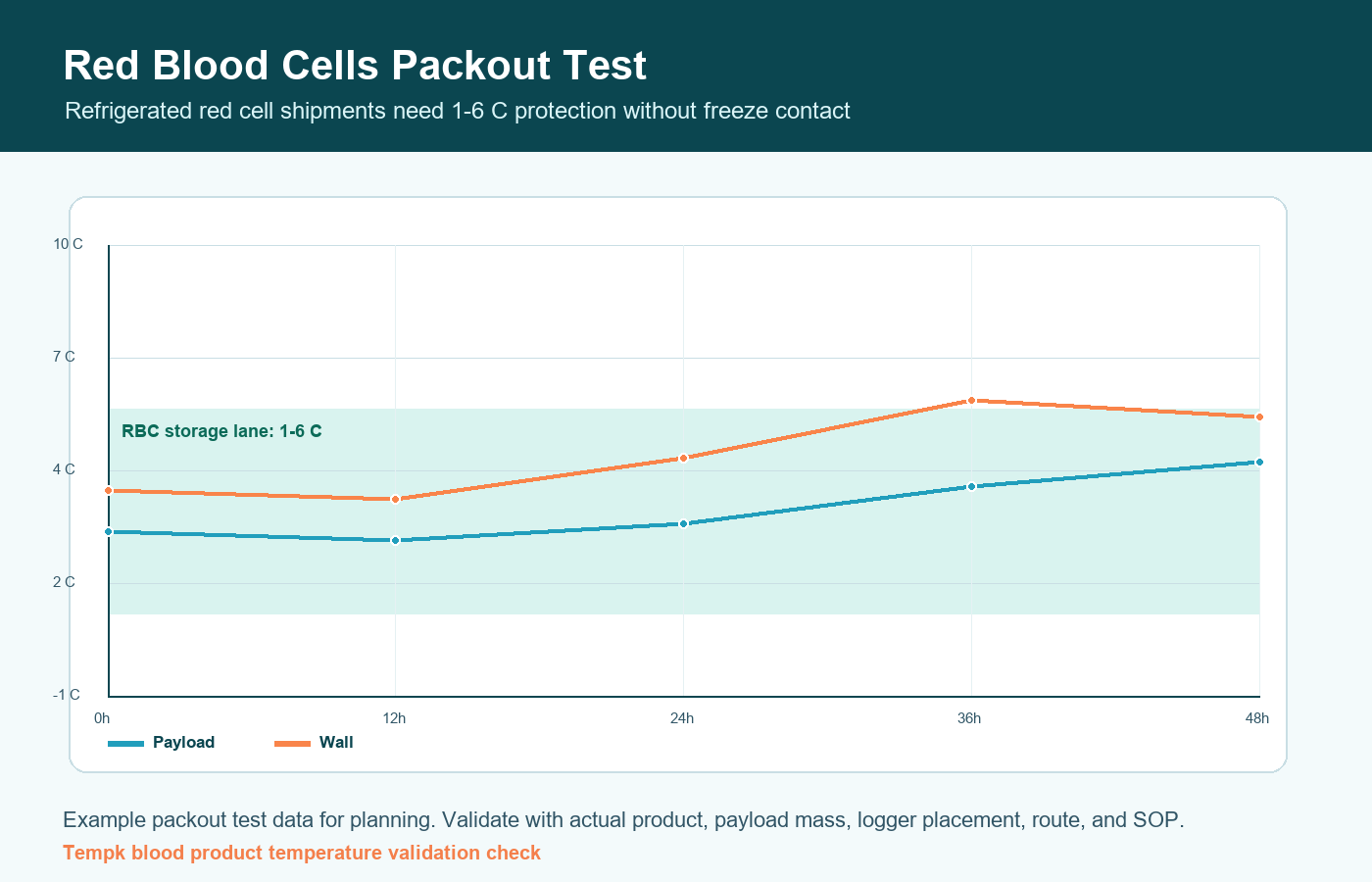
Use the test curve as a working comparison, then validate with the actual payload, shipper, coolant or dry ice mass, lane duration, ambient profile, and receiving process.
Use these pages to compare nearby blood product routes, coolant choices, insulation options, and route-risk questions before sampling.
Red blood cells require controlled chilled transport with careful logger placement. The package should prevent both warming and accidental freezing during handoff.
Freeze exposure, warm receiving delays, bag pressure points, and poor payload separation are the main failure modes.
Use a qualified blood shipper with a payload compartment, absorbent liner, and separation from coolant. Keep bags flat enough to avoid pressure damage.
Use qualified 1 to 6 C packaging components. Do not substitute standard frozen gel packs without full validation.
Review minimum and maximum logger data, bag condition, leak control, and time from delivery to controlled storage.
Red blood cells require a qualified chilled route, not a generic ice-pack box. The payload area should protect bags from direct coolant and include enough absorbent control for leakage risk.
Use validated 1 to 6 C components and keep the temperature logger in the payload zone. A logger against the cold wall may overstate freeze risk, while a logger outside the payload may miss warming.
Tempk review should cover bag count, payload mass, route duration, handoff time, and receiving workflow. Check minimum and maximum temperature, bag condition, leakage, and transfer into controlled storage.
Custom packout support
For fixed carton sizes, payload limits, branding requirements, seasonal lanes, or validation targets, Tempk can adapt this solution into a custom cold-chain packout.
Share the component type, payload count, bag or container size, target range, route duration, ambient condition, courier steps, handoff limit, and receiving checks. Tempk can help compare the shipper, coolant layout, support insert, monitoring position, and validation plan.
Request a packout review