


Blood Specimens
Match the test protocol, then protect tubes from freezing, heat, cap leakage, breakage, and missing receiving records.
Clinical sample packaging should begin with the sample type, test protocol, container, and maximum transport time. Tempk helps labs, CROs, hospitals, and diagnostic networks compare the shipper, coolant, secondary containment, absorbent layer, tube or container support, logger position, and receiving checks before route validation.
Blood tubes, tissue containers, and PCR swabs do not need the same packout. One route may be refrigerated, another may be ambient, and a frozen test may require dry ice or ultra-low handling. The useful packaging decision is to protect both sample integrity and the lab receiving workflow.
Match the test protocol, then protect tubes from freezing, heat, cap leakage, breakage, and missing receiving records.
Fresh, fixed, and frozen tissue routes need different temperature choices, cushioning, leak control, and handoff timing.
Protect swab tubes or VTM/UTM containers with upright support, coolant separation, short handoff windows, and clear lab paperwork.
| Sample route | Temperature intent | Packaging setup | Coolant or dry ice planning | Receiving check |
|---|---|---|---|---|
| Blood specimens for routine refrigerated transport | Follow the test protocol. Many routine sample lanes are planned around 2-8 C, while some tests need ambient or frozen handling. | Leak-resistant secondary packaging, absorbent layer, tube rack or sleeve, coolant divider, outer insulated shipper, and logger near the warm edge. | For a small 3-8 L shipper, trials often start around 0.6-1.5 kg conditioned gel or 2-8 C PCM for 0-8 h, and 1.5-3 kg for 8-24 h lanes. | Tube condition, cap seal, no freezing, no leakage, readable labels, chain record, and arrival temperature. |
| Biopsy or tissue specimens, fresh, fixed, or frozen | Use the collection or lab protocol. Fresh tissue may need 2-8 C, fixed tissue may move differently, and frozen tissue may require dry ice. | Rigid primary container, absorbent secondary packaging, cushioning, upright support, wet-zone separation, and document sleeve away from coolant or liquid. | For fresh 2-8 C tissue, start around 0.8-2.5 kg conditioned coolant in small shippers. For frozen tissue, use dry ice only where protocol and carrier rules allow. | No leakage, container intact, tissue not crushed, correct temperature record, dry documents, and lab handoff time. |
| PCR swab specimens in VTM, UTM, or dry swab tubes | Follow the diagnostic protocol. Short lanes often use 2-8 C; delayed or protocol-specific lanes may require frozen handling. | Upright tube divider, absorbent layer, sealed secondary bag, coolant barrier, clear specimen list, and a shipper sized to avoid tube pressure. | For 2-8 C same-day routes, start around 0.5-1.5 kg conditioned coolant. For 24-48 h routes, test 1.5-3 kg or a larger shipper; frozen lanes may require dry ice. | No tube leakage, no cap pressure, correct sample list, no thaw-refreeze where frozen, and fast lab receiving. |
These are planning ranges for packaging discussion. Final handling must follow the test protocol, laboratory SOP, transport classification, carrier rules, and local requirements for the exact sample.
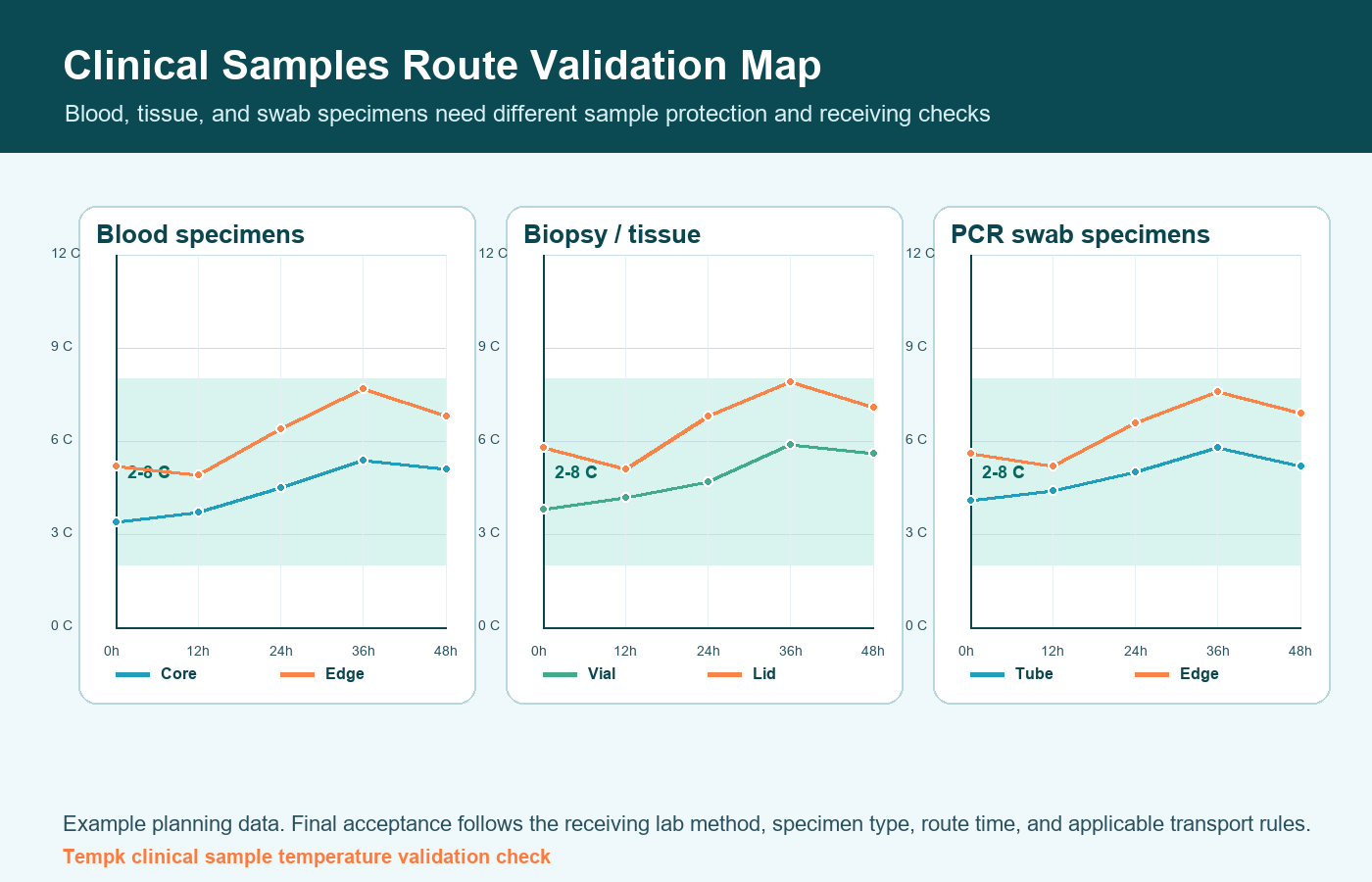
Use the curve to compare refrigerated, frozen, and diagnostic sample routes before scaling. A useful review combines the logger curve with leakage checks, tube or container condition, label readability, and handoff time.
Mixed diagnostic routes and smaller sample programs can use the broader clinical sample guide while the three pages above cover the highest-value shipment types.
Packaging notes for blood, tissue, and PCR swab routes with 2-8 C, frozen, dry ice, leakage, and handoff controls.
Use these pages to compare coolant choice, route risk, insulation structure, nearby medical logistics cases, and final packout questions before sampling.
Clinical samples can be ambient, chilled, frozen, or deep frozen depending on the assay. The packaging plan must start with specimen type and lab acceptance criteria.
Failures include hemolysis, thawed samples, lost chain-of-custody forms, leakage, and specimens delivered outside the lab’s receiving window.
Use leakproof primary containers, absorbent secondary packaging, and a rigid outer shipper. Keep requisition forms dry and separate from specimen containers.
Use chilled gel, dry ice, or room-temperature PCM according to the assay. Do not choose coolant by habit when the lab requirement is different.
Confirm temperature, leakage, label readability, and receiving cut-off time. A lab rejection review should be part of route validation.
Custom packout support
For fixed carton sizes, payload limits, branding requirements, seasonal lanes, or validation targets, Tempk can adapt this solution into a custom cold-chain packout.
Share the sample type, tube or container, target temperature, maximum transport time, payload count, route duration, ambient profile, courier steps, classification, and receiving checks. Tempk can help compare the shipper, coolant layout, secondary packaging, absorbent layer, inserts, logger position, and validation plan.
Request a packout review