


Tube freezing or warm exposure
Frozen gel packs, cold walls, summer handoff, and long receiving dwell can all create local temperature risk.
Blood specimen shipments should be planned from the test requirement and tube format. The packout has to protect the temperature range, tube caps, labels, absorbent layer, and receiving record at the same time.
A blood specimen can arrive with a good average temperature but still fail receiving because a tube froze at the coolant face, leaked into the bag, or lost its chain record.
Frozen gel packs, cold walls, summer handoff, and long receiving dwell can all create local temperature risk.
Loose tubes, heavy coolant, or no rack support can press caps, crack glass, or wet the paperwork.
Labs need clear records: sample list, temperature curve, handoff time, and container condition.
| Route condition | Temperature intent | Packaging setup | Coolant or dry ice planning | Receiving check |
|---|---|---|---|---|
| Same-day local courier, 0-8 h | Follow the lab protocol. For refrigerated tests, plan around 2-8 C without freezing the tubes. | Small EPP or insulated carton shipper, upright tube rack, sealed secondary bag, absorbent layer, coolant divider, and one logger near the warm edge. | Trial 0.6-1.5 kg conditioned gel packs or 2-8 C PCM for a 3-8 L shipper. Reduce coolant if winter freeze risk is high. | No leakage, cap tightness, tube support, no freeze marks, label readability, and pickup-to-receipt time. |
| Regional courier or parcel, 8-24 h | Hold the required temperature through sorting, vehicle dwell, and lab receiving delay. | Higher insulation, stronger tube dividers, absorbent secondary packaging, top and side coolant separated from tubes, and two logger positions. | Start around 1.5-3 kg conditioned 2-8 C coolant for small shippers; test warm edge and cold face before live use. | Temperature record, cold-side tube condition, dry documents, receiving notes, and chain handoff. |
| Frozen blood fraction or protocol-specific frozen test | Use the requested frozen range and avoid thaw-refreeze during handoff. | Frozen shipper, protected sample rack, dry ice separation layer, vented outer packaging, absorbent secondary containment, and document sleeve away from frost. | Use dry ice only when protocol and carrier rules allow. Small trial lanes often begin around 2-6 kg dry ice for 0-24 h, then validate. | Remaining dry ice, no thaw evidence, rack stability, readable labels, and immediate freezer transfer. |
Use these values as starting points for sampling and quotation. Final coolant, PCM, dry ice, insulation, secondary packaging, logger, and handling choices must be validated with the real sample container, route, carrier process, season, classification, and receiving procedure.
Do not choose coolant until the lab requirement, tube type, maximum transport time, and receiving window are clear.
Use racks or sleeves so tubes cannot collide, tip over, or press directly against coolant.
Use a sealed secondary bag and enough absorbent material for the tube volume and route risk.
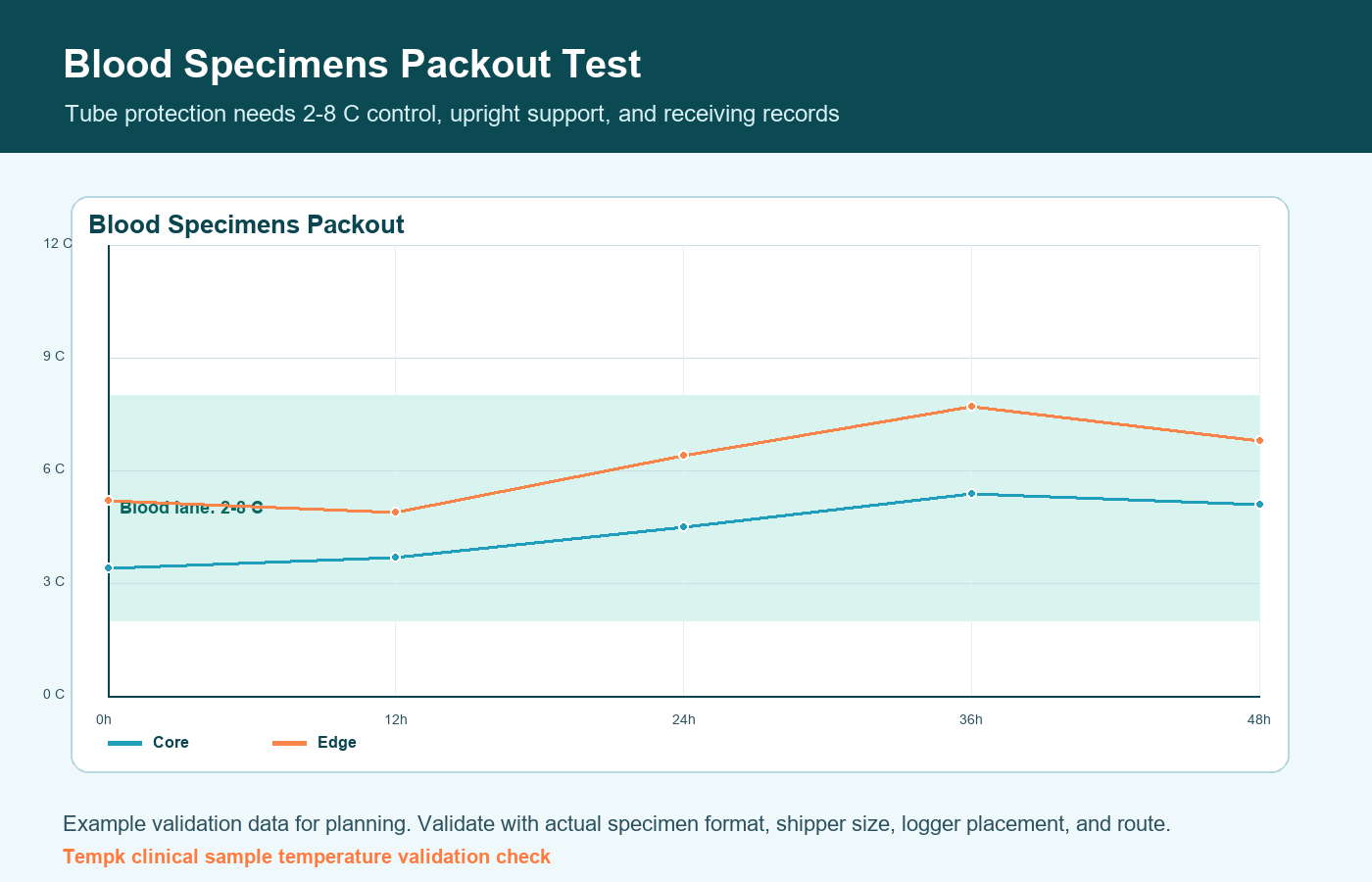
During validation, check the warm edge and the cold-side position close to coolant, not only the center.
These are the visible and operational problems the packout should reduce before the shipment reaches the receiver.
Use the test curve as a working comparison, then validate with the actual sample container, shipper, coolant or dry ice configuration, lane duration, ambient profile, and receiving process.
Use these pages to compare nearby clinical and medical routes, coolant choices, insulation options, and route-risk questions before sampling.
Blood specimens need temperature control that matches the test while preventing tube breakage and hemolysis. The packout must also keep paperwork and labels readable.
Common problems are hemolysis from rough handling, leaking tubes, delayed lab receipt, and coolant touching tubes that should not freeze.
Use tube racks or sleeves, absorbent secondary packaging, and a rigid outer shipper. Keep requisition forms outside the wet or cold zone.
Use chilled gel packs only when the assay requires 2 to 8 C. For ambient tests, use protective packaging without unnecessary cold packs.
Check tube integrity, label readability, leakage, temperature, and lab acceptance after the trial route.
Custom packout support
For fixed carton sizes, payload limits, branding requirements, seasonal lanes, or validation targets, Tempk can adapt this solution into a custom cold-chain packout.
Share the tube type, sample count, protocol temperature, route duration, ambient profile, courier steps, classification, and receiving checks. Tempk can help compare the shipper, coolant mass, tube support, absorbent layer, logger position, and validation plan.
Request a packout review