


Wrong temperature mode
Fresh, fixed, and frozen tissue routes may need different handling; assuming one cold route can create receiving problems.
Biopsy and tissue specimen packaging depends on whether the sample is fresh, fixed, or frozen. The same box cannot safely cover all three routes without checking the collection protocol, container, leak risk, and receiving deadline.
Tissue samples are sensitive to temperature mismatch and physical handling. The packout should prevent container leakage, tissue crush, freeze-thaw errors, and document damage.
Fresh, fixed, and frozen tissue routes may need different handling; assuming one cold route can create receiving problems.
Liquid containers need upright support, absorbent secondary packaging, and paperwork protected away from wet zones.
Small tissue containers can move inside a large shipper unless cushioning and dividers are sized to the payload.
| Route condition | Temperature intent | Packaging setup | Coolant or dry ice planning | Receiving check |
|---|---|---|---|---|
| Fresh tissue, short diagnostic route | Follow the lab protocol. Many fresh tissue routes use 2-8 C and short handoff windows. | Rigid leak-resistant primary container, absorbent secondary packaging, cushioning, coolant divider, and logger near the payload. | For a 3-8 L shipper, trial 0.8-2 kg conditioned 2-8 C PCM or gel packs for local routes. Avoid direct coolant contact. | No leakage, tissue container stable, no freezing, dry request form, and receiving time. |
| Fixed tissue or ambient protocol route | Use the collection protocol. Some fixed samples may not need refrigerated coolant, but still need leak and document protection. | Rigid outer shipper, upright support, absorbent secondary layer, cushioning, and separate document sleeve. | Insulation may be used for temperature buffering. Avoid adding cold packs unless the lab protocol asks for them. | Container intact, cap sealed, no liquid in outer bag, readable labels, and chain record. |
| Frozen tissue or molecular testing route | Maintain frozen condition when required and avoid thaw-refreeze during transfer. | Dry ice shipper, frozen sample rack, dry ice barrier, vented packaging, absorbent secondary containment, and frost-protected documents. | Small frozen tissue lanes may start around 2-6 kg dry ice for 0-24 h and 6-12 kg for longer or hot routes, then validate. | Remaining dry ice, no thaw evidence, sample rack stable, dry paperwork, and freezer transfer at receiving. |
Use these values as starting points for sampling and quotation. Final coolant, PCM, dry ice, insulation, secondary packaging, logger, and handling choices must be validated with the real sample container, route, carrier process, season, classification, and receiving procedure.
Confirm specimen condition before choosing refrigerated coolant, ambient buffer, or dry ice.
Use cushioning and upright support so small containers do not strike the shipper wall or coolant block.
Pair the primary container with absorbent secondary packaging and keep requisition forms outside wet or frost zones.
Route testing should include pickup delay, lab handoff, receiving time, and container inspection.
These are the visible and operational problems the packout should reduce before the shipment reaches the receiver.
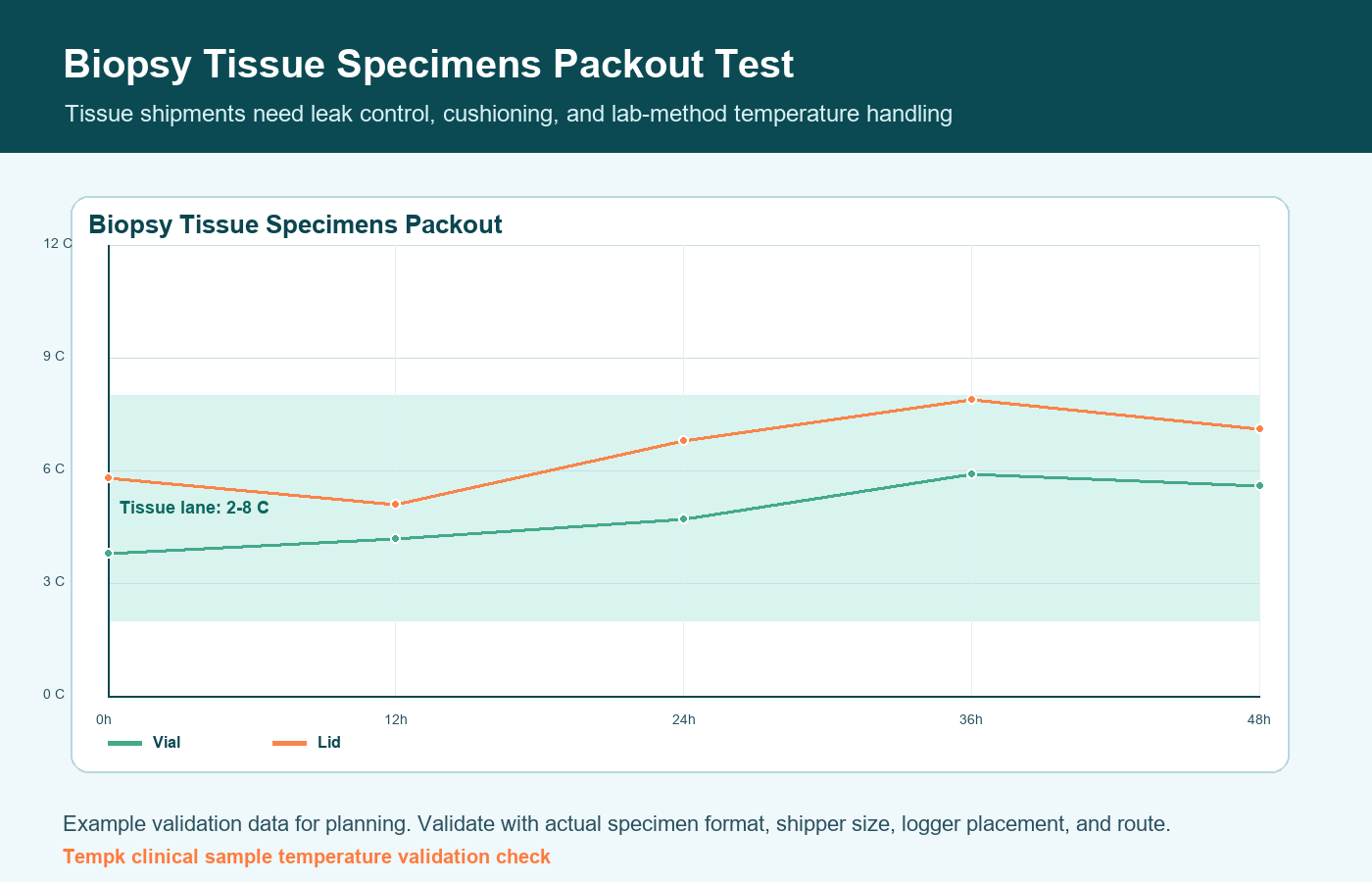
Use the test curve as a working comparison, then validate with the actual sample container, shipper, coolant or dry ice configuration, lane duration, ambient profile, and receiving process.
Use these pages to compare nearby clinical and medical routes, coolant choices, insulation options, and route-risk questions before sampling.
Biopsy and tissue specimens are not a single temperature category. Fresh tissue, preserved tissue, and frozen tissue can require different packouts for the same route.
Losses include thawed frozen tissue, dry tissue, leaking containers, formalin-container damage, and missed lab receiving windows.
Use rigid secondary containment, absorbent material, and a document pocket. Protect specimen jars from hard coolant and from impact against the outer wall.
Use chilled gel, dry ice, or no coolant according to the preservation method and lab instruction. Frozen tissue should be validated separately from fixed specimens.
Confirm preservative, specimen temperature, container integrity, paperwork, and lab acceptance criteria before releasing the lane.
Custom packout support
For fixed carton sizes, payload limits, branding requirements, seasonal lanes, or validation targets, Tempk can adapt this solution into a custom cold-chain packout.
Share whether the tissue is fresh, fixed, or frozen, plus the container size, target temperature, route duration, ambient profile, dry ice allowance, and receiving deadline. Tempk can help compare shipper, coolant, dry ice, cushioning, absorbent layer, and validation layout.
Request a packout review