


Tube leakage or cap pressure
Loose tubes and overfilled shippers can press caps against dividers or coolant packs.
PCR swab specimen shipments are usually judged by temperature, tube integrity, sample identification, and quick diagnostic handoff. The packout should prevent leakage, cap pressure, tube mixing, and avoid thaw-refreeze if frozen handling is required.
PCR swab routes often look simple because the payload is small. The risk is that small tubes move, caps press against coolant or dividers, records get mixed, or samples warm during receiving delay.
Loose tubes and overfilled shippers can press caps against dividers or coolant packs.
Some protocols accept refrigerated short-term transport while others require frozen handling for delays.
High-volume swab routes need clean labeling, specimen lists, and handoff records so the lab can receive quickly.
| Route condition | Temperature intent | Packaging setup | Coolant or dry ice planning | Receiving check |
|---|---|---|---|---|
| Same-day refrigerated diagnostic route, 0-12 h | Follow the collection protocol. Many short swab routes are planned around 2-8 C. | Small insulated shipper, upright tube divider, sealed secondary bag, absorbent layer, coolant barrier, and simple sample list. | Trial 0.5-1.5 kg conditioned gel or 2-8 C PCM for small shippers. Keep coolant away from direct tube contact. | No leakage, tube caps secure, sample list matches, no freezing, and fast lab handoff. |
| Regional or weekend-risk route, 12-48 h | Hold the required range through vehicle dwell, sorting, and lab receiving delay. | Higher insulation, top-side coolant with dividers, stronger tube tray, two logger positions, and protected paperwork. | Start around 1.5-3 kg conditioned coolant for small-to-medium shippers, then adjust by route test and season. | Warm-edge temperature, tube pressure marks, label readability, received count, and handoff time. |
| Frozen swab route or delayed testing | Use frozen handling only when the protocol requires it and prevent thaw-refreeze. | Dry ice shipper or frozen packout, tube rack support, dry ice separation, vented outer packaging, and frost-protected documents. | If dry ice is allowed, small lanes may start around 2-5 kg for 0-24 h and more for delayed routes. Validate with the actual carrier process. | Remaining dry ice, no thaw signs, tube rack stable, dry paperwork, and immediate freezer transfer. |
Use these values as starting points for sampling and quotation. Final coolant, PCM, dry ice, insulation, secondary packaging, logger, and handling choices must be validated with the real sample container, route, carrier process, season, classification, and receiving procedure.
VTM, UTM, dry swabs, and study-specific kits can have different transport windows.
Use tube dividers or trays so tubes stay separated, caps are not compressed, and sample IDs remain readable.
Place gel packs, PCM, or dry ice behind barriers so tubes do not touch a cold surface.
High-volume swab programs should make sample count, paperwork, logger access, and lab handoff easy.
These are the visible and operational problems the packout should reduce before the shipment reaches the receiver.
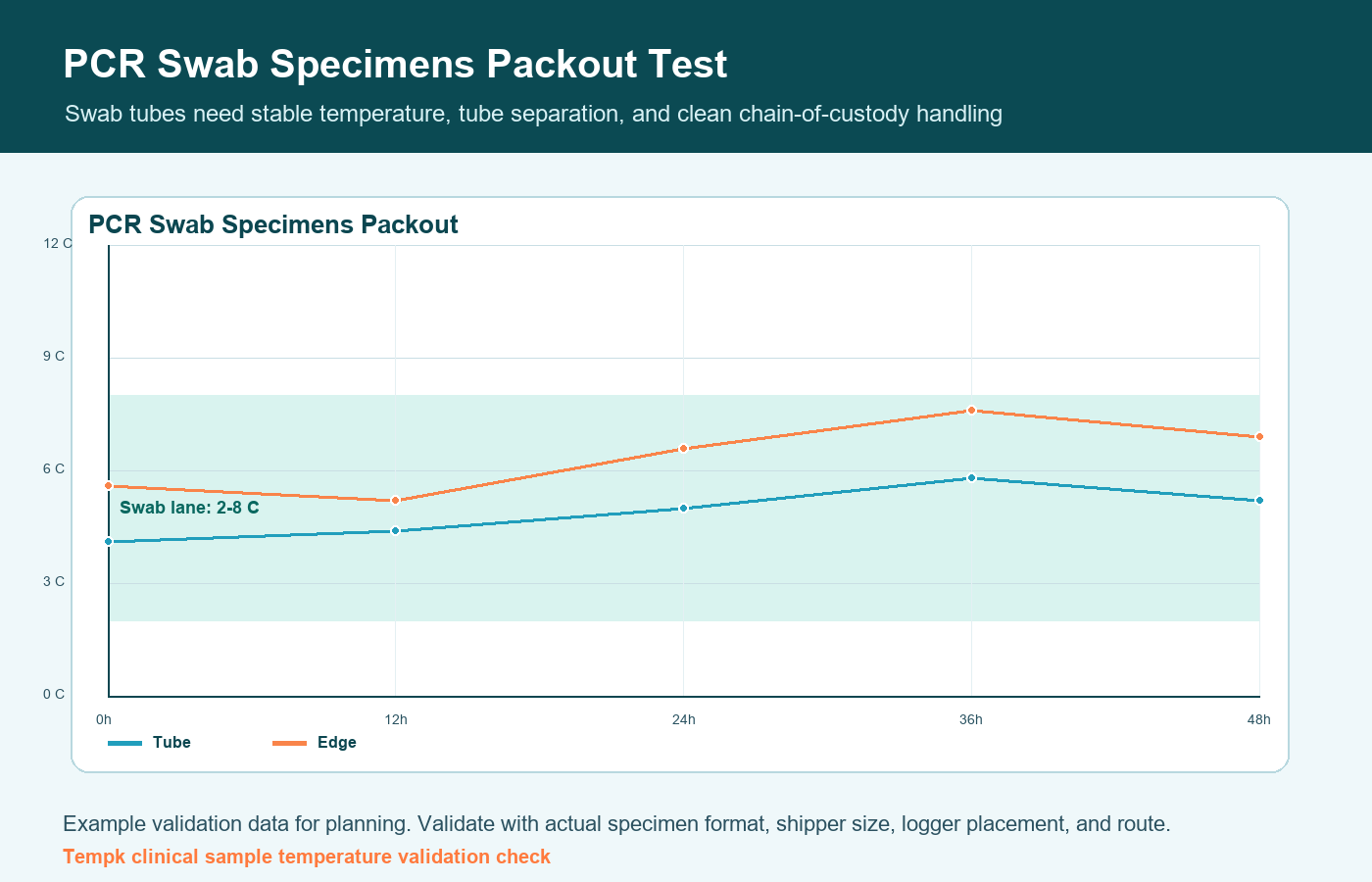
Use the test curve as a working comparison, then validate with the actual sample container, shipper, coolant or dry ice configuration, lane duration, ambient profile, and receiving process.
Use these pages to compare nearby clinical and medical routes, coolant choices, insulation options, and route-risk questions before sampling.
PCR swab specimens are often time-sensitive and high-volume. The packout should prevent tube leakage, keep labels readable, and meet the lab’s required temperature.
Failures include leaking transport media, unreadable labels, warm excursions, frozen tubes when not allowed, and late delivery beyond the testing window.
Use tube sleeves, absorbent secondary packaging, and a rigid shipper. Keep sample bags organized so the lab can process them without searching through wet packaging.
Use chilled gel packs for short 2 to 8 C routes when required. Do not use dry ice unless the lab specifies frozen transport.
Check tube seal integrity, label readability, temperature log, and delivery time to the testing lab.
Custom packout support
For fixed carton sizes, payload limits, branding requirements, seasonal lanes, or validation targets, Tempk can adapt this solution into a custom cold-chain packout.
Share the swab medium, tube count, target temperature, transport window, ambient profile, courier steps, dry ice allowance, and receiving process. Tempk can help compare the shipper, coolant layout, tube tray, absorbent layer, logger position, and validation plan.
Request a packout review