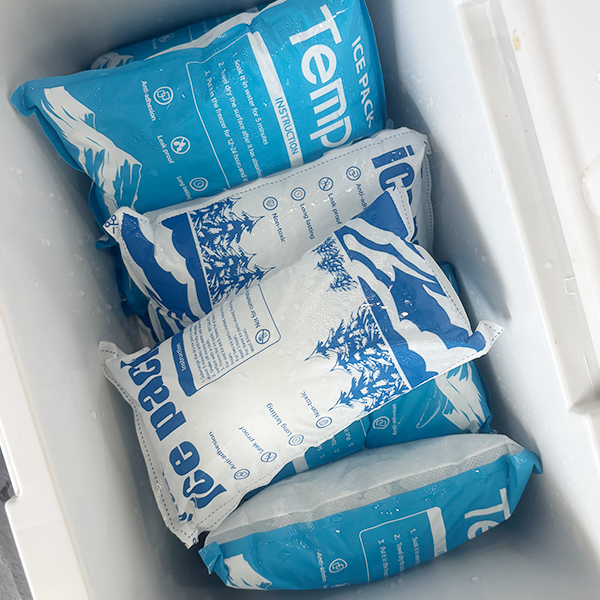
Five Gates for a Supplier Dry Ice Pack for Pharmaceutical Logistics
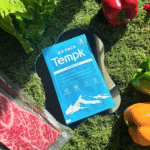
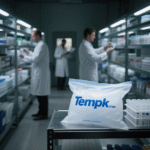
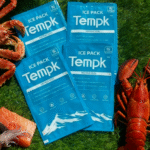
Before approving a supplier dry ice pack for pharmaceutical logistics, pass the proposed component through five gates: identity, product requirement, packout evidence, operational reproducibility, and lifecycle control. The first gate prevents a dangerous naming error. Tempk's hydration dry ice pack is a water-activated frozen coolant sheet; it is not solid carbon dioxide or UN1845 dry ice. The other gates prevent an equally important technical error: treating a coolant component as though it were a complete, universally qualified shipping system. Approval should attach to an exact configuration and controlled process for a defined medicine and route.
Gate One: Establish the Exact Coolant Identity
Names such as dry ice pack, ice blanket, gel sheet, and phase-change pack are used inconsistently across the market. A procurement record needs more precision. Identify the product by code, revision, construction, cell layout, dimensions, activation method, intended conditioning state, and supplier-approved handling method.
For a Tempk hydration sheet, water is added before freezing. That distinguishes it from a prefilled gel pack, a rigid PCM plate, and carbon dioxide. Each alternative places different demands on storage, preparation, packaging geometry, and staff. Carbon dioxide also introduces hazards and transport controls that should not be transferred to a non-CO2 sheet simply because of a similar name.
The reverse is just as important. A non-CO2 coolant should not be assumed to replicate the temperature or sublimation behavior of solid dry ice. It does not acquire deep-frozen performance from the trade term. Any required temperature range and duration must be shown in the proposed insulated packout.
Write the identity into the specification and training materials. If a carrier, packer, quality reviewer, or receiver could reasonably mistake the component for carbon dioxide, improve the wording. Clear identity supports correct handling, accurate declarations, useful risk assessment, and meaningful comparison between suppliers.
Gate Two: Convert the Medicine and Lane Into a Testable Brief
The coolant cannot define the target. Start with approved product information and the organization's quality requirements. Document the acceptable temperature limits, product presentation, sensitivity to freezing or other environmental conditions, payload range, and any justified excursion process.
Then map the lane. A route is more than the scheduled transit time. Include warehouse staging, loading, local collection, hubs, airport or border handling, customs, final delivery, and receipt. Consider both warm and cold seasons where relevant. Identify credible disruptions and the maximum delay the packaging design is expected to cover. Unlimited contingency is not a test condition; it is a sign that operational controls also need work.
The result should be a shipping requirement that engineers and suppliers can interpret in the same way. At a minimum, it should answer:
Which exact product limits govern the shipment?
What are the minimum and maximum payload presentations?
Which outer carton and insulation are fixed, and which are still candidates?
What starting conditions apply to the medicine, coolant, and shipper?
Which ambient exposures represent the intended distribution environment?
Where are the likely hot and cold spots?
How will temperatures be monitored and excursions assessed?
Which steps must be feasible at every packing location?
Avoid defaulting to a familiar pharmaceutical temperature band. Many medicines use common labeled conditions, but no single band applies to all products. Good distribution practice centers on maintaining the conditions authorized for the specific medicine.
Gate Three: Demand Evidence for the Full System
A hydration sheet absorbs heat as its frozen water warms and melts. Insulation slows heat transfer. The payload adds thermal mass. Gaps, seams, contact points, and headspace shape temperature gradients. None of those elements works independently in a real parcel.
This system behavior creates two failure directions. Too little cooling or excessive heat ingress can raise product temperature. Direct contact, overpacked coolant, or an unsuitable conditioning state can drive a local product position below its lower limit. The strongest coolant loading is not necessarily the safest.
Ask for enough context to interpret any thermal claim:
exact coolant product and quantity;
hydration and conditioning method;
insulation material and complete container construction;
payload type, mass, arrangement, and starting temperature;
ambient temperature profile and duration;
probe type, calibration, placement, and attachment;
product or air temperature measured;
predefined acceptance criteria;
Helpful decision tools
Check the details before you choose packaging
These quick tools can help you compare route risk, sizing needs, coolant choices, and packaging details before you request a quote.
Coolant & PCM Reference
Compare coolant and PCM options when a route needs added temperature support.
Compare optionsRoute Risk Checker
Review lane conditions before selecting packaging for real operating requirements.
Check route riskBox Liner & Pallet Cover Sizing
Check box liner and pallet cover sizing logic for insulated packaging projects.
Estimate sizingdeviations and complete results, not only a summary graph.
WHO guidance treats a passive shipping system as a combination of insulated material and temperature-stabilizing media and emphasizes qualification of both shipping container and route. EU good distribution practice similarly expects the defined product conditions to be maintained in transport and uses route risk assessment to determine appropriate controls. ISTA thermal profiles and ASTM package-test methods can provide legitimate frameworks, but their names should never replace a review of the actual test.
Use a decision ledger
| Decision gate | Green signal | Caution signal | Stop signal |
|---|---|---|---|
| Identity | Exact product and revision are controlled | Generic family name used in early discussion | Carbon dioxide and hydration sheet are confused |
| Product and lane | Approved limits and credible route profile are documented | Some handover or payload data remain open | Generic temperature target is assumed |
| Thermal evidence | Exact packout passes an approved, relevant protocol | Supplier report supports development only | Hold time is claimed without test context |
| Operations | Sites can reproduce activation, conditioning, packing, and monitoring | Pilot reveals manageable training gaps | Required freezer or process capability is absent |
| Lifecycle | Lot traceability, change review, continuity, and deviations are controlled | Agreements are still being completed | Silent substitution or untraceable stock is accepted |
The ledger makes uncertainty visible. A caution signal is not automatically a rejection; it is a prompt for development or additional evidence. A stop signal identifies a misconception or control failure that should be corrected before price, volume, or schedule drives the project forward.
Gate Four: Prove That Operations Can Reproduce the Packout
Laboratory success can be undermined at the packing bench. Hydration sheets create specific process steps: dry storage, activation with water, drainage, freezer conditioning, prepared-inventory management, inspection, placement, and disposal or controlled reuse. Every step should be feasible under normal throughput.
Run a production-representative pilot before scale-up. Use intended operators, freezers, racks, hydration stations, work instructions, product cartons, loggers, and staging areas. Watch what actually happens. Do sheets stick together in the freezer? Do cells expand into space reserved for the payload? Can staff see when hydration is uneven? Is there a controlled place for draining? How long are conditioned sheets exposed while a packout waits for a missing item?
The pilot should challenge the written instruction. If trained staff interpret an orientation photograph differently, improve it. If a folded sheet moves during simulated distribution, add a controlled restraint or revisit the geometry. If minimum and maximum payloads require different coolant layouts, make the variants unmistakable rather than asking operators to exercise informal judgment.
Instrumentation also has to work operationally. A temperature data logger records conditions; it does not protect the medicine. Confirm its range, accuracy, calibration, interval, start logic, placement, and data-retrieval process. Decide who reviews the data, what constitutes an alert or excursion, and how product is held pending quality assessment. A receiver should not release or reject medicine simply because a coolant sheet feels frozen or thawed.
Practical example: the packout that passed but could not scale
Imagine a development engineer prepares hydration sheets individually, freezes them flat with ample separation, and assembles a successful thermal study. The program then moves to a busy regional depot. Operators hydrate multiple sheets together, stack them while wet, and load a crowded freezer. Some cells condition unevenly and several sheets adhere to one another. To keep dispatch on schedule, staff separate them by bending the frozen seams and place whatever remains intact into the shipper.
The test report has not become false; the routine process has become different. The organization responds by pausing scale-up, mapping freezer capacity, defining rack spacing, clarifying hydration batches, establishing readiness and damage criteria, and repeating a representative pilot. Qualification may need to be supplemented if the controlled routine method differs from the original study.
The lesson is wider than hydration sheets. A qualified design is useful only when the operating network can reproduce it.
Gate Five: Control Supply From First Lot to Final Use
Bulk purchasing introduces variation over time. The commercial description and the qualified component specification should point to the same item. Product code, revision, cell pattern, permitted tolerances, materials, seam configuration, packaging, labeling, and intended use status need appropriate control.
Lot traceability supports investigations. Incoming inspection can verify identity, visible integrity, dryness or other storage condition, labeling, dimensions, and documentation according to risk. Sampling plans and acceptance criteria should be established by the buyer's quality system rather than invented during receipt.
Change notification is a critical supplier question. Altering film, absorbent media, cell geometry, seam process, manufacturing location, or packing method may affect water uptake, expansion, strength, or thermal behavior. The buyer needs enough advance information to assess impact and determine whether document updates, trials, or requalification are warranted.
Continuity planning should avoid uncontrolled substitution. A backup coolant sheet may look similar but differ in mass distribution or geometry. Preassess alternatives where supply risk justifies it, and document what comparability testing would be required. Expediency does not make two components technically equivalent.
Finally, manage the component after delivery. Dry sheets need protected storage. Prepared sheets need controlled conditioning and inventory status. Reuse, if proposed and supported for the chosen format, needs defined return, cleaning, inspection, rehydration, performance, and retirement rules. Without that system, "reusable" is an aspiration rather than an operational claim.
Procurement Economics Beyond Unit Price
Flat dry supply can be attractive because unactivated sheets occupy less volume than some prefilled coolant formats. That advantage should be evaluated alongside the work transferred to the packing site. Total operational fit includes water handling, drainage space, freezer energy and capacity, racks, labor, prepared-inventory buffers, quality controls, training, and rejected components.
Price comparisons should use the approved packout, not one sheet versus one rigid pack. The configurations may require different quantities, insulation, preparation, or shipping mass. They may also create different risks of delay or process error. A procurement decision becomes more defensible when cost is linked to a configuration that has met thermal and operational requirements.
Ask commercial questions as variables unless the supplier has provided verified answers: minimum order quantity, production lead time, packaging quantities, custom-print implications, forecast commitments, sample terms, and contingency support. Do not let an attractive custom feature enter the qualified system without a technical reason and a controlled specification.
Receiving, Excursions, and Periodic Review
The cold chain does not end when the courier marks a parcel delivered. Receiving instructions should cover inspection for damage or leakage, prompt transfer to approved storage, logger handling, record retention, and escalation. If the parcel arrives late or the monitor alarms, the product should be managed under the organization's excursion procedure.
An excursion is a quality decision informed by product-specific stability data, exposure history, instrument information, and approved procedures. The coolant's appearance cannot settle it. Neither can an unqualified assumption that a brief deviation is harmless.
After launch, review actual performance. Look for recurring delay points, packing deviations, damaged sheets, hydration variability, monitoring alarms, seasonal differences, complaints, and supplier changes. Lane verification and trend review can show whether the original risk assessment remains representative. Major changes to product, payload, coolant, insulation, packing site, route, or equipment should trigger a documented impact assessment.
Frequently Asked Questions
What is the first document to request from the supplier?
Start with a controlled product specification or equivalent technical description for the exact sample offered. It should distinguish the hydration sheet from carbon dioxide and identify the configuration, materials, dimensions, cell layout, activation, conditioning, inspection, and revision. Thermal reports are useful only after you can confirm that they apply to that exact component.
Can one qualification cover different medicines?
Only if the organization has a scientifically and procedurally justified bracketing or platform approach that covers each medicine's limits, presentation, payload, and risk. A packout that protects one product does not automatically protect another, even when both are called refrigerated. Quality approval should define the permitted product and configuration scope.
Should coolant sheets be conditioned at the same temperature for every packout?
No universal conditioning instruction should be assumed. Conditioning affects the coolant's starting state and cold-side risk. Follow the supplier's technical information during development and the exact method established by the qualified packout. If the method changes, assess the impact before routine use.
What supplier changes deserve notification?
Changes to material composition, absorbent structure, cell size or count, seam design, dimensions, manufacturing process or site, product code, labeling, packing, and handling instructions may be relevant. The quality agreement or purchasing controls should define notification expectations and allow the buyer to assess impact before changed product enters a qualified process.
How do we know whether reuse is worthwhile?
Evaluate achieved return rate, cleaning and inspection feasibility, rehydration behavior, physical integrity, thermal consistency, traceability, reverse logistics, and disposal. Reuse must preserve the qualified configuration and be controlled by procedure. A sheet's ability to refreeze is not, by itself, a sufficient lifecycle assessment.
Conclusion: Approval Is a Chain of Evidence
The five gates create a practical approval chain. Identify the coolant correctly. Define the medicine and lane. Test the complete packout. Prove the packing sites can reproduce it. Then control lots, changes, continuity, receiving, and review.
This approach lets a hydration sheet be judged on its real strengths, such as flat dry storage and flexible cell geometry, without turning those features into unsupported pharmaceutical claims. The best supplier relationship is one in which assumptions are exposed early and evidence remains attached to the exact system that will be used.
About Tempk
Tempk supplies cell-based hydration coolant sheets that are activated with water and frozen before use in insulated cold-chain packouts. We can help pharmaceutical logistics buyers compare layouts, clarify handling steps, and prepare component samples for system-level development. Our contribution should sit inside the customer's approved product, route, qualification, and quality framework. Tempk does not treat the phrase "dry ice pack" as proof of UN1845 identity, a universal temperature range, or route performance; those points must be defined and demonstrated for the exact application.
Share your medicine's approved limits, payload range, shipper design, lane profile, and packing-site capabilities with Tempk. Use those inputs to request a focused sample plan and the technical information needed for qualification review.