Selecting a Foil Bubble Insulated Box Without the Hype
A foil bubble insulated box should be approved as a specific packout, not purchased as a promise attached to a shiny sheet. The decision is straightforward when buyers ask four questions in order. Does this format fit the product and route? Is the intended reflective air space preserved? Does the complete box, coolant, payload, and closure meet the acceptance criteria? Can operators reproduce it at scale? Sustainability and price come next, using the actual material structure and operating loop. This sequence protects buyers from unsupported R-values, universal hold-time claims, and a liner that saves warehouse space but creates uncontrolled work at the packing bench.
Decide Whether a Foil Bubble Insulated Box Belongs on the Route
Begin with a one-page lane definition. State the product temperature range, starting condition, primary pack, sensitivity to freezing or heat, payload dimensions, minimum and maximum load, planned duration, handovers, vehicle environment, seasonal exposure, and credible delay. Add physical hazards such as drops, stacking, puncture, rain, or condensation. The correct insulation family usually becomes clearer when these facts are visible.
A foil-bubble format is worth investigating where thin walls, flexible sizes, low inbound storage volume, or fast carton conversion have real operational value. It may suit controlled local delivery, selected parcel shipments, or a secondary buffer inside another transport system. It is less attractive when the route demands long uncontrolled protection, the contents are sharp, the packout is routinely overfilled, the outer case gets wet, or the process cannot maintain a consistent fold and air gap.
Define the product requirement independently of the package. "Chilled" and "frozen" do not state an accepted range. Medicines, foods, specimens, chemicals, and electronics can have different limits and consequences. Applicable regulations and customer agreements also vary. The supplier can propose packaging after the requirement is known; it should not create the requirement.
Clarify the box's role. The foil-bubble liner provides a thermal layer. The outer carton usually supplies shape, compression strength, and surfaces for labels and seals. Coolant supplies finite thermal capacity. Dividers manage contact and movement. Primary packaging contains the product. A logger records exposure. Calling all of those functions "the box" hides gaps in responsibility.
Use a stop rule during screening. If the supplier cannot state the laminate, seam design, closure, tested coolant, payload, ambient profile, and acceptance limit, do not compare its duration with another quote. Request the missing basis first.
Build an Evidence Ladder From Surface to Lane
Evidence should climb four levels. The first is material identity: reflective-film type, bubble substrate, adhesives, thickness, surface orientation, and condition. The second is specimen testing, which can characterize a flat material under a named method. The third is an assembled-package test with the actual carton, liner, coolant, payload, seams, and closure. The fourth is route qualification or verification that connects the package to its commercial environment.
The levels answer different questions. ASTM C518 measures steady-state thermal transmission through flat specimens. It does not recreate a folded box. ASTM D3103 addresses thermal insulation performance of distribution packages. ISTA 7E provides parcel-delivery thermal profiles, and ISTA Standard 20 supplies a design and qualification process for insulated shipping containers. A method is useful when its scope matches the question; no standard name makes an untested configuration universal.
Reflective physics belongs between the first and second levels. Low-emittance foil can reduce radiative exchange when it faces an air space. If that face is pressed against a product, coolant, or carton, conduction becomes important. Department of Energy and ASTM reflective-insulation guidance both emphasize the adjacent air space. They explain why the installation matters, but building-insulation guidance is not a shipping-box qualification.
Treat R-value with the same boundary. A reported resistance may be valid for a specific tested assembly, temperature, heat-flow direction, and air-space arrangement. The FTC R-value Rule applies to home insulation, not shipping boxes. It is a useful reminder that R-value claims need proper tests and conditions, but the shipment still needs whole-package evidence and a route decision.
At package level, request the test protocol and raw context, not only a pass summary. Look for box and component revisions, starting temperatures, coolant conditioning, payload arrangement, external profile, sensors, calibration, interval, acceptance limits, run count, deviations, and photographs. Ask whether the test used the minimum payload, since low mass and excess air may be challenging. Also check the maximum load for compression and closure.
The final level asks whether the commercial lane stays within the qualified assumptions. Monitor selected pilot shipments, investigate dwell and handling differences, and define requalification triggers. Route evidence supplements laboratory evidence; a few fair-weather deliveries do not replace seasonal challenge work.
Audit Supplier Claims Before Comparing Price
Translate every attractive word into a verification request. This is faster than debating adjectives and makes quotes comparable.
| Supplier claim | Clarifying question | Decision evidence |
|---|---|---|
| "High R-value" | What assembly, air spaces, method, temperatures, and heat-flow direction produced it? | Original test report plus relevance review |
| "Keeps cold for days" | Which payload, coolant, ambient profile, sensor locations, and acceptance range? | Complete-packout thermal report |
| "Reflects most heat" | Which surface property was measured, and where is the air space in the box? | Surface data and assembly drawing |
| "Leakproof" | Does this cover sheet, seams, top closure, punctures, and repeated folding? | Finished-liner leakage or use-condition test |
| "Reusable" | What cleaning, inspection, damage, and retirement process supports reuse? | Reuse protocol and production-representative trial |
| "Recyclable" | Which complete components fit which collection and recycling stream? | APR, RecyClass, recycler, or market-specific assessment |
| "Qualified" | What exact configuration and distribution profile were qualified? | Controlled report with revision and scope |
The purpose is not to reject every claim. It is to attach a boundary to it. A flat-sheet result may support design screening. A finished-liner water test may support limited containment. A thermal report may support one packout. Buyers make poor decisions when they extend one boundary to another.
Look closely at thin-material comparisons. A foil-bubble liner may preserve usable payload space and reduce inbound cube. A foam or fiber system may offer a different balance of conductive resistance, structure, moisture response, and disposal. A hybrid may combine functions. Compare these options with the same product, profile, coolant, and acceptance limits, then add physical handling and operating cost.
Food contact and pharmaceutical compliance also need boundaries. If the liner touches food, verify the intended-contact documentation for the market. If sealed primary packs prevent contact, document that arrangement. For pharmaceuticals, product stability, GDP-related quality controls, monitoring, and lane qualification remain separate from the material. Do not accept a thermal result as proof of universal compliance.
Dry ice claims require added caution. Dry ice is extremely cold and releases carbon dioxide gas. Its use can affect product compatibility, worker safety, venting, labeling, and carrier requirements. The liner must not be treated as a sealed pressure vessel or as automatic authorization for dry-ice shipping.
Make the Tested Geometry Repeatable at the Packing Bench
A reflective design can be more sensitive to installation than its simple appearance suggests. The approved drawing should show which face points where, which air spaces are intentional, how corners fold, where coolant sits, how product is separated from cold surfaces, and how the top closes. Mark fold lines or use a fitted insert if the air gap depends on consistent geometry.
Control component conditioning. Product should enter within its release condition. Coolant should follow a defined conditioning method, not an informal instruction such as "freeze overnight." If a phase change material is used, its state and preparation should match the test. Liners and cartons should be dry, undamaged, and stored away from contamination.
Helpful decision tools
Check the details before you choose packaging
These quick tools can help you compare route risk, sizing needs, coolant choices, and packaging details before you request a quote.
Ice Pack Calculator
Estimate gel ice pack quantity for chilled shipments and practical route planning.
Estimate ice packsCoolant & PCM Reference
Compare coolant and PCM options when a route needs added temperature support.
Compare optionsCompliance Checklist Generator
Build a practical checklist for packaging review, shipping, and documentation.
Build checklistInspect failure-prone areas during packing:
- Punctures, pinholes, delamination, and abraded reflective faces
- Crushed bubble zones at corners, under straps, or beside dense payloads
- Tape that lifts, wrinkles, or bridges the closure
- Carton deformation that removes the designed air gap
- Excess headspace that permits product and coolant movement
- Overfill that prevents full liner and carton closure
- Moisture or residue that affects hygiene and adhesion
Receiving must know what evidence to check. Define package-condition inspection, approved temperature measurement, logger retrieval when used, quarantine triggers, and disposition authority. A damaged carton does not always mean failed product, and a clean-looking box does not prove temperature compliance. Use the approved quality process.
Change control protects the evidence. A different tape, carton grade, liner film, adhesive, bubble tool, cold pack, product pack, or carrier plan can alter the system. Ask the supplier for production controls and advance notification. Internally, review new routes, seasons, payloads, and delivery windows.
Practical example: storage savings create a line-speed problem
Imagine a distributor replaces preformed coolers with flat foil-bubble liners to free warehouse space. The thermal trial is acceptable when engineers assemble each liner carefully. During the first packing pilot, operators need several attempts to form the corners, tape use varies, and some top folds spring open before the carton closes.
The distributor does not solve this by adding more coolant. It measures line time and scrap, then tests a preformed liner with marked folds and a fitted top panel. The revised version consumes slightly more inbound volume but assembles consistently. Thermal testing is repeated because the seam and air-space geometry changed. The final cost model includes storage, assembly labor, tape, scrap, and package performance.
This hypothetical case shows that operational repeatability is a technical requirement. A laboratory-perfect liner that cannot be packed at commercial speed is not production ready.
Choose the Lower-Waste System, Not the Greenest Word
Start at the top of the waste hierarchy. Reduce material by right-sizing the carton, controlling cut scrap, removing unnecessary layers, and avoiding overprotection on easy routes. Preventing product loss is also important because a failed shipment can waste both goods and packaging. Use route classes so a demanding export packout is not automatically used for a short conditioned delivery.
Reuse needs a closed loop. A flexible liner may survive several trips, but fold fatigue, puncture, tape residue, contamination, and lost parts can make the practical cycle count lower than expected. Establish return ownership, cleaning compatibility, drying, inspection, status marking, and retirement. Count actual safe cycles; do not market a theoretical maximum as an achieved result.
Recycling requires a component map. A metallic layer, polymer films, bubble substrate, adhesive, printed label, tape, carton, and coolant pack may enter different streams. APR and RecyClass guidance evaluates complete design features for compatibility, not only the main polymer. Confirm local collection and sorting in the destination market. Separation instructions need to be realistic for the receiver.
Regulation (EU) 2025/40 on packaging and packaging waste generally applies from August 12, 2026, with detailed obligations and transitions around minimization, design for recycling, reuse, labeling, and substances. EU-facing buyers should obtain advice for their packaging role and dates. A supplier's environmental phrase does not replace that review.
Total cost should include liner, carton, coolant, inbound cube, assembly labor, equipment, scrap, outbound cube and weight, monitoring, product holds, return logistics, cleaning, and end-of-life fees. Compare cost per safe delivered shipment under each route class. That metric can support a thin liner on one lane and a more robust system on another without forcing a false universal winner.
Frequently Asked Questions
What is the first document to request from a supplier?
Request the finished construction and packout basis together. You need the liner layers, dimensions, seam and closure method, carton, coolant, payload, external profile, and acceptance limits. A material data sheet alone cannot show how the loaded box performs, while a duration claim without construction cannot support change control.
Does foil work if there is no air gap?
The surface still exists, but its reflective contribution changes when it is in direct contact because conduction becomes a major path. Low-emittance reflective systems derive their distinctive benefit across an air space. Use the same orientation and spacing as the tested configuration, then verify the full package.
Should the liner be reusable?
Only if the network can return, clean, inspect, identify, and retire it safely. Flexible laminates can develop pinholes, crease fatigue, delamination, and tape residue. Approve reuse through an actual operating loop and track completed cycles rather than assuming durability from appearance.
How should buyers compare foil bubble with other insulation?
Test production-representative systems against the same payload, coolant, external profile, acceptance limits, and physical hazards. Then compare usable volume, packing time, inbound storage, weight, moisture response, supplier controls, and end of life. Avoid comparing a flat-sheet R-value with a whole-package duration.
Can one test cover every carton size?
Not automatically. Geometry changes exposed area, seams, internal air, coolant-to-payload ratio, and closure. Engineering analysis may support a bracketing strategy, but the rationale must be documented. Do not transfer a result solely because the same liner material is used.
Conclusion
A credible foil bubble insulated box decision follows a sequence: define the lane, preserve the reflective air-space geometry, qualify the complete packout, prove packing repeatability, and evaluate cost and waste across the real network. Material claims are inputs, not shipment outcomes.
The best next action is to build a production-representative sample for the hardest intended route and the lightest approved payload. That trial will reveal whether the thin reflective format offers genuine operational value or whether another insulation system provides a safer margin.
About Tempk
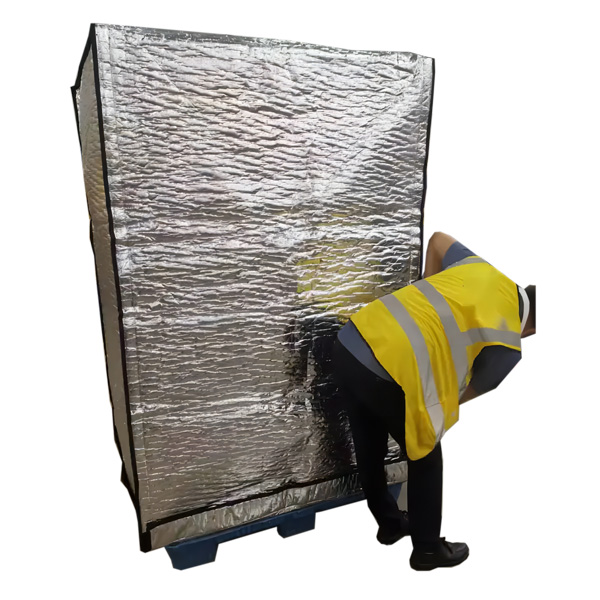
Tempk offers temperature-control packaging categories that include insulated boxes, insulated bags, thermal pallet covers, and cold packs. We can review a custom shipment brief covering product requirements, carton dimensions, coolant, route exposure, assembly method, and order scale. Tempk does not publish a standard product page for a foil bubble insulated box, so buyers should not assume a fixed construction or performance. Any proposed option should be assessed through its specific sample, documents, and complete-packout test conditions.
Start with evidence: Send Tempk your lane brief and minimum-load drawing to compare suitable packaging formats and define what must be tested before a production order.