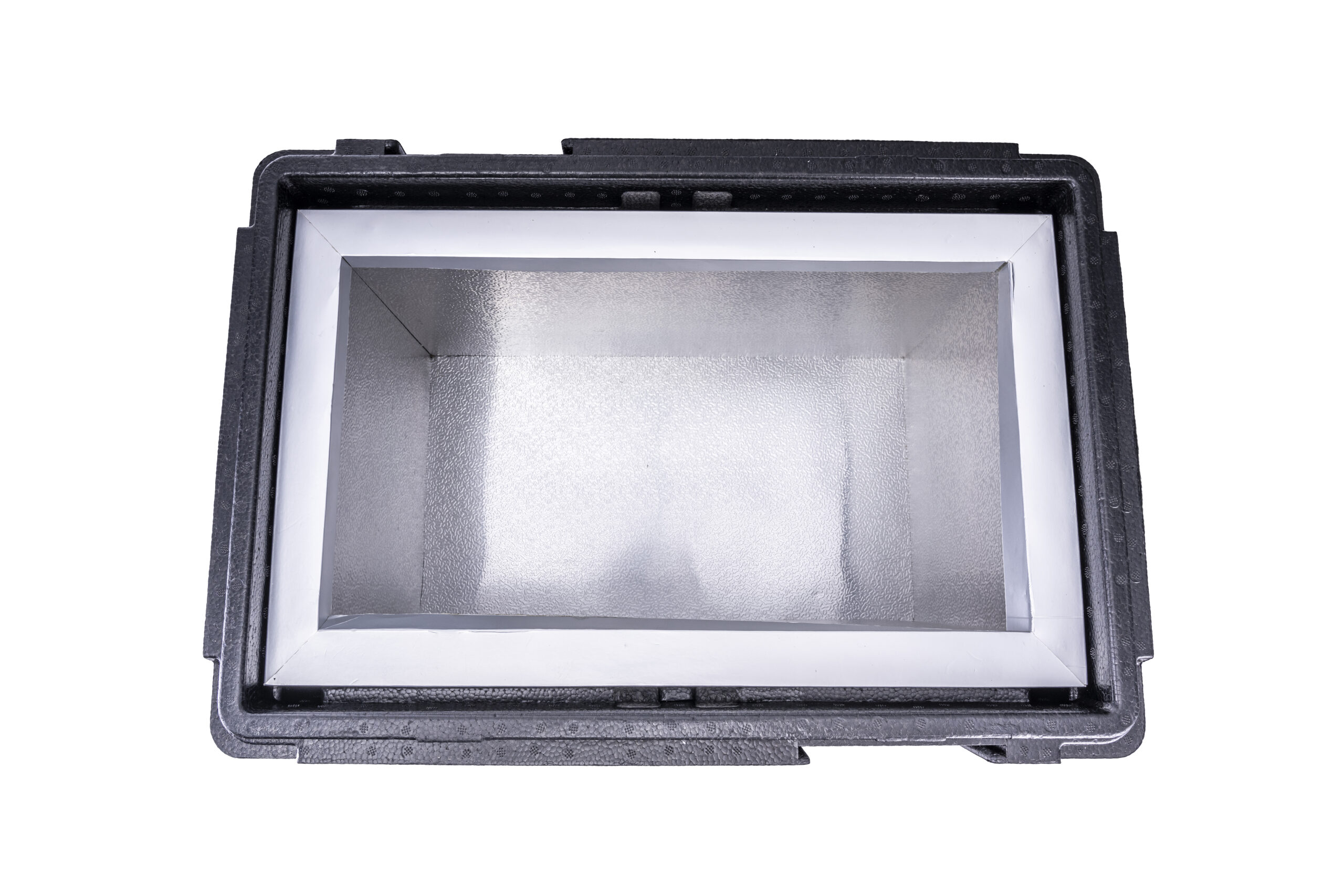
Selecting a VIP Shipping Container for Cosmetic Cold Chain
A VIP shipping container for cosmetic cold chain should be selected only when product evidence defines a meaningful thermal risk and route analysis shows that high-performance passive insulation is justified. Cosmetics have no universal 2°C to 8°C shipping rule, and many require no refrigeration. An intact VIP slows heat flow but does not cool the payload; PCM or another approved thermal medium, conditioning, geometry, and packing create the temperature profile. The buyer must evaluate the system, control it in routine use, and judge sustainability across materials, product loss, freight, recovery, and reuse. Those are the conclusions that separate a defensible solution from an expensive box.
Product evidence comes before cold-chain design
The most consequential input is the approved condition of the cosmetic in its marketed primary package. A raw-material data sheet may identify a sensitive ingredient, but it does not automatically define stability of the complete formula. The emulsion system, antioxidant package, preservative system, headspace, container barrier, closure, and manufacturing process can change how the product responds to heat, cold, light, oxygen, and time.
FDA explains that temperature changes and exposure to sunlight and air can alter cosmetic color, texture, and odor. Moisture and heat can also affect preservative performance and microbial growth conditions. ISO/TR 18811:2018 provides a stability-testing framework while explicitly leaving methods, conditions, specifications, and acceptance criteria to the manufacturer because cosmetic products and uses vary so widely.
That evidence may lead to several different transport controls. A balm might need an upper limit to prevent softening. A water-rich emulsion might need protection from both heat and freezing. A volatile product could depend more on seal integrity and light protection. A robust cleanser may need only normal distribution precautions. The word “cosmetic” cannot choose among them.
Treat VIP, coolant, and payload as one thermal assembly
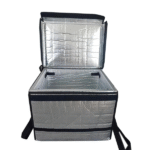
A vacuum insulation panel places a porous supporting core inside a high-barrier envelope and removes most of the internal gas. Lower gas conduction gives an intact panel high thermal resistance for its thickness. The thin-wall potential is useful when a shipper must preserve payload space within a parcel-size limit or add thermal resistance without a large foam wall.
The panel is one heat-flow element. Edges, folded envelope material, joints, corners, lids, closures, and structural supports can bridge heat around the center. Effective box performance can therefore differ materially from a fresh center-of-panel conductivity value. Gas or moisture entering the envelope over time can degrade insulation, while a puncture or seal failure can cause a much faster loss. The design must protect panels from packing tools, product corners, repeated handling, and cleaning.
A passive VIP container has no powered refrigeration or feedback controller. Its temperature behavior comes from starting conditions and the balance between environmental heat flow and the thermal capacity inside. PCM adds latent-heat storage near its phase transition, while gel packs, ice bricks, or other approved media can provide different cooling behavior. None is universally suitable.
Select the coolant against both the upper and lower product limits. A colder PCM is not automatically safer. Frozen surfaces placed beside a freeze-sensitive bottle can create a local cold zone even while a central air sensor looks acceptable. The packout may need conditioned rather than deeply frozen units, fixed pockets, dividers, or buffer layers. Those elements should be shown in the controlled drawing.
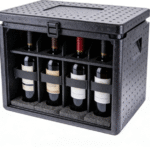
Payload is part of the assembly too. Product mass contributes thermal inertia, primary cartons influence airflow, and empty space allows movement. A one-bottle order and a full case can create different hot and cold locations. Gross internal volume is therefore a poor purchasing measure. Ask for usable chamber dimensions after VIPs, coolant, separators, inserts, and monitoring devices are in place.
Translate a delivery lane into testable conditions
A route profile should cover the entire time outside the approved storage condition. Include pre-carrier staging, pickup, sorting, line haul, customs, last-mile vehicles, failed delivery, weekend dwell, and receiving. Carrier service time alone excludes several places where parcels face uncontrolled air or direct solar heating.
Separate hot-season and cold-season hazards. A design intended to buffer summer heat may need different PCM conditioning from one intended to protect against winter cold soak. If one year-round configuration is proposed, test whether it controls both directions without creating a new limit violation. Seasonal packouts can be easier to optimize, but they require clear changeover dates, component identity, training, and inventory control.
Use actual commercial payloads or justified thermal substitutes. Document the unit count, fill level, starting temperature, orientation, and primary packaging. Define the ambient profile, duration, sensor locations, logger capability, pass criteria, and allowed preconditioning. A reference such as ISTA 7E may help structure parcel thermal testing, but product-specific limits and lane relevance still have to be established.
Monitor likely hot and cold points rather than relying on one center sensor. Air temperature, bottle-surface temperature, and product-simulating mass have different response times, so the protocol should state what each measurement represents. Measurement uncertainty and sensor calibration matter when results approach a limit.
A compact go-or-no-go review
| Review question | Go signal | Stop or investigate signal |
|---|---|---|
| Is there a defined thermal requirement? | Finished-product stability and quality approval establish limits | Range copied from another product or industry |
| Does VIP solve a route problem? | Exposure, space, or duration makes stronger insulation useful | Controlled route has no material thermal risk |
| Is the coolant compatible? | Conditioning and placement control heat without violating the lower limit | Deeply frozen pack selected because it “lasts longer” |
| Is performance relevant? | Loaded test matches justified payload, profile, and pass criteria | Only panel data or an unrelated test is offered |
| Can operators repeat it? | Components, stages, positions, closure, and logger steps are explicit | Success depends on informal judgment at the bench |
| Can the design stay controlled? | Specification, incoming inspection, and change notification are agreed | Critical materials or dimensions can change silently |
| Is the environmental case defined? | Complete alternatives share a functional unit and route boundary | “Reusable” or “recyclable” is treated as proof by itself |
This review helps procurement stop weak projects early. A “stop” result does not always reject VIP technology; it identifies missing product evidence, system data, or operating control. Resolve that gap before comparing prices or approving production quantities.
From supplier sample to routine shipment
Begin with a design brief rather than a catalog code. It should state product limits, payload drawings, route exposure, temperature-monitoring purpose, conditioning equipment, pack-station constraints, receiving process, and whether the operating model is one-way or reusable. The supplier can then propose insulation, coolant, and geometry as a coordinated configuration.
Next conduct development mapping to find hot and cold zones. Use the results to adjust panel joints, lid design, PCM quantity and location, buffer layers, or payload inserts. A failed trial is valuable if it exposes a mechanism and leads to a controlled change. Repeating the same test without documenting the change produces little evidence.
The confirmation test should use the proposed production configuration and an approved protocol. The report needs enough context to reproduce the result: sample identities, component versions, conditioning, elapsed staging, payload, ambient profile, sensor map, raw records, deviations, and acceptance. An advertised hold time without these conditions should not be transferred to the cosmetic program.
A monitored route pilot can challenge laboratory assumptions. It may reveal loading-dock dwell, customs variability, orientation, door exposure, or data-retrieval problems. Quality staff should decide whether route results support routine release, require seasonal adjustment, or show that a different service level is needed.
Helpful decision tools
Check the details before you choose packaging
These quick tools can help you compare route risk, sizing needs, coolant choices, and packaging details before you request a quote.
Ice Pack Calculator
Estimate gel ice pack quantity for chilled shipments and practical route planning.
Estimate ice packsInsulation Material Drop Resistance
Review drop resistance and handling factors before choosing insulation materials.
Check resistanceDry Ice Calculator
Estimate dry ice needs for frozen or ultra-cold shipments before packing.
Estimate dry iceBefore scale-up, lock the bill of materials and work instruction. Define incoming checks for box dimensions, panel condition, PCM identity, fill or mass where critical, seal integrity, inserts, labels, and carton fit. Agree which supplier changes require notification and whether review, bridging work, or retesting is necessary. A sample is useful only if production units remain equivalent in the attributes that matter.
Control the packout where it actually fails
Conditioning is a frequent source of variation. An instruction such as “freeze overnight” does not define equipment set point, loading pattern, minimum time, staging allowance, or readiness. PCM behavior depends on thermal state. Specify how packs are arranged in the conditioning equipment, how ready units are identified, and how long they can wait at the bench.
The pack diagram should be visual and positional. Number PCM panels or bricks, show separator orientation, define payload count, identify the sensor location, and state the closure and sealing steps. If different seasonal configurations exist, make component colors or codes unambiguous without relying on color alone.
Receiving turns monitoring into action. Assign responsibility for logger retrieval, review, excursion escalation, and shipment disposition. A logger detects what happened at its location; it neither prevents an excursion nor proves that every unit experienced the same condition. Combine data with the qualified sensor map, parcel condition, route events, and product-specific decision rule.
Keep compliance and microbiological safety in their lanes
In the United States, most ordinary cosmetics and their ingredients do not require FDA approval before marketing, apart from requirements that apply to color additives. Manufacturers and distributors remain responsible for safety and truthful labeling. A VIP container should not be described as granting general FDA approval or compliance to the cosmetic.
Product claims can change classification. Sunscreens, acne treatments, and other products intended to treat or prevent disease or affect body structure or function may be drugs or both drugs and cosmetics. Those products face additional requirements, including drug stability and expiration dating. Confirm classification stock keeping unit by stock keeping unit and market by market.
Cold-chain packaging does not replace preservation. FDA identifies ineffective preservation, inadequate packaging, poor shipping or storage, contaminated materials, manufacturing conditions, and consumer use as distinct microbiological risks. A chilled route may slow growth under defined conditions, but it does not validate antimicrobial protection or make contaminated product acceptable. Preservation efficacy, hygienic manufacture, primary-package protection, and transport control must each do their own job.
Make sustainability a measured design constraint
High-performance insulation can improve payload efficiency in some designs because a thinner wall leaves more internal space. It may also reduce the coolant needed to meet a profile. Neither outcome should be assumed; compare qualified packages by external dimensions, total mass, usable payload, coolant, product loss, and delivery performance.
VIP construction combines a core, barrier envelope, and protective layers or shell. End-of-life pathways depend on the exact materials and local infrastructure. Ask for material declarations and separation instructions. If recycling access is limited, do not turn theoretical recyclability into a broad environmental claim.
Reusable shippers add return transport, cleaning, inspection, loss, repair, and retirement. Their impact depends on achieved use, not a design-cycle headline. Closed routes with consolidated returns may support reuse better than dispersed consumer delivery, but the comparison must use actual operating assumptions.
For companies placing packaging on the EU market, the Packaging and Packaging Waste Regulation entered into force in February 2025 and generally applies from August 2026, with different measures following their own timelines. It reinforces the need to review minimization, recyclability, labeling, recycled content, and reuse obligations as applicable. Legal specialists should determine the exact duties; thermal necessity should be documented while unnecessary volume and material are designed out.
Frequently asked questions
When is VIP worth the added cost?
VIP is most defensible when route exposure, narrow product limits, high consequence of loss, or external size constraints make its high resistance per thickness useful. Compare it with a conventional insulated option under the same payload and ambient profile. If both meet the requirement reliably, the simpler total system may be preferable.
Can a VIP container protect cosmetics without coolant?
Sometimes the objective is only to slow external heat or cold, and insulation without coolant may be evaluated. Where the chamber must be held near a target region, a conditioned PCM or other thermal medium is usually part of the passive system. The correct configuration depends on product limits and route conditions.
What should be included in a supplier quotation?
Request external and usable internal dimensions, component materials, payload drawing, panel protection, coolant specification, conditioning and packing instructions, test evidence, sensor map, inspection criteria, production tolerances, and change-control terms. Separate established facts from items that require a sample trial or buyer qualification.
Does passing an ISTA thermal profile validate every route?
No. A standardized profile can support comparison and testing, but it may not represent every climate, dwell point, payload, service, or failure scenario. The product owner must approve the acceptance criteria and justify profile relevance. Lane monitoring and seasonal risk assessment may still be needed.
Can refrigeration compensate for a weak preservative system?
No. Temperature control and preservation address different risks. Cold transit cannot validate the formula’s antimicrobial protection, remove contamination, or replace good manufacturing and protective primary packaging. The preservation program and transport program should be evaluated separately, then reviewed together for the finished product.
Approve a system, not a panel
The right decision begins with a cosmetic-specific envelope and ends with a routine process that can reproduce the tested configuration. VIP supplies powerful passive insulation in a thin section, while coolant, geometry, conditioning, and payload determine how that advantage affects product temperature. Testing must represent the lane and commercial load, and monitoring must connect to an approved receiving decision.
Buy only after the evidence, operating burden, supplier controls, and life-cycle case are visible. That approach may select a VIP-PCM packout, a simpler insulated carton, or no thermal shipper at all. Each can be correct when it is tied to the product’s real risk.
About Tempk
Tempk provides VIP insulated boxes and configurable passive packouts that pair protected panel layouts with PCM packs, gel packs, or ice bricks. We can review payload-chamber dimensions, coolant form, conditioning, separation, packing sequence, and repeat-order controls against a buyer’s stated requirements. Tempk’s published VIP-PCM pharmaceutical parcel shipper shows this integrated architecture, but it is not cosmetic validation. We help prepare candidate samples and technical inputs so the cosmetic brand can evaluate the complete system under its own stability, route, quality, and sustainability criteria.
Share your product envelope, payload drawing, route exposure, and pack-station constraints with Tempk. Request a candidate configuration and test plan before committing to a routine cosmetic cold-chain packout.