VIP Shipping Box for Delicatessen Shipping: Proven Fit
The practical conclusion is that a VIP shipping box for delicatessen shipping is a strong candidate when limited parcel space, difficult ambient exposure, or valuable perishable food justifies higher thermal resistance. It succeeds only as a complete passive system: protected panels, compatible coolant, sealed primary food packs, a repeatable layout, tested time-temperature performance, and decisive receiving rules. There is no universal deli temperature or shelf life, and colder is not always better. VIP is also not automatically the greener option; compare food loss, material use, freight, recovery, and actual reuse before making a sustainability claim.
Pass four gates before choosing VIP
The fastest way to avoid an expensive mismatch is to require the shipment to pass four decision gates.
Gate 1: the food requirement is known. Define the manufacturer's shipping and storage conditions, safety limits, tighter quality limits where applicable, remaining shelf life at dispatch, initial product temperature, and receiving criteria. Do this for sliced ready-to-eat meat, cheese, pâté, terrine, salads, sauces, and accompaniments separately. Delicatessen is a merchandising category, not a technical temperature classification.
Gate 2: the lane creates a real insulation need. Count time from controlled storage at origin through packing, pickup, sorting, delivery, and receiving disposition. Include a reasonable delay scenario and seasonal exposure. If a qualified insulated liner or EPP box meets the requirement with suitable margin, VIP may add cost and handling sensitivity without enough operational value.
Gate 3: the packout can be repeated. The proposed internal chamber must fit the allowed payload, coolant, dividers, and void control without operators forcing the lid or improvising. Coolant conditioning and loading order need a work instruction that a busy packing team can follow.
Gate 4: evidence supports the finished assembly. Material conductivity alone does not establish hold time. Review the box geometry, payload, coolant, starting temperatures, ambient profile, sensors, pass limits, physical stresses, number of builds, and deviations. Approval belongs to the named configuration, not the words “VIP box.”
If any gate remains open, treat the design as a prototype. That is a useful status because it makes the missing work visible.
Translate a deli assortment into thermal requirements
Begin with hazards and quality, then build the logistics specification. Many deli meats, soft cheeses, and pâtés are refrigerated ready-to-eat foods. Some dry sausages, aged cheeses, or sealed products may be shelf-stable when their validated formulation and process support that status. Frozen items and hot prepared foods form different shipment classes. Never infer the class from appearance, price, curing language, or where the item sits in a shop.
Ready-to-eat deserves special care because consumers may not apply a cooking step that reduces biological hazards. The Centers for Disease Control and Prevention explains that refrigeration does not kill Listeria, and the Food and Drug Administration notes that the organism can survive and grow under refrigeration. Insulation slows heat gain; it does not repair poor sanitation, remove contamination, or reset shelf life.
List what must remain separate. A deeply conditioned pack can create a cold-contact quality failure in cheese or a fat-rich emulsion. A leaking meat pack can contaminate another item. Milk, egg, fish, tree nuts, wheat, sesame, or other regulated allergens may be present in foods and accompaniments. The packout needs physical separation, reliable seals, and accurate labeling as well as thermal performance.
Define minimum and maximum order profiles. A dense full chamber has different thermal inertia from a light gift box full of decorative air. A glass pâté jar conducts and stores heat differently from a foam tray of sliced meat. If substitutions are allowed, document them by thermal and physical equivalence or send them through review. Marketing may change an assortment overnight; qualified packaging cannot.
How the system controls heat
A vacuum insulation panel encloses a porous core in a high-barrier envelope and removes much of the internal gas. That suppresses gaseous conduction and convection, which can give the panel much lower center-of-panel thermal conductivity than conventional foam at the same thickness. The thin wall can preserve payload room inside a carrier-limited carton.
Yet a six-sided shipper is not one infinite panel. Heat travels through faces, folded or sealed panel edges, corners, the lid, seams, and any structural bridge. Research on VIP barrier envelopes shows a genuine design tension: a strong gas barrier helps retain vacuum, while metallic layers and panel edges can increase thermal bridging. Gas and water-vapor ingress gradually change performance, and high temperature can accelerate barrier permeability. A puncture, sharp crease, or damaged seal may cause a faster loss.
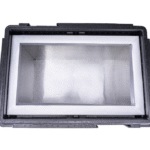
That is why a VIP needs protection. Tempk's official range, for example, includes panel-supported arrangements with plastic shells, EPP boxes, or liners. A protective shell contributes impact resistance and handling structure; it does not make every panel immune to damage. Establish incoming checks, pre-use inspection, quarantine, and retirement criteria with the supplier.
Coolant carries the thermal reserve. Its mass, phase behavior, starting condition, surface area, and placement determine how it absorbs incoming heat. Gel packs conform around irregular products; rigid ice bricks can help standardize a layout; phase-change materials may be selected around a product need. None maintains a stable range automatically. The chosen coolant belongs to the same tested bill of materials as the box.
The product itself contributes thermal mass. Warm-loaded food consumes coolant reserve immediately. Define the maximum time out of controlled storage during picking and packing, and control coolant preparation with measurable criteria rather than “freeze overnight.”
Compare systems under the same conditions
Procurement comparisons often fail because suppliers quote different outer sizes, payloads, test profiles, and definitions of hold time. Normalize the use case first.
| Decision factor | VIP hybrid | EPP cooler | Insulated carton liner |
|---|---|---|---|
| Payload space at fixed outer size | Often favorable because walls can be thinner | More wall volume may be needed | Varies with liner type and folds |
| Handling tolerance | Requires deliberate panel protection | Commonly suited to repeated handling | Relies heavily on carton and closure |
| Return-loop fit | Possible with inspection and component control | Often practical on closed routes | Commonly suited to one-way shipment |
| Evidence that matters | Complete-box thermal and post-impact data | Thermal, closure, cleaning, and durability data | Carton-fit, thermal, moisture, and closure data |
| Best question | Does thin-wall performance solve a documented route constraint? | Will usable space and return operations work? | Is the route predictable enough for this simpler packout? |
Use the same external limit, usable payload, food simulant or actual product, coolant condition, ambient profile, sensor plan, and acceptance criteria. A qualified EPP system can outperform a poorly assembled VIP shipper. A liner may be the responsible choice on a short predictable lane. VIP is justified by verified system advantage, not by material prestige.
Qualify from prototype to production
Write a user requirement specification before requesting a performance claim. It should state the food profiles, acceptable temperature conditions, payload range, permitted substitutions, lane and contingency time, ambient exposures, package orientation assumptions, external size limit, and receiving decision. Identify which conditions protect safety and which protect quality.
Helpful decision tools
Check the details before you choose packaging
These quick tools can help you compare route risk, sizing needs, coolant choices, and packaging details before you request a quote.
Ice Pack Calculator
Estimate gel ice pack quantity for chilled shipments and practical route planning.
Estimate ice packsInsulation Material Reference
Compare insulation material choices for different cold chain packaging needs.
Compare materialsCoolant & PCM Reference
Compare coolant and PCM options when a route needs added temperature support.
Compare optionsChoose a relevant test method. ASTM D3103-20(2025) addresses thermal insulation performance of distribution packages under variable ambient temperatures and stresses the value of testing the actual package. ISO 22982-1 covers general requirements for temperature-controlled parcel transport packages, while ISO 22982-2 addresses physical, conductivity, and insulation performance tests. ISO explicitly keeps safety and sanitation outside Part 1's scope.
ISTA 7E offers standardized heat and cold profiles developed from parcel transport data. It helps compare and qualify systems on a common basis, but ISTA distinguishes it from customized lane data and customized worst-case qualification. Use standard profiles where appropriate, then add lane-derived conditions when geography, season, service, or delay risk falls outside the design basis.
Instrument likely warm and cold locations. A center air sensor can miss a warm lid corner and a cold product-coolant contact point. Use calibrated devices with suitable uncertainty and sampling, synchronize clocks, and state how the result will be interpreted. Where product measurement is impractical, justify simulant geometry, mass, starting temperature, and thermal properties.
Run boundary cases with multiple builds and operators. Include minimum and maximum payloads, allowed void patterns, seasonal coolant conditioning, and relevant delays. Combine thermal and physical evidence: parcel impact, vibration, or compression can alter a closure or damage a panel before the hottest part of the route. Predetermine acceptance criteria and document failures rather than tuning the report around a favorable run.
Production transfer is a separate risk. Freeze the bill of materials, drawings, panel arrangement, coolant specifications, carton, separators, and work instruction. Compare production units with the approved sample. Ask the supplier to notify you before changes to the panel core or barrier, shell, adhesive, dimensions, coolant film or fill, or other features that may affect performance. Change control decides whether assessment or retesting is needed.
Keep food compliance in its proper layer
The FDA Food Code is a model for retail and food-service safety offered to state, local, tribal, territorial, and federal jurisdictions for adoption. It is not a universal transport regulation. Its provisions can inform an establishment's controls, but businesses must verify adopted local requirements and the rules for their product and market.
The FDA sanitary transportation rule applies to certain U.S. shippers, loaders, motor or rail carriers, and receivers, subject to its scope, exceptions, and waivers. It addresses suitable and cleanable equipment, temperature controls needed for safety, protection of ready-to-eat food, allergen cross-contact, training in specified arrangements, and records. The statute does not apply that rule to transportation by air or ship, although other obligations and contracts can govern those modes.
Food-contact compliance follows intended contact. A VIP hidden inside an outer wall should not be advertised as a food-grade panel without product-specific support. The sealed tray, pouch, wrap, jar liner, divider, or absorbent that touches food must be suitable for its intended conditions. FDA regulates food-contact substances in the United States; the European Union applies its framework to materials intended to contact food. Keep supporting declarations matched to the actual material, use, temperature, and market.
Sanitation and allergens do not disappear inside a cold box. Protect sealed ready-to-eat food from raw items and leaking coolants. Preserve lot and ingredient labels. In the United States, sesame has joined the eight previously defined major allergens for applicable packaged-food requirements. Destination markets use their own allergen lists and rules, so global hampers need market review rather than a copied label.
Release each parcel through a controlled workflow
At the packing bench, stage only current components and display a concise diagram. Verify food lot and condition, coolant preparation, component count, dividers, void control, logger activation where used, lid seating, tamper evidence, label version, and completion time. Connect the carrier record to the packout revision. A logger can provide exposure evidence, but it cannot cool food or prove sanitary production.
At receipt, inspect the carton, tamper seal, moisture, crushing, product seals, coolant leakage, and elapsed time. Measure at the approved location and quarantine exceptions for trained review; odor, appearance, and remaining coolant are not release tests. For reusable systems, preserve damage evidence, then clean, sanitize where required, dry, inspect, and record return to service under a material-compatible procedure. ISO/TS 22984 offers relevant guidance, while the food business remains responsible for its own operation.
Make sustainability claims measurable
A thin VIP may reduce package volume or coolant demand in a qualified design, but its composite barrier and core may be difficult to recover through ordinary collection. Reuse distributes manufacturing impacts only across completed, cleaned, serviceable return cycles. Compare systems per successful delivery by tracking component mass, payload ratio, freight, food rejection, replacement, returns, washing, damage, repair, and actual end of life.
The European Union Packaging and Packaging Waste Regulation entered into force in February 2025 and generally applies from August 2026. Its life-cycle direction includes packaging minimization and recyclability objectives, while exact duties depend on the finished system and operator. Describe recyclability by component and destination market. EPA's sustainable materials approach also supports including prevented food loss, because rejected food carries the resources used to produce, process, cool, and distribute it.
Frequently asked questions
How long will a VIP deli box stay cold?
There is no responsible universal answer. Duration depends on the finished box, panel condition, coolant and conditioning, starting product temperature, payload mass and geometry, ambient profile, handling, and acceptance range. Request time-temperature traces for the exact or representative packout and test the route's normal and delay scenarios before assigning a working duration.
Is a VIP box safer than an ordinary insulated box?
VIP can provide stronger insulation in thinner walls, but food safety depends on the complete controlled system. A damaged panel, wrong coolant, warm-loaded product, poor sanitation, leaking primary pack, or weak receiving rule can defeat the advantage. Compare qualified systems under the same conditions and retain the food-safety controls that operate before and after transport.
Can one packout ship meat, cheese, and pâté together?
Possibly, if their approved conditions are compatible and the tested layout covers the combined payload. Check cold-contact sensitivity, primary-package integrity, allergens, cross-contamination, geometry, minimum and maximum mass, and shelf-life status. If requirements conflict, separate the products or develop another configuration rather than averaging their limits.
When should a reusable VIP box be retired?
Use supplier-supported, design-specific criteria. Warning signs may include puncture, severe crease, swelling, damaged edge seals, shell failure, closure wear, persistent soil or odor, coolant leakage, or unexplained thermal drift. Quarantine doubtful components instead of patching them. Record inspection and retirement so repeated failures can lead to a design or handling correction.
Approve the system, then control the routine
VIP is worth buying when the route and payload need its thin-wall thermal performance and the full assembly proves that advantage. Define each food's condition, test boundary payloads and delays, protect panels, control coolant, and connect the approved bill of materials to pack and receive instructions. Review food-contact, sanitation, allergens, transport scope, and sustainability as their own evidence streams. That produces a deli shipping decision your operations and quality teams can defend.
About Tempk
Tempk lists VIP insulated boxes with removable or integrated panels and hybrid designs that can combine VIP with plastic shells, EPP boxes, or liners. We also offer relevant gel packs, ice bricks, and PCM options for passive packouts. Our practical role is to turn your food profile, usable payload, route exposure, coolant plan, panel protection, and reuse needs into a product shortlist and sample discussion. Final performance and suitability should be verified with the intended configuration and evidence before production release.
Contact Tempk to compare verified relevant products, including VIP box formats, EPP alternatives, insulated liners, and gel-pack options. Share your food requirements, payload range, lane, and test expectations so the next step is a reviewable sample plan rather than a generic claim.