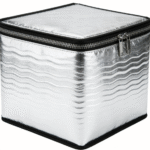
Frozen-food container insulation should be compared through the complete loaded assembly. Wall material, joints, lid, inserts and outer protection work together with the coolant and payload. A material conductivity value or a thick wall alone cannot establish shipping duration or product acceptability.
Define an equivalent comparison
Use the same product limits, relevant payload range, starting conditions and exposure objectives. Record the container dimensions and supported coolant arrangement. Compare actual usable space and loading effort as well as thermal evidence.
EPS, EPP, polyurethane and vacuum insulation panels describe different material or construction families, not fixed finished-shipper rankings. Exact design and closure matter.
Look beyond nominal wall thickness
| Assembly feature | Comparison question |
|---|---|
| Walls | What exact construction is used? |
| Lid and joints | How does the loaded closure fit? |
| Inserts | Do they preserve the supported positions and separation? |
| Outer protection | Does handling compress or damage insulation? |
| Usable volume | Can the complete product/coolant load fit? |
| Condition | What damage or reuse criteria apply? |
Two containers with similar dimensions may have different usable layouts or vulnerable closure areas. Assess them with the supported load rather than an empty-container impression.
Treat material data as a selection input
DOE: insulation types and heat-transfer principles explains insulation types and heat-transfer principles in a building-science context. Use relevant physical concepts carefully; it is not parcel qualification data or proof of a shipping R-value.
Ask suppliers for finished-system evidence and its conditions. A radiant or foil surface does not establish a universal packaging benefit without the actual assembly and relevant exposure.
For vacuum panels, obtain the supplier’s condition-assessment process; for reusable containers, obtain permitted cleaning, inspection and replacement instructions. Do not infer suitability from an intact exterior alone.
Helpful decision tools
Check the details before you choose packaging
These quick tools can help you compare route risk, sizing needs, coolant choices, and packaging details before you request a quote.
Coolant & PCM Reference
Compare coolant and PCM options when a route needs added temperature support.
Compare optionsDry Ice Calculator
Estimate dry ice needs for frozen or ultra-cold shipments before packing.
Estimate dry iceIce Pack Calculator
Estimate gel ice pack quantity for chilled shipments and practical route planning.
Estimate ice packsAssess the operational result
- Monitor justified product locations across relevant exposure.
- Review warm and cold departures against predefined criteria.
- Record closure and loading consistency.
- Assess package condition after representative handling.
- Compare daily preparation and return requirements.
- Review substitutions and configuration changes.
Avoid claiming one material is always cheaper, greener or longer-lasting. Those comparisons need the actual equipment, route, recovery system and evidence boundary.
Product controls and transport acceptance remain separate requirements. A favorable insulation comparison cannot certify every food operation or approve all coolant uses.
Frequently asked questions
Does the lowest material conductivity mean the longest shipment duration?
Not by itself. Review the complete assembly, load and exposure.
Does thicker insulation always solve a closure gap?
No. Address the actual finished-container design and supported use.
Can building insulation data qualify my parcel?
No. Use an appropriate shipping-system assessment.
Use material-specific and system guides
Use the small EPP box guide for compact EPP fit and the complete shipping-system specification guide for configuration control.