Dry Ice Packs Bulk: 2025 Buying, Storage & Shipping Guide
At a glance—what you’ll learn
What “dry ice packs bulk” means (and what it doesn’t).
How to choose pellets vs. blocks and the right insulated container.
A quick estimator for how much dry ice to load.
The exact 2025 labels & paperwork that pass acceptance checks.
Safety limits for CO₂ and the right way to store/vent.
1‑sentence definition (featured snippet‑ready):
Dry ice packs bulk refers to pallet/bin or case quantities of solid CO₂ (pellets/blocks) supplied in vented liners and used with insulated, venting shippers; boxes must be marked “Dry ice”/“Carbon dioxide, solid,” UN 1845, and net dry‑ice mass (kg) per air/ground rules.
What exactly are you buying?
Common formats
Pellets (≈3–16 mm): fast pulldown, even coverage.
Rice/mini pellets (≈⅛–¼″): dense packing around irregular shapes.
Blocks/loaves: slower sublimation, longer holds with fewer openings.
(Choose by lane length and opening frequency.)
EPS (budget, 24–48 h)
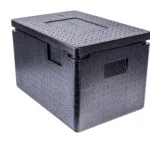
EPP (tough/reusable, 36–72 h)
VIP hybrids (longest hold, 48–96 h+)—often lets you shrink dry‑ice mass and DIM weight due to much lower heat leak. (VIPs deliver ultra‑low conductivity; model cost vs. refrigerant savings.)
How much dry ice do you need?
Two ground‑truth rates from FAA testing are widely used for planning:
Small packages (~5 lb): ~2% of mass per hour
Large/tightly packed (~100 lb): ~1% per hour
Also, 1 lb dry ice → ~8.8 ft³ CO₂ gas (plan ventilation).
Quick estimator (planner’s shortcut)
Prefer metric? 1 lb ≈ 0.454 kg.
Physics cross‑check: Dry ice absorbs ~25–27 kJ/mol on sublimation (≈571–615 kJ/kg); your lane math should make sense against that energy budget.
(The estimator and planning ranges consolidate the calculators you drafted, tightened by FAA/NIST data.)
Starter table (with 25% delay buffer)
| Box (inner L) | Container | Transit (h) | Est. dry ice (kg) | Notes |
|---|---|---|---|---|
| 22 L | EPS 30 mm | 24–36 | 3.5–5.0 | Minimize headspace |
| 30 L | EPP 40 mm | 36–48 | 5.0–7.0 | Add 25% in summer |
| 45 L | VIP hybrid | 48–72 | 6.5–10.0 | Less ice, higher box cost |
Pellets vs. blocks: which lasts longer?
Pellets spread evenly and pull down temperature quickly → best for mixed SKUs & frequent door‑opens.
Blocks/loaves have lower surface‑area‑to‑volume → slower sublimation and longer holds; ideal for long lanes with minimal opening.
(Blend both: blocks for base load + pellet “rim” near hot spots.)
Compliance that passes in 2025 (air & ground)
On the package (air):
Helpful decision tools
Check the details before you choose packaging
These quick tools can help you compare route risk, sizing needs, coolant choices, and packaging details before you request a quote.
Insulation Material Drop Resistance
Review drop resistance and handling factors before choosing insulation materials.
Check resistanceRoute Risk Checker
Review lane conditions before selecting packaging for real operating requirements.
Check route riskIce Pack Calculator
Estimate gel ice pack quantity for chilled shipments and practical route planning.
Estimate ice packsProper shipping name “Dry ice” or “Carbon dioxide, solid”
UN 1845
Net mass of dry ice in kilograms
Class 9 label (no writing inside the diamond)
Use the 2025 IATA Dry Ice Acceptance Checklist; it standardizes what ground crews verify.
Air waybill: include dry‑ice entry with packages × net kg; some operators request net weight at booking to check aircraft limits (66th Ed. addendum).
U.S. ground (DOT): packaging must permit CO₂ release; modes have specific marks (e.g., vessel warnings). See 49 CFR §173.217.
USPS (domestic air mail): ≤5 lb (≈2.27 kg) per mailpiece, no international dry‑ice mail; follow Packaging Instruction 9A.
Pro tip: Print labels with UN 1845 and net kg on the same face as the hazard label when space allows—carriers echo this in 2025 job aids.
Safe storage & handling (people and rooms)
Never airtight. Use vented coolers/liners; do not tape inner foam lids shut.
Ventilate staging areas—CO₂ sinks low; consider floor‑level monitors at bulk volumes.
Gloves + eye protection to avoid cold burns.
Respect occupational exposure limits for CO₂: TWA 5,000 ppm and STEL 30,000 ppm (NIOSH/OSHA).
Container picking (buy the box before the ice)
| Container | Best lane | Ice impact | When to pick |
|---|---|---|---|
| EPS (25–40 mm) | 24–48 h | Higher charge | Budget starter |
| EPP (30–50 mm) | 36–72 h | Moderate charge | Reuse/durability |
| VIP hybrid | 48–96 h+ | Lowest charge | Long/hot lanes; cut DIM |
VIPs often reduce refrigerant mass for 72–144 h routes thanks to ultra‑low thermal conductivity. (Validate with data loggers.)
Buying in bulk (without surprises)
Delivery form: totes/bins (~200–1,400 lb) or palletized cases; set recurring drops and reorder triggers.
Vendor scorecard: grade/spec (SDS, pellet diameter/block size), supply resilience, packaging (ventable liners), and compliance support (sample labels).
Cost control: shrink headspace → place ice on top → improve insulation before adding more ice; VIP may lower total landed cost when lanes go long.
Frequently asked questions
Q1: Are “dry ice packs” the same as gel/PCM packs?
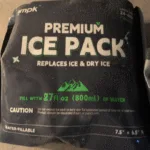
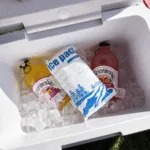
No. Dry ice is solid CO₂ (~−78.5 °C) for frozen lanes; gels/PCMs target chilled temps and aren’t a substitute for UN 1845 dry ice.
Q2: How much dry ice per day should I plan?
Use ~1–2%/h mass‑loss as a starting point (FAA), then add 25–50% buffer for delays and openings. Cross‑check against the sublimation energy budget.
Q3: What must be on the box for air?
“Dry ice”/“Carbon dioxide, solid”, UN 1845, net kg, and Class 9—plus AWB text. Use the IATA 2025 checklist.
Q4: USPS limits for dry ice?
Domestic air mail is capped at ≤5 lb per mailpiece; international mail with dry ice is prohibited.
Q5: Is it okay to seal the inner liner to hold cold longer?
No. Packaging must vent CO₂ to prevent pressure build‑up.
How‑to: pack a frozen box with bulk dry ice (20‑minute SOP)
Assemble shipper (EPS/EPP/VIP) and confirm vent paths.
Bag payload, add a rigid divider/tray to separate from ice.
Top‑load dry ice above product; minimize headspace with fitments.
Apply UN 1845, Class 9, net kg; verify AWB text.