


Estimate coolant mass
Use payload weight, box size, route duration, and ambient season before the first lane test.
Meal kits mix proteins, dairy, sauces, produce, and paper inserts in one parcel. A useful packout holds the high-risk ingredients cold while protecting herbs, leafy greens, sauces, recipe cards, and dry ingredients from freeze marks and condensation.
The coolant amounts below are starting ranges for planning. Final packout should be validated with the exact order mix, shipper size, carrier lane, and season.
| Route condition | Temperature intent | Tempk packaging setup | Coolant planning range | Coolant position |
|---|---|---|---|---|
| Local or same-day kit, 8-18 h | 0-4 C chilled kit | Insulated carton or EPP box, protein compartment, produce divider, leak liner, dry insert sleeve. | 0.8-1.4 kg conditioned gel packs or 0 C PCM for 2-5 kg payload. | Gel packs near protein and dairy, separated from produce by divider or paperboard. |
| Overnight meal kit, 18-30 h | 0-4 C with mixed-item protection | Thicker insulation, protein bottom chamber, produce/dry-zone separation, absorbent layer. | 1.4-2.6 kg gel packs or PCM for 2-5 kg payload. | Top and side coolant, with produce buffered from direct frozen gel contact. |
| Hot lane or delay risk, 30-48 h | Validated chilled lane | Higher insulation, reduced void space, stronger dry-zone protection, route risk check. | 2.6-4.2 kg gel packs or PCM for 2-5 kg payload. | If greens freeze or inserts wet, improve separation before adding more coolant. |
Use the Ice Pack Calculator for chilled routes. For frozen boxes, compare with the Dry Ice Calculator before testing.
A good subscription box should hold temperature and still arrive clean, readable, separated, and easy for the customer to unpack.
Proteins and dairy should drive the cold chamber; greens, herbs, bread, spice packets, and paper inserts need separation.
Use a liner and absorbent base so raw protein purge does not reach produce or recipe materials.
Keep coolant near high-risk ingredients while using dividers to prevent frozen gel contact on produce.
Record protein temperature, produce freeze marks, sauce leaks, wet paper, gel pack movement, and outer carton dryness.
Use these checks when adjusting coolant quantity, liner structure, insulation thickness, or fulfillment timing.
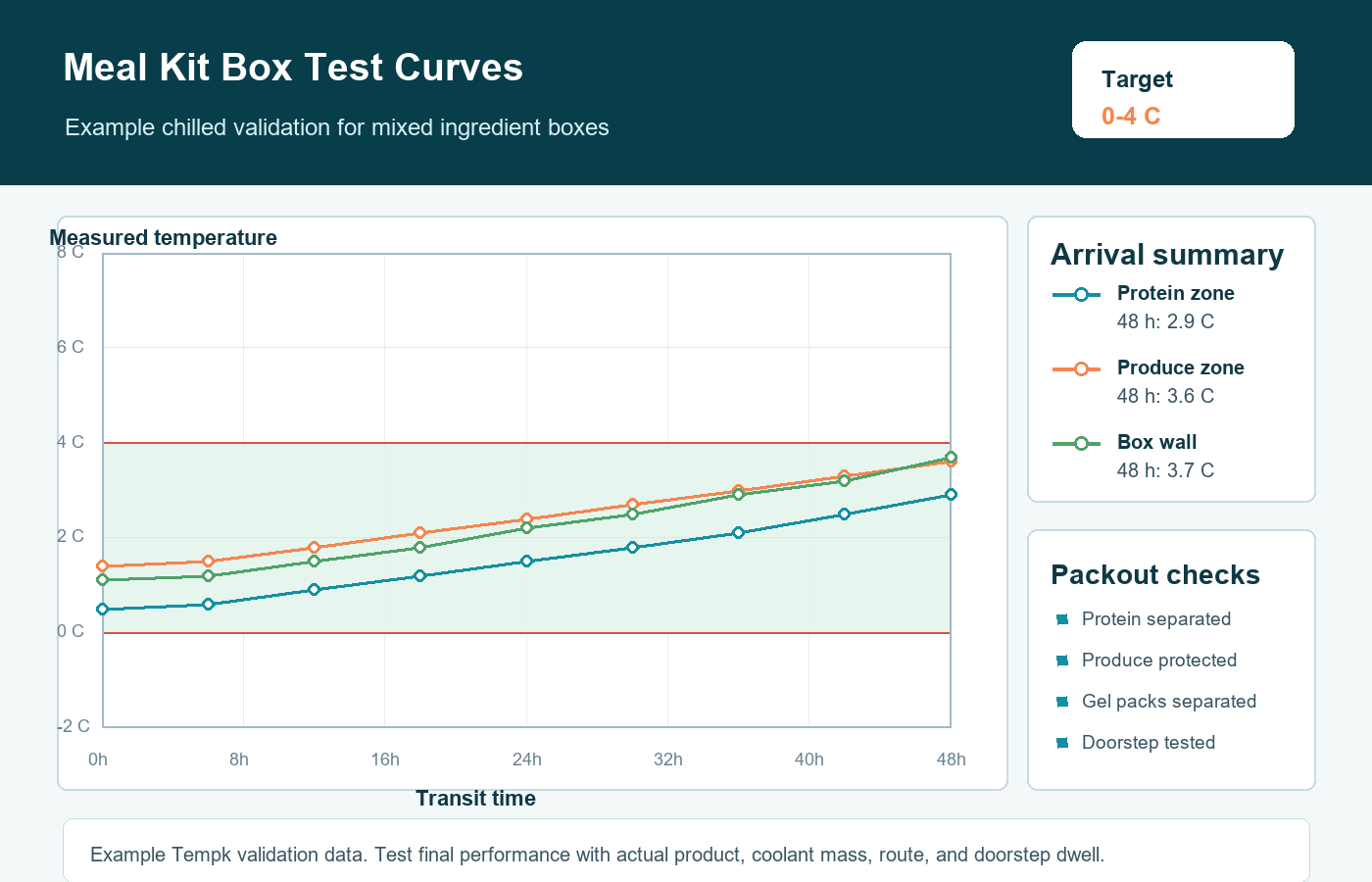
Use the product page for handling logic, then size the first trial with tools and validate the real parcel route.
Use payload weight, box size, route duration, and ambient season before the first lane test.
Compare conditioned gel packs, 0 C PCM, and dry ice where frozen delivery is required.
Review fulfillment dwell, pickup delay, last-mile exposure, and receiving window before launch.
Share the product mix, payload weight, box size, fulfillment dwell time, route duration, season, and receiving standard. Tempk can help choose insulation, coolant mass, liner structure, and validation checks.
Custom packout support
For fixed carton sizes, payload limits, branding requirements, seasonal lanes, or validation targets, Tempk can adapt this solution into a custom cold-chain packout.