A Release-Ready EPP Insulated Box Factory for Aerospace Sourcing Plan
Two factories can quote the same EPP box drawing and offer very different levels of risk. One prices the moulded shape. The other identifies unsupported loads, lid tolerances, grade choices, test assumptions, and production changes that could invalidate approval. An EPP insulated box factory for aerospace should be selected on the second kind of evidence. The product is not just foam around a payload; it is a controlled answer to a defined handling problem. Buyers need to know who owns that answer from the first requirement through tooling, qualification, series inspection, reuse, and eventual change.
Begin with the consequence of failure
Most sourcing projects begin with dimensions and forecast volume. Aerospace packaging should begin one step earlier: what happens if protection is inadequate or the package is used incorrectly? The answer sets the depth of engineering and evidence.
A scuffed noncritical bracket, a contaminated optical surface, an ESD-damaged circuit assembly, a shifted calibration, and a temperature-exposed adhesive are not equivalent outcomes. Nor are a line-side transfer and an international repair loop. Rank the plausible failures by consequence and detectability. Then spend design effort on the failure modes that matter rather than adding features indiscriminately.
Create a short failure brief for the supplier. It can identify:
- Surfaces and features that cannot carry load or touch foam
- Maximum permitted movement or the restraint objective
- Fragility or shock information approved by the part owner
- Temperature limits and time basis, where the item has them
- ESD, cleanliness, corrosion, moisture, or light sensitivity
- Dangerous-goods status or the need for specialist classification
- Expected drops, vibration, stacking, orientation, dwell, and openings
- Receiving checks that determine whether the item may enter service
Choose the packaging architecture before choosing the supplier
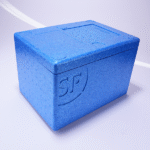
EPP can play three broad roles. First, it can be a cushioning or handling material shaped around a part. Second, it can be an insulating enclosure that slows heat flow. Third, it can be one component of a passive temperature-controlled system that includes coolant or phase-change material, spacers, payload, assembly instructions, and a qualified test profile. Those roles should be named explicitly in the specification.
For mechanical protection, EPP's resilience and energy absorption are useful design inputs. Performance still depends on grade, moulded density, thickness, bearing area, geometry, and the payload's response. For thermal protection, the closed-cell structure resists heat flow, but lid joints, corners, internal free space, payload, starting condition, and ambient exposure govern the package result. In both cases, the material enables a design; it does not approve the design.
A hybrid architecture may be more sensible than asking one material to do everything. A corrugated or rigid outer may provide label space, tamper features, stacking, or weather protection. A moulded EPP insert may provide restraint and cushioning. A separate barrier may address cleanliness or vapor. An ESD bag or purpose-selected grade may serve sensitive electronics. Each layer needs a stated function so later cost reduction does not remove an apparently minor component that was actually controlling risk.
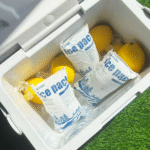
Avoid treating optional accessories as interchangeable. A gel pack, ice brick, or phase-change component has its own thermal behavior and conditioning requirements. A divider changes payload location and air space. A strap changes closure security. An outer carton changes mechanical exposure and may change thermal behavior. If an accessory appears in the tested configuration, it belongs in configuration control.
How to Assess an EPP Insulated Box Factory for Aerospace
The phrase “EPP factory” can hide three different capabilities. A converter can mould parts repeatably from a defined grade and tool. A packaging engineer can translate payload and route information into a protective concept. A system developer can design and document a passive thermal packout. Some suppliers cover more than one capability; buyers should verify rather than infer.
Ask the factory to describe ownership at each decision point. Who selects the material grade? Who calculates or tests cushioning? Who defines the thermal protocol? Who approves the drawing? Who controls the coolant and accessories? Who reviews test deviations? Who authorizes a production change? If the answer is “the customer,” make sure your organization has the responsible expertise. If the factory owns a task, request the method and deliverable.
Manufacturing assessment should follow the real process. EPP beads are moulded under heat and pressure, and part quality is influenced by tooling, fill, venting, processing, cooling, shrinkage, and warpage. Review incoming material identification, storage, batch traceability, process parameters, tool and cavity control, dimensional methods, appearance criteria, nonconformance, maintenance, and final packing. Pay attention to post-mould additions such as printing, labels, straps, liners, bonded items, and cartons.
QMS evidence and product evidence stay on separate pages
If AS/EN/JISQ 9100 certification is required, verify the certificate's site, scope, validity, and issuing scheme. The 9100 standard addresses quality management systems across aviation, space, and defense supply organizations. It may support confidence in contract review, traceability, risk control, nonconformance, and change management.
It does not certify a box. Product evidence still needs an approved specification, material definition, inspection results, and any mechanical, thermal, ESD, cleanliness, or transport tests relevant to the application. A factory can have a suitable QMS and an unqualified design, or a sound prototype and inadequate series controls. The sourcing decision must address both.
Turn claims into an evidence contract
Marketing language can be converted into verifiable statements. Instead of “excellent insulation,” define the temperature requirement, complete packout, ambient profile, duration, sensor placement, and acceptance rule. Instead of “impact resistant,” define the loaded package, distribution sequence, orientations, instrumentation where needed, and payload inspection. Instead of “reusable,” define inspection, cleaning, retirement, and tracking.
| Proposed claim | Minimum useful evidence | Question that exposes a weak claim |
|---|---|---|
| The box fits the part | Controlled drawing plus representative payload fit review | Which surfaces carry load in every expected orientation? |
| The package protects against distribution hazards | Test protocol and report for the complete loaded unit | Does the sequence represent our route and acceptance limits? |
| The packout maintains a required temperature | Traceable thermal report for the exact configuration | Are payload, coolant, ambient profile, sensors, and starting conditions the same? |
| The material provides ESD protection | Named grade data and final-part verification | What electrical property is controlled after moulding, cleaning, and conditioning? |
| The product is reusable | Defined inspection, cleaning, traceability, and retirement process | Who prevents a failed box from returning to service? |
| Production matches the approved sample | First-article and process-control evidence | Which material, tool, cavity, site, and operations form the baseline? |
| A standard is met | Clause-level compliance matrix and required reports | Who invoked the standard, which revision applies, and what remains excluded? |
The last column is valuable during supplier interviews because it reveals whether the statement has an engineering boundary. Good evidence does not need to be elaborate for a low-risk application, but it must be relevant. A report on an empty box, a different size, or a different payload should not be presented as direct proof.
Select standards through applicability, not familiarity
ATA Spec 300 is a recognized reference for packaging airline supplies. Its scope includes packaging and testing guidance for repairable and expendable units, hazardous-material preparation, and ESD-sensitive devices. That makes it a strong candidate when an airline or program uses it. Applicability, revision, category, specific provisions, and customer interpretation still need confirmation. “Designed with ATA principles” is not a substitute for a required test or compliance matrix.
ASTM D4169 can support performance evaluation of shipping units against selected distribution hazards. ASTM D3103 can support evaluation of thermal insulation performance of distribution packages. Each has a defined scope; neither is an all-purpose aerospace approval. A packaging authority should select the method and acceptance criteria appropriate to the route and product.
Military aerospace work may invoke MIL-STD-2073-1 or a special packaging instruction. When invoked, those contract requirements govern preservation and packing decisions. A commercial EPP concept cannot replace them without authorized review.
IATA publications enter the decision when the item moves by air under temperature-control or dangerous-goods requirements. Lithium batteries and other regulated contents must be classified and prepared under current applicable rules, including government and operator variations. The EPP container may be part of the solution, but it does not make the shipment compliant. Keep current regulatory review with trained personnel.
The practical tool is a one-page applicability matrix. List the contract and customer documents, regulatory sources, industry methods, internal procedures, current revisions, applicable clauses, responsible owner, required evidence, and exclusions. Resolve conflicts before testing. This avoids learning after production that the laboratory ran a technically valid test against the wrong requirement.
Qualify the configuration that will ship
Qualification planning should begin before the tool is released because the test can reveal design requirements. For thermal work, identify the exact box, inserts, coolant or phase-change components, payload, starting conditions, conditioning, assembly method, closure, ambient profile, sensor locations, calibrated instruments, duration, and pass criteria. ASTM's thermal-package guidance reinforces why actual package, energy source, and payload matter.
For mechanical work, define the shipping unit as it will enter distribution, including outer carton, straps, labels, closures, internal bags, and documentation pockets. Choose hazard sequences and levels from the governing method or route analysis. Inspect the package and payload after the sequence, and include functional or calibration checks where visual inspection cannot detect the relevant failure.
Helpful decision tools
Check the details before you choose packaging
These quick tools can help you compare route risk, sizing needs, coolant choices, and packaging details before you request a quote.
Coolant & PCM Reference
Compare coolant and PCM options when a route needs added temperature support.
Compare optionsBox Liner & Pallet Cover Sizing
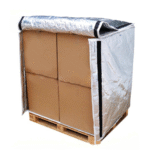
Check box liner and pallet cover sizing logic for insulated packaging projects.
Estimate sizingPackaging Selector
Compare insulated packaging options by product, route, and temperature need.
Find packagingQualification units should be representative of production. A hand-fabricated sample may answer an early fit question but differ from moulded geometry and properties. Record deviations and decide whether they affect the conclusion. When final tooling units become available, close the gap with the required first-article, verification, or repeat qualification.
Make series production auditable without making it slow
The approved baseline should connect drawing revision, bill of materials, material grade, target process definition, tooling and cavity, manufacturing site, post-mould operations, packaging accessories, inspection plan, work instructions, and qualification reports. Operators should be able to identify the current version at the point of use.
Use risk-based inspection. Critical dimensions, lid engagement, insert position, part mass or another process indicator, label content, and visual fusion limits may warrant defined checks. The exact plan depends on how each characteristic affects fit, protection, or traceability. Trending can reveal drift before parts cross a specification limit.
Change control is the bridge between approval and long-term supply. Define notification thresholds for material grade, density or formulation, recycled content, colorant or additive, tool repair, cavity, process equipment, manufacturing site, sub-supplier, closure, liner, label, coolant, or outer carton. Require an impact assessment that considers fit, thermal, mechanical, ESD, cleanliness, regulatory, and sustainability consequences as relevant.
Not every change demands full requalification. The program's authorized technical and quality functions should decide the evidence needed. The supplier's duty is to provide enough information before shipment for that decision to be made.
Price the operating system, not only the foam part
Custom tooling can be justified by recurring volume, improved fit, reduced assembly steps, or lower damage risk, but the decision needs the actual release pattern. Ask who owns the tool, where it resides, how it is maintained, whether multiple cavities are planned, and how transfer or end-of-program disposition works. Separate one-time costs from recurring costs.
For a reusable loop, establish ownership and return economics before selecting the design. A container with excellent durability but no recovery process may become single-use in practice. Track return, loss, cycle time, cleaning rejection, repair, damage mode, and retirement. These measures also support credible sustainability decisions.
EPP is technically recyclable, but actual recovery depends on collection, sorting, contamination, attached materials, and local processing. Ask how labels, straps, liners, and mixed inserts separate at end of life. Avoid a lower-impact claim unless the comparison defines reuse, transport, cleaning, loss, and end-of-life boundaries.
Release through a controlled pilot
Before a broad order, run a pilot that follows the real work instruction and route. Use intended production units and representative payloads. Observe loading, closure, labelling, handover, receiving, cleaning, inspection, and return. Capture handling errors and near misses, not only product damage.
Close findings through controlled changes, then update drawings and instructions. Confirm that the final production configuration is supported by the evidence.
The release package should allow procurement to answer five questions without interpretation: What are we buying? What use is approved? What evidence supports it? How is production kept consistent? What changes require review? If any answer lives only in a sales conversation, the project is not release ready.
Frequently asked questions
What should an aerospace buyer send with the first enquiry?
Send the payload drawing and mass, protected surfaces, route and handling map, required temperature or fragility limits, ESD and cleanliness needs, dangerous-goods status, external size constraints, return model, forecast pattern, and invoked specifications. Mark unknowns and identify who owns them. This allows a factory to propose a defensible development path rather than quote a shape based on incomplete assumptions.
Can one test report cover a family of box sizes?
Possibly, but only with a documented rationale accepted by the responsible technical authority. Geometry, wall thickness, joints, payload mass, free space, coolant ratio, and handling response can change with size. Define the family boundaries, worst case, and bridging evidence. Do not assume that a result for the largest or smallest box automatically represents every configuration.
Should recycled-content EPP be accepted for aerospace packaging?
It can be considered when permitted by the customer and specification, but the exact grade and formulation must enter material approval and change control. Verify required mechanical, thermal, cleanliness, ESD, appearance, and ageing properties on a relevant basis. Recycled content is not automatically equivalent to virgin material, nor is it automatically unsuitable; evidence and program requirements should decide.
What is the clearest warning sign during supplier selection?
A major warning sign is a broad performance or compliance promise made before the supplier understands the payload, packout, route, test profile, and governing requirements. Other concerns include reluctance to identify material grade, unclear tool ownership, informal sample approval, missing change notification, and reports for unrelated configurations. Useful suppliers ask precise questions because their claims have boundaries.
The deliverable is a controlled protection decision
An EPP insulated box factory for aerospace should show how the material becomes a controlled protection decision. EPP can provide an efficient combination of insulation, cushioning, low weight, and reusable geometry. Aerospace readiness comes from consequence-based requirements, clear architecture, grade selection, manufacturable design, relevant tests, standards applicability, traceable production, controlled changes, and a workable return loop. Source the factory that can show those connections, not the one that offers the longest list of unsupported badges.
About Tempk
Tempk offers EPP cooler-box products, project customization, and related packout options that may include gel packs, ice bricks, phase-change materials, dividers, labels, straps, and outer cartons. For aerospace sourcing, we can review the proposed role of each element against your payload and route before a configuration is quoted for development. We treat exact performance, dimensions, test scope, factory controls, production schedule, commercial terms, and any standard or compliance expectation as project-specific items requiring written confirmation.
Share your failure brief, payload data, route, and approval requirements with Tempk to define a sample-to-release plan and the evidence your team needs before committing to production.