


Dry shipper not ready
An undercharged or unqualified dry shipper can lose reserve time before the product reaches the receiver.
Cell therapy shipments are built around product identity, custody, and validated hold time. When the SOP requires cryogenic transport, a normal insulated box with dry ice or gel packs is not a substitute for a qualified vapor-phase liquid nitrogen dry shipper.
The payload can be small, but the route is operationally heavy. The packaging decision has to protect the product, identity record, courier handoff, and receiving readiness together.
An undercharged or unqualified dry shipper can lose reserve time before the product reaches the receiver.
A temperature pass is not enough if labels, chain-of-identity records, or handoff documentation are incomplete.
Cassette movement, upside-down handling, or impact can create a quality concern even when temperature remains acceptable.
| Route condition | Temperature intent | Packaging setup | Coolant or dry shipper planning | Receiving check |
|---|---|---|---|---|
| Same-day hospital or manufacturing transfer | Follow the product SOP. If cryogenic control is required, keep the payload in a validated vapor-phase liquid nitrogen dry shipper. | Pre-charged dry shipper, canister or cassette fit check, tamper seal, absorbent or secondary containment as required, and custody packet. | Plan by dry shipper hold time rather than coolant mass. The shipper should have documented charge status and enough reserve after delivery. | Dry shipper condition, seal, identity match, orientation, custody record, and receiver readiness. |
| Regional air route, 1-3 days | Protect cryogenic condition through pickup, airline transfer, customs, and receiving windows. | Qualified dry shipper matched to route duration, shock or orientation indicator, courier SOP, and protected paperwork. | Build reserve time into the shipper selection. A common planning target is route time plus at least 48 h of contingency where the SOP allows. | Remaining hold-time record, transfer timestamps, custody chain, and immediate storage transfer. |
| International or disrupted lane, 3-10 days | Avoid last-minute shipper substitution and keep the route within validated dry shipper performance. | Higher-capacity dry shipper, contingency lane, receiver appointment, customs documents, and emergency contact path. | Use the shipper validation data and lane qualification. Do not replace a cryogenic dry shipper with dry ice unless the product owner approves that route. | Logger or shipper record as applicable, customs dwell, receiver signoff, and documented exceptions. |
Use these values as starting points for sampling and quotation. Final coolant, PCM, dry ice, insulation, dry shipper, logger, and handling choices must be validated with the real payload, lane, carrier process, season, and receiving procedure.
Before quoting the packout, confirm whether the product requires vapor-phase liquid nitrogen, ultra-low frozen, or another labeled condition.
Choose a shipper that covers pickup, flight, customs, delivery, and receiving delay with a documented reserve.
Match shipper labels, payload ID, custody forms, tamper seals, and receiver instructions before dispatch.
Use orientation markers, shock indicators where useful, and courier handoff notes so the dry shipper is not handled like a normal parcel.
These are the visible and operational problems the packout should reduce before the shipment reaches the receiver.
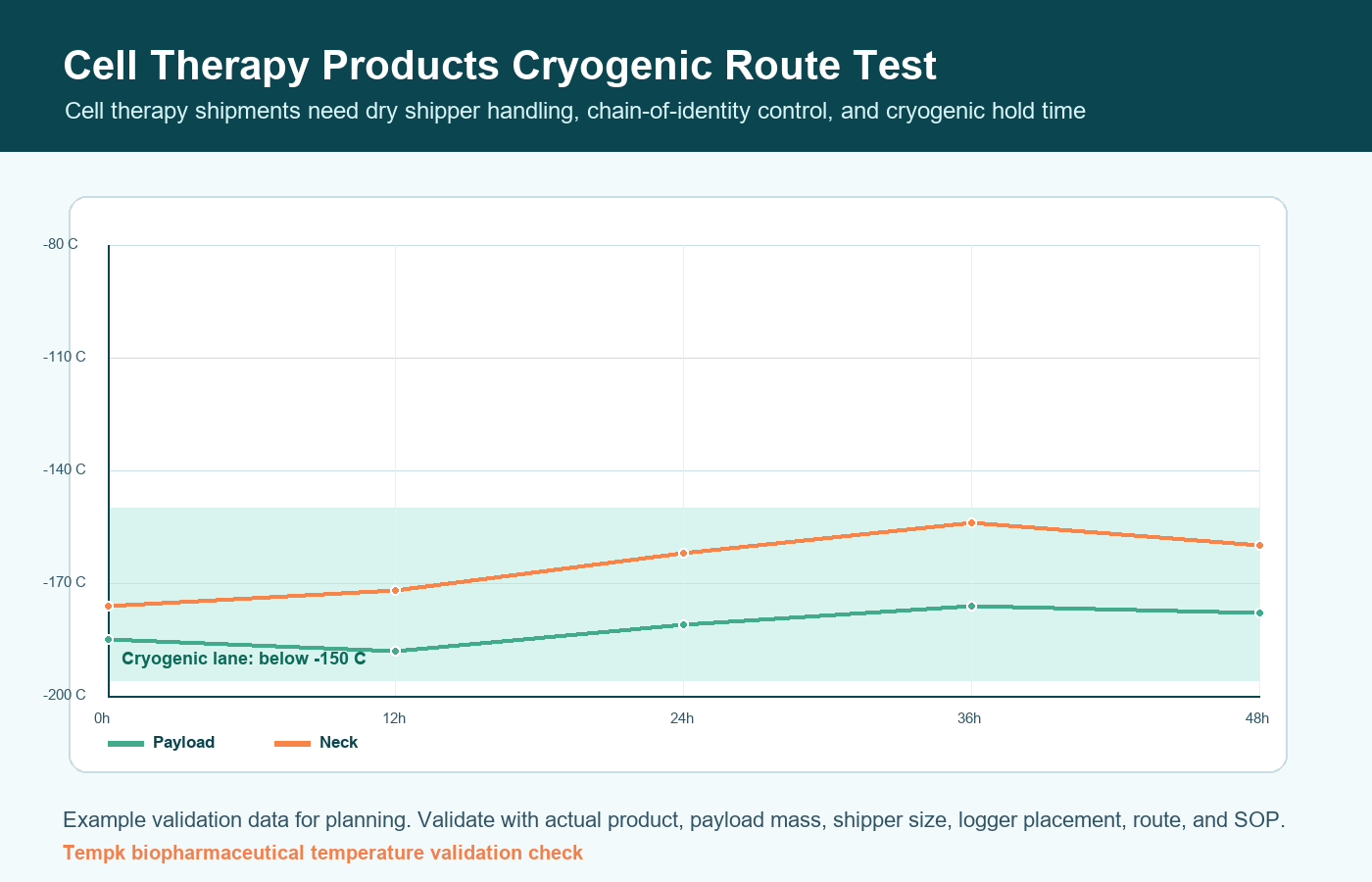
Use the test curve as a working comparison, then validate with the actual payload, shipper, coolant or dry shipper configuration, lane duration, ambient profile, and receiving process.
Use these pages to compare nearby biopharmaceutical routes, coolant choices, insulation options, and route-risk questions before sampling.
Cell therapy products are high-value and often time-critical. Packaging decisions must support temperature control, chain-of-custody documentation, and clear handoff at the treatment site.
Loss can come from temperature excursion, courier delay, incomplete paperwork, incorrect orientation, or mishandled cryogenic equipment.
Use validated cryogenic or controlled-temperature packaging matched to the product. Secure the payload and documentation so receiving staff can verify identity quickly.
Many cell therapy lanes use dry vapor liquid nitrogen or other cryogenic systems rather than standard gel packs. Follow the therapy-specific validation package.
Audit temperature record, custody scans, orientation, courier handoff, and site receiving time. This route needs process validation as much as packaging validation.
Custom packout support
For fixed carton sizes, payload limits, branding requirements, seasonal lanes, or validation targets, Tempk can adapt this solution into a custom cold-chain packout.
Share the required temperature mode, dry shipper hold-time requirement, payload format, pickup point, route duration, custody process, and receiving window. Tempk can help compare shipper structure, protection inserts, and validation checks.
Request a packout review