


Dry ice depletion
A lane that looks short can lose dry ice quickly in hot weather, with aircraft transfer, or with long receiving dwell.
Gene therapy vectors often move in frozen, ultra-low frozen, or cryogenic lanes. The right setup depends on the labeled range and vial format: a dry ice shipper may be suitable for one lane, while another route needs a validated dry shipper.
Vector shipments need temperature control and physical control at the same time. The route should prevent thaw, refreeze, vial movement, dry ice contact damage, and paperwork problems.
A lane that looks short can lose dry ice quickly in hot weather, with aircraft transfer, or with long receiving dwell.
Repeated door-open checks or slow handoff can warm vials enough to create a route exception.
Loose racks, direct dry ice contact, and frost-wet paperwork can cause receiving problems even when dry ice remains.
| Route condition | Temperature intent | Packaging setup | Coolant or dry shipper planning | Receiving check |
|---|---|---|---|---|
| Dry ice route, 0-24 h | Use the product-approved frozen or ultra-low range and avoid thaw during packout. | Vented dry ice shipper, vial rack support, dry ice barrier, absorbent or secondary containment, and protected document sleeve. | For small parcels, initial tests often start around 3-7 kg dry ice, then adjust by lane temperature, payload mass, and carrier rules. | Logger curve, remaining dry ice, vial position, no wet documents, and immediate freezer transfer. |
| Dry ice route, 24-48 h or hot season | Maintain the frozen range through pickup, transfer, weekend risk, and receiving delay. | Higher-capacity shipper, top and side dry ice placement with separation, route-risk review, and receiver appointment. | Many small-to-medium trials begin around 8-15 kg dry ice. Use the dry ice calculator, then validate the real shipper and lane. | Dry ice remaining, no thaw evidence, rack condition, outer carton integrity, and receiving timestamp. |
| Cryogenic or product-specific route | Use a validated dry shipper when the product label or SOP requires LN2 conditions. | Pre-charged dry shipper, vial cassette or canister support, chain-of-custody records, tamper seal, and orientation control. | Plan by dry shipper hold-time reserve, not dry ice mass. Do not substitute dry ice for a cryogenic route unless the product owner approves. | Dry shipper status, custody records, orientation, handoff notes, and storage transfer. |
Use these values as starting points for sampling and quotation. Final coolant, PCM, dry ice, insulation, dry shipper, logger, and handling choices must be validated with the real payload, lane, carrier process, season, and receiving procedure.
Choose dry ice, ultra-low, or dry shipper logic from the product label and SOP before choosing a box.
Use rack support and barriers so vials do not press directly into dry ice blocks or loose pellets.
Put documents in a dry sleeve and away from the dry ice zone so receiving can read labels and release paperwork.
Gene therapy lanes should arrive to an assigned freezer, trained receiver, and documented transfer process.
These are the visible and operational problems the packout should reduce before the shipment reaches the receiver.
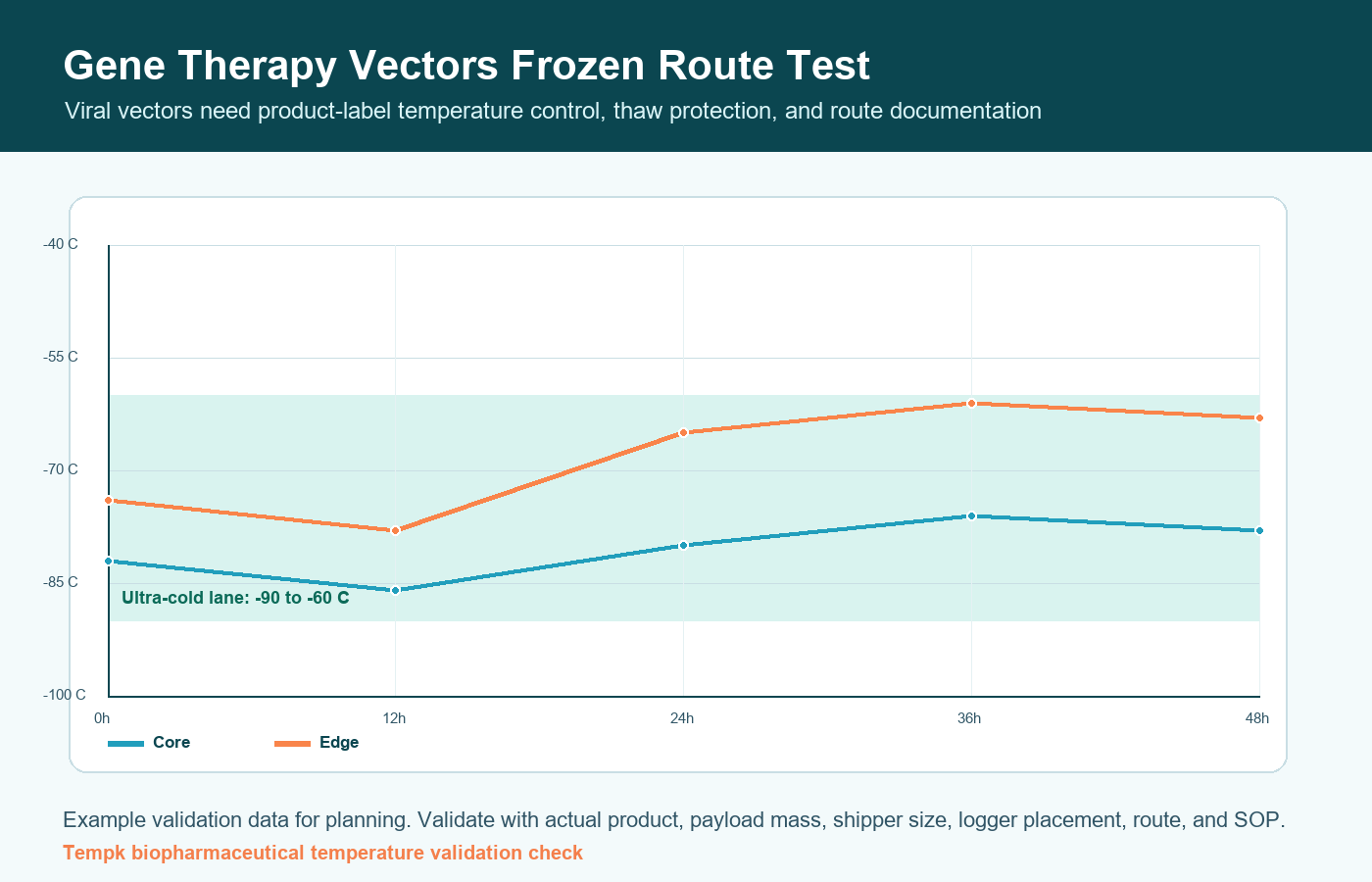
Use the test curve as a working comparison, then validate with the actual payload, shipper, coolant or dry shipper configuration, lane duration, ambient profile, and receiving process.
Use these pages to compare nearby biopharmaceutical routes, coolant choices, insulation options, and route-risk questions before sampling.
Gene therapy vectors may require deep frozen or cryogenic transport, depending on formulation. The packout should be selected from the product stability requirement, not from general pharmaceutical practice.
The main risks are dry ice depletion, vial breakage, thaw during customs delay, logger failure, and loss of custody documentation.
Use vial racks, secondary containment, and a payload zone that keeps samples stable during handling. Documentation should stay accessible without opening the cold zone.
Use dry ice or cryogenic equipment according to the validated lane. Standard 2 to 8 C packaging is not suitable for deep frozen vector shipments.
Check dry ice margin, payload temperature, vial integrity, customs dwell, and chain-of-custody records before approving the lane.
Custom packout support
For fixed carton sizes, payload limits, branding requirements, seasonal lanes, or validation targets, Tempk can adapt this solution into a custom cold-chain packout.
Share the vector type, labeled storage range, vial or rack format, route duration, ambient condition, dry ice allowance, carrier steps, and receiving freezer plan. Tempk can help compare dry ice mass, shipper structure, separators, and validation checks.
Request a packout review